
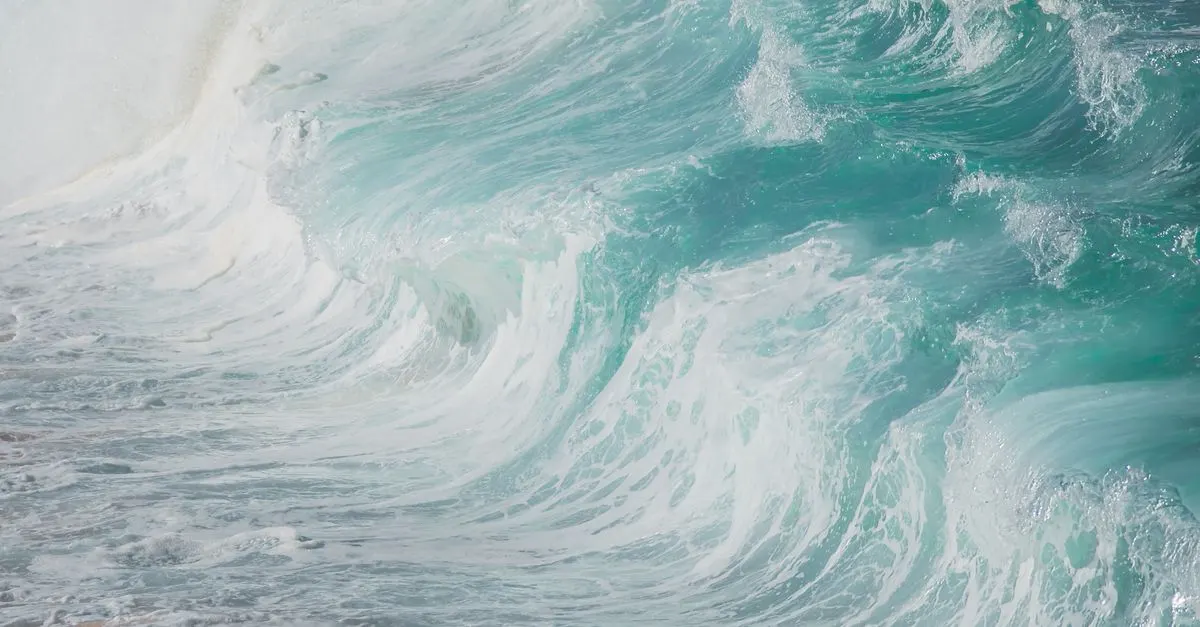
In the early hours of December 26, 2004, a magnitude 9.1 earthquake tore open the seafloor off the coast of Sumatra and lifted the sea bottom by several meters in an instant (USGS). The rupture ran for hundreds of kilometers, and the water sitting on top of all that rising rock had nowhere to go but out. Hours later, waves reached coastlines across ten of the hardest-hit nations and killed more than 200,000 people. It remains the deadliest tsunami in recorded history, and the whole catastrophe started with a single move of the ground under the ocean.
A tsunami is the ocean reacting to a shove from below
A tsunami is caused by something suddenly displacing a huge volume of seawater, almost always a large undersea earthquake that shifts the seafloor up or down. When the bottom of the ocean jumps, it lifts or drops the entire water column above it, and that displaced water spreads outward as a series of long, fast waves (USGS). Landslides and volcanic eruptions can move the seafloor or the water the same way, so they make tsunamis too (NOAA). The key word is displacement. A tsunami is not water being pushed across the surface. It is water being shoved from the floor up.
That single fact separates a tsunami from every other wave you have seen. The ordinary swells that roll onto a beach are made by wind dragging across the surface, and that energy reaches only a short way down. A tsunami's energy runs from the surface all the way to the seabed, because the seabed is what created it.
Why a quake has to lift the seafloor, not just shake it
Not every undersea earthquake makes a tsunami. The motion has to be the right kind. To shove the water, a quake has to move the seafloor mostly up or down, not side to side.
The dangerous ones happen at subduction zones, where one tectonic plate is sliding under another and getting stuck. Stress builds for centuries until the locked edge of the upper plate breaks free. The USGS describes the moment plainly: "the leading edge of the overriding plate breaks free and springs seaward, raising the sea floor and the water above it. This uplift starts a tsunami" (USGS). These are called thrust earthquakes, and they are the classic tsunami makers.
A side-to-side, or strike-slip, quake mostly slides one block of crust past another. The seafloor jolts violently but barely changes height, so it hardly disturbs the water above. That is why the USGS notes thrust earthquakes are far more likely to generate tsunamis, and why magnitude matters: quakes below about 6.5 are very unlikely to trigger one, while events around 7.6 and larger can produce destructive waves, especially near the epicenter (USGS). Size and direction both have to line up.
The wave that travels at jet speed and hides in plain sight
Here is the part that makes a tsunami so dangerous, and so strange. Out in the deep ocean it is nearly invisible.
A tsunami in deep water can move as fast as a jet plane, over 500 mph, and cross an entire ocean in less than a day (NOAA). Yet a ship sitting right over it would feel almost nothing. That is because the energy is spread through an enormous wavelength, sometimes more than a hundred miles from one crest to the next, while the height of the wave might be only a foot or two. All that power is there. It is just stretched thin and low across miles of water, sliding by underneath unnoticed.
The speed comes straight out of the physics. A tsunami's velocity depends on the water depth: the deeper the water, the faster it runs. In the open Pacific, where the seabed is thousands of meters down, that works out to airliner speeds. So when a quake lifts the floor of the deep ocean, the resulting wave races away from the source faster than most planes fly, and it can do it across an ocean that is miles deep in places.
Why it turns into a wall at the coast
A tsunami arriving at the shore is a different animal from the gentle bump it was at sea. The reason is the seafloor again, this time on the way in.
As the wave reaches shallow water near land, the seabed slows the front of it down. The water behind, still in deeper water, keeps rushing in at speed and stacks up against the slowing front. The wave drops to roughly 20 to 30 mph but piles up, growing in height as currents intensify (NOAA). This squeezing of a long, low, fast wave into a short, tall, slow one is called shoaling. Most tsunamis end up less than 10 feet high, but in extreme cases they can top 100 feet (NOAA).
Shoaling is also why one of the early warning signs is the sea pulling back. If the trough of the wave arrives first, the water can drain away suddenly and expose the bare ocean floor, sometimes for hundreds of yards, before the crest comes back as a fast-rising flood or a wall of water. The ocean withdrawing is not curiosity. It is the countdown.
The biggest wave ever recorded came from a falling mountain
Earthquakes get the headlines, but the tallest tsunami on record was not made by a quake shaking water. It was made by a mountain falling into it.
On July 9, 1958, a magnitude 7.9 earthquake on Alaska's Fairweather Fault knocked a colossal slab of rock loose at the head of Lituya Bay. The rock avalanche crashed into the water and threw up a wave that ran up the opposite shore to 524 meters, about 1,719 feet (USGS). That is taller than the Empire State Building, a wave of water stripping a forested mountainside down to bare rock in seconds. Tsunamis like this are caused on impact, as the moving landslide mass enters the water and water is displaced behind and ahead of it (USGS).
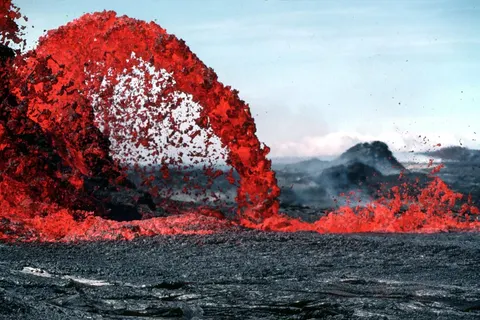
Volcanoes can do it too, by a route that surprised even scientists. When the Hunga Tonga volcano erupted on January 15, 2022, it generated a local tsunami that reached about 22 meters on Tofua Island. But it also sent a massive atmospheric pressure wave around the planet, and that pressure wave generated a separate set of tsunamis observed across ocean basins worldwide (NOAA). A tsunami showing up on a coast an ocean away, driven not by water moving but by the sky pressing down on it, was something the old models did not fully account for. The same trapped gas that drives a volcanic eruption had reached out through the air to push the sea.
The unsettling thing about a tsunami
What makes a tsunami feel so different from other natural disasters is the lag. The ground moves, and then nothing seems to happen. The deadly wave is already racing across the ocean at the speed of a jet, low and silent, while the coast it is heading for sits in ordinary sunshine. The energy is committed the moment the seafloor jumps. Everything after that is just the time it takes to arrive.
That is the real answer to what causes a tsunami: not the water, but the floor beneath it, and a sudden shove powerful enough to move an ocean. Understand that one move, and the rest of the wave's strange behavior falls into place, from the invisible crossing to the pile-up at the coast.
Keep wondering: trace the trapped gas that powers an eruption from below, see how wind builds the everyday waves that a tsunami dwarfs, then find out how deep the ocean really goes for a wave to cross it in a single day.
Join the conversation
Comments are reviewed before they appear. Be kind and stay curious.
Loading comments…