
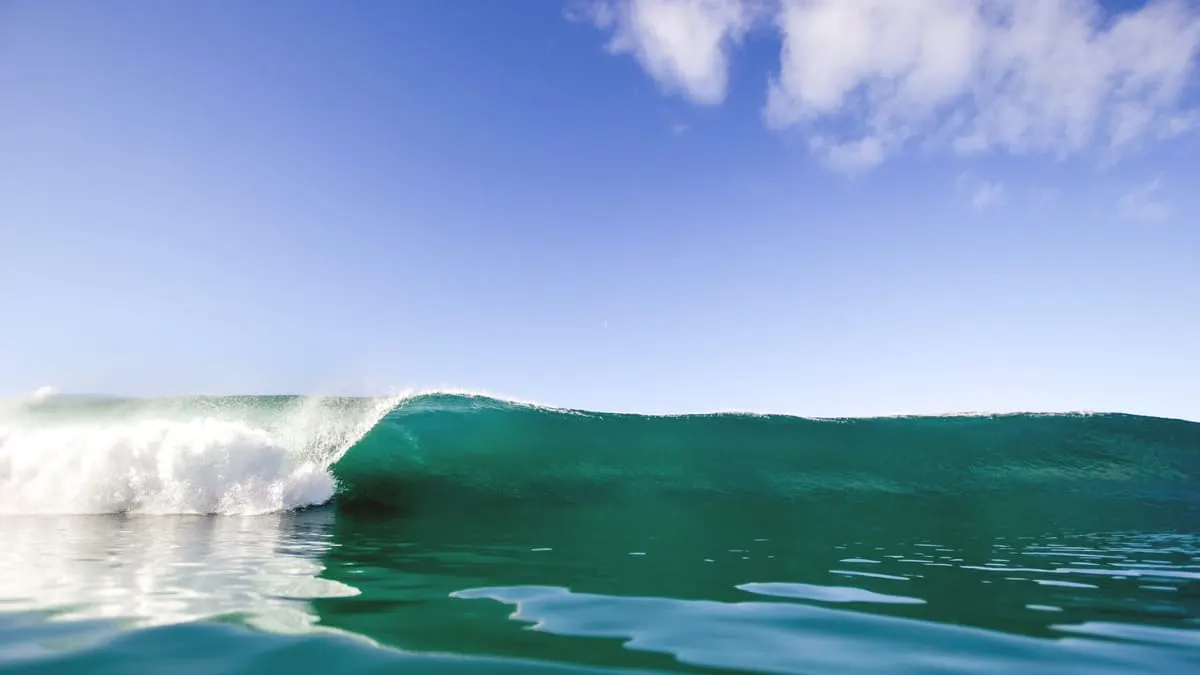
Waves arrive at a beach in endless lines, as if the sea were being pushed in from somewhere out past the horizon. It is one of the most hypnotic sights there is, and a bit of a trick, because the water rolling in at the shore has mostly not traveled anywhere at all.
The wind writes them
So why does the ocean have waves? The everyday answer is wind. The dramatic exception is a tsunami, which is born from the seafloor lurching rather than the breeze. When wind blows across the surface of the sea, friction drags on the water and hands some of the wind's energy to it, first as tiny ripples, which give the wind more to push against, which builds the ripples into waves (NOAA). Calm air, flat sea. A stiff breeze, and the surface starts to stack up.
How big those waves get comes down to three things working together: how fast the wind blows, how long it keeps blowing, and the fetch, the stretch of open water the wind crosses in one direction. Real size needs all three at once (NOAA Ocean Service Education). A gust over a pond does nothing. A steady gale blowing for days across a thousand miles of open ocean builds the monsters. It also means waves can outlive the weather that made them: the energy keeps traveling great distances as "swell" long after the wind that raised it has died, which is why big sets can arrive at a sunny, windless beach (Roger Williams University).
The water barely goes anywhere
Now the part that quietly breaks your brain. A wave moving across the ocean is not water traveling toward the shore. It is energy traveling through water that mostly stays put. As a wave passes, each parcel of water rolls in a small circle, up, forward, down, and back to about where it started (Roger Williams University). The shape moves on. The water stays home.
You can watch the proof yourself. A gull or a bottle sitting offshore does not get carried toward the beach as the swells roll under it. It just bobs up and down in place while the waves pass through. The wave is real, the motion is real, but what is actually moving across the sea is the energy the wind put in, not the sea itself. The ocean is less a conveyor belt than a long row of dominoes, passing a push along without the pieces going anywhere.
Not every wave is the wind's doing
"Wave" is a bigger word than the surf at the beach. The slow, twice-daily rise and fall of the sea, the tides, are not made by wind at all but by the gravity of the Moon and the Sun tugging on the oceans. Tsunamis, the rare and dangerous giants, are something else again: walls of energy set off by earthquakes or undersea eruptions, not by weather (NOAA). That is exactly why scientists dislike the old phrase "tidal wave" for them, since tides have nothing to do with it.
And the reason any of them finally break, curling over into white foam, is the shore itself. As a wave runs into shallow water, the bottom drags on it and slows it down, the wave grows steeper, and the crest topples over (NOAA Ocean Service Education). The crash you hear is a wave running out of room.
So the endless march of the surf is mostly the wind's signature, written on water that stays where it is. The sea is not coming for you. It is just passing along a message the wind started, somewhere far out of sight.
Keep wondering: follow the water down in how deep is the ocean, find out why ice floats when almost nothing else does in its own liquid, and meet the animals lighting up the dark in why sea creatures glow.
Join the conversation
Comments are reviewed before they appear. Be kind and stay curious.
Loading comments…