
A shark swimming in the cold North Atlantic today may have been born before Isaac Newton, before the Great Fire of London ever lit the sky. One specimen pulled up in 2016 was estimated at 392 years old. And that animal does not even hold the overall record. To find the oldest living thing with a heartbeat, or something close to one, you have to go deeper, slower, and stranger than a shark.
A glass sponge may be the oldest, but a clam holds the cleanest record
The longest living animal depends entirely on what you count and how you measure it. By the broadest reckoning, a deep-sea glass sponge called Monorhaphis chuni is the champion, with one specimen estimated at roughly 11,000 years old. But that number rests on an indirect calculation. The oldest animal whose age was actually counted, ring by ring, is an ocean quahog clam nicknamed Ming, which lived 507 years. And the oldest backboned animal, the longest-lived vertebrate known, is the Greenland shark.
So there is no single answer. There is a podium, and each animal earned its place by a completely different method. The interesting part is not just how old these creatures get. It is how anyone could possibly know.
The Greenland shark and the clock inside its eye
Start with the shark, because its dating story is the cleverest. The Greenland shark (Somniosus microcephalus) is a slow, blunt-nosed predator of the deep cold Arctic, and in 2016 a team led by Julius Nielsen estimated the largest individual in their sample, a 5-meter female, at 392 years old, give or take 120 years (Virginia Institute of Marine Science). Even the low end of that range, around 272 years, would make it the oldest vertebrate ever recorded.
The problem is that a shark has no bones to read. Fish are usually aged by counting growth bands in calcified tissue, the way you count rings in a tree, but Greenland sharks have soft skeletons with nothing to count. So the researchers went for the one tissue in the body that never gets replaced: the lens of the eye.
The crystalline proteins at the center of an eye lens form before the animal is even born and stay there, untouched, for life. The oldest material an animal owns sits at the dead center of that lens, and everything laid down afterward wraps around it. By radiocarbon-dating that central tissue from 28 sharks caught as bycatch, the team could read each animal's birth year off its own eye (ScienceDaily).
There was a bonus marker hidden in the data. Nuclear bomb tests in the 1950s and early 1960s flooded the oceans with a spike of radiocarbon, a clear chemical timestamp around 1960. Sharks born after that carried the spike; the giant ones did not, which means they were already swimming long before the atomic age (VIMS). It fits the species' glacial pace of life: these sharks grow less than half an inch a year and may not reach sexual maturity until they are around 150.
Ming the clam, and the 507 rings nobody meant to count
The Greenland shark's age is a careful estimate with a wide error bar. Ming the clam is different. Its age was counted.
Ming was an ocean quahog (Arctica islandica), a thick-shelled bivalve dredged from the seabed off northern Iceland in 2006. When scientists at Bangor University sectioned its shell and counted the annual growth bands, the way you would count tree rings, they landed on a number that made it the oldest non-colonial animal ever found: 507 years (Guinness World Records). It was born around 1499, while the Ming dynasty ruled China, which is where a journalist got the nickname.
The figure crept up over time. The team first announced about 405 years, then revised it to 507 in 2013 after using more refined techniques to read the bands on the outer shell margin and cross-check against other clams (CBS News). The revision held up against carbon-14 dating.
Here is the part nobody likes to mention. The researchers killed Ming to age it. They froze the clam and pried the shell open, not realizing the animal in their hands had been alive since before Columbus sailed (CBS News). A creature that survived five centuries of storms, ice, and shifting seas ended on a lab bench by accident. Those same growth bands turned out to be a gift, though: locked inside them is a year-by-year chemical record of ocean temperature stretching back to the 1400s, which is why these clams are now treated as living climate archives.
The sponge that may have outlasted the last ice age
Now go deeper, and slower, until the idea of a single lifespan starts to bend. Monorhaphis chuni is a glass sponge that lives on the deep floor of the western Pacific, between roughly 1,000 and 2,000 meters down. It anchors itself with a single needle of glassy silica called a giant basal spicule, and that needle can grow up to 3 meters long, the largest biological silica structure known on Earth (PMC).
That spicule grows the way the clam's shell grows, in microscopic layers laid down over time. When researchers analyzed the chemistry of those layers in 2012, the math pointed to an astonishing age: one specimen came out at roughly 11,000 years old, and a set of others fell somewhere between 6,000 and 18,000 years (Wikipedia). If that holds, this animal would have been alive when the last ice age was ending and the first farming villages were appearing.
I want to be honest about that number, because it is the wobbliest one on the podium. Eleven thousand years is an estimate built from growth-rate assumptions and geochemical proxies, not a clean count of 11,000 rings, and the uncertainty runs to thousands of years in either direction. Unlike Ming, whose 507 bands you could in principle photograph and tally, the sponge's age is inferred. It is almost certainly the oldest animal alive, far older than any clam or shark. It is also the one whose record we are least able to verify down to the year. Both of those things can be true at once, and the science says so plainly.
The jellyfish that refuses to stay on the chart
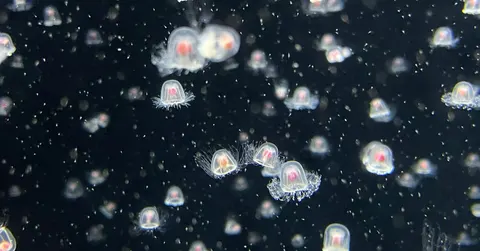
There is one animal that breaks the question instead of answering it. The immortal jellyfish (Turritopsis dohrnii) is tiny, about 4.5 millimeters across, and when it is starving, injured, or stressed, it does something no shark or clam can do. It rewinds.
Instead of dying, an adult medusa can collapse back into a young polyp, the earlier stage of its own life cycle, through a process called transdifferentiation in which mature cells reorganize into different cell types (Wikipedia). In theory this loop can repeat with no built-in end, which is why people call the animal biologically immortal. It does not have to age toward death the way the rest of us do.
But "immortal" is doing a lot of work in that sentence. In practice these jellyfish still get eaten, still catch disease, and still die in the wild long before any clock runs out, and no one has ever followed one individual living for centuries (Wikipedia). So it cannot really go on the same chart as Ming or the Greenland shark. Those animals have a measured age. The jellyfish has a measured lack of aging, which is a different claim. It belongs on the podium with an asterisk: the only entrant that, left undisturbed, might never grow old, and the only one whose record can never be confirmed.
That is the strange shape of this whole question. The animals that live the longest are almost never the ones we expect. They are not the big, fast, famous ones. They are cold, slow, deep-sea things that barely move and barely burn energy, plus one jellyfish that simply opts out of the rules. Living a long time, it turns out, is mostly about doing as little as possible, in the cold and the dark, for as long as the world will let you.
Keep wondering: if longevity fascinates you, look at why turtles live so long, then meet the animal that may be effectively immortal, and follow these record-breakers down into how deep the ocean really goes.

Join the conversation
Comments are reviewed before they appear. Be kind and stay curious.
Loading comments…