
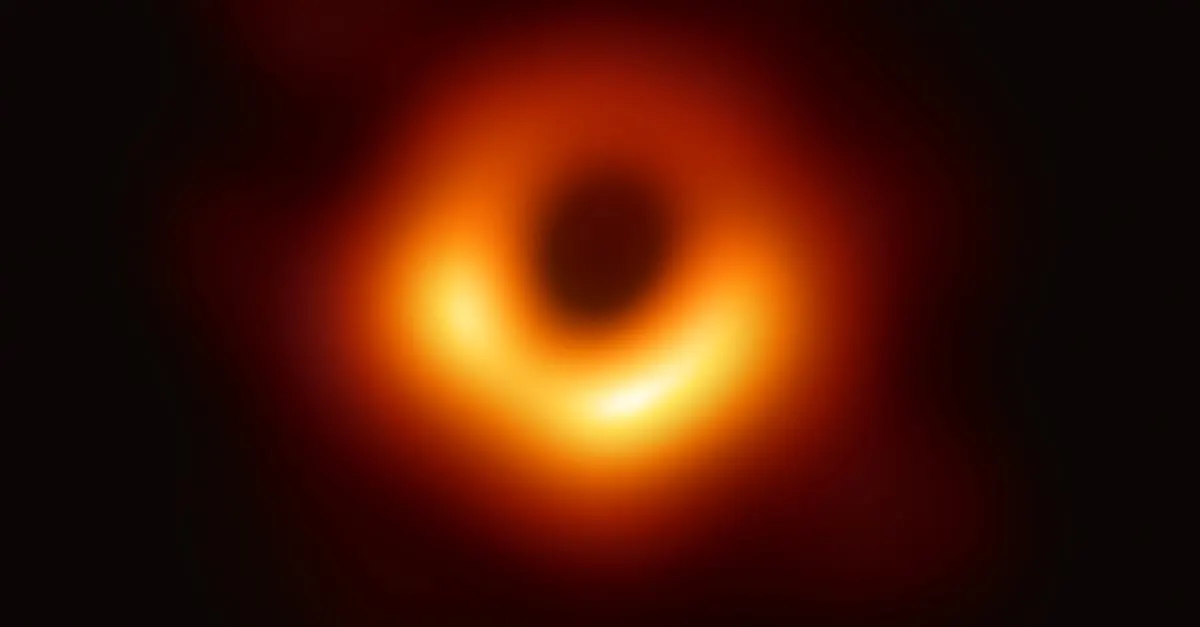
Pick the worst way to die and a black hole probably beats it. So here is a genuinely useful question with a genuinely strange answer: what would happen if you fell into a black hole? In the clean thought experiment used by physicists, with no lethal accretion disk or radiation and a simple nonrotating black hole, the answer depends heavily on its mass. A supermassive one could let you cross the point of no return before tidal forces tear you apart.
A small black hole shreds you, a giant one lets you in
What happens to your body depends on the size of the black hole, and the deadly part is spaghettification: a tidal force that stretches you into a thin strand (NASA). Gravity pulls harder on whatever is closest to the center, so if you fall feet first, your feet get yanked harder than your head. That difference is the tidal force, and near a black hole it grows monstrous. It stretches you head to toe and squeezes you side to side, until you are pulled out into a long, thin shape.
Here is the twist most people miss. The smaller the black hole, the worse this is. A stellar-mass black hole packs a few times the Sun's mass into a tiny region, the kind of object left behind when a heavy star runs out of fuel, much like what happens when the Sun dies but with a far bigger star. Its edge sits very close to all that gravity, and the tidal forces there are savage. NASA astrophysicist Jeremy Schnittman puts it plainly: stellar-mass black holes, up to about 30 solar masses, "possess much smaller event horizons and stronger tidal forces, which can rip apart approaching objects before they get to the horizon" (NASA). You would be torn apart in open space, before reaching the edge at all.
A supermassive black hole is the gentler option in this idealized setup. Its horizon is so large that gravity there changes only slowly from your feet to your head. In NASA's model of a 4.3-million-solar-mass black hole like Sagittarius A* at the center of our galaxy, the horizon is about 25 million kilometers across, roughly 17 percent of the distance from Earth to the Sun (NASA). That giant sits at the heart of a galaxy inside a cosmos so large it is hard to picture just how big the universe is. The horizon's tidal force can be mild enough that you would not notice the crossing itself. A real accretion flow, however, could flood the region with lethal heat and radiation long before you arrived.
Crossing the event horizon, and not feeling it
The event horizon is the line that defines a black hole. It is not a wall or a surface. It is the boundary where gravity becomes strong enough that not even light moving outward can escape, which means nothing inside can ever signal or climb back out.
At a sufficiently massive, quiet black hole you could cross that line alive. There is no jolt and no membrane to break. The horizon is not a locally detectable wall, so in the idealized case you could pass through without an instrument announcing the exact instant. Curvature is still present, and the tidal forces keep growing as you fall. The catch is that the horizon works only one way. Once across, every future-directed path stays inside.
Then the clock runs fast. In NASA's simulation of a fall into a nonrotating black hole modeled on Sagittarius A*, once the camera crosses the horizon, its destruction by spaghettification is only 128,000 kilometers and 12.8 seconds away (NASA). The tidal forces that were too weak to feel at the edge climb fast as you fall inward. They still find you, but only after you are already inside.
Why people watching you never see you fall in
This is where a black hole stops obeying common sense. Suppose a friend watches from a safe distance while you fall. They will never see you cross the horizon. Gravity warps time so heavily near the edge that your clock, seen from outside, slows toward a standstill. Your light gets stretched toward red and goes dim. From their view you appear to slow, redden, freeze just shy of the horizon, and fade until you vanish, while never quite arriving (Physics LibreTexts).
You experience none of that. From inside your own frame, time runs normally and you fall straight through in the few seconds your watch records (Physics LibreTexts). Both stories are true at once. There is no single answer to "how long does it take," because near a black hole time itself stops being something everyone agrees on, which is a stranger version of the way time seems to speed up as you get older. The effect is real and measurable even without a fall: an astronaut who orbited close to Sagittarius A* for a six-hour round trip would come back 36 minutes younger than colleagues who waited far away (NASA).
The theorem says spacetime ends, not what replaces it
And the singularity itself? Here the honest answer is that we do not know. The simplest classical model, a nonrotating Schwarzschild black hole, contains a central curvature singularity often described as a point of infinite density. A rotating Kerr black hole has a different classical interior and a ring-shaped singularity, which is one reason "everything collapses to an infinite point" is too broad a claim (University of Cambridge).
The Penrose singularity theorem makes a precise but more limited statement. Under physically reasonable conditions, some causal paths through spacetime cannot be extended indefinitely. Physicists call that geodesic incompleteness. The theorem does not tell us that the singularity must be a material point, nor does it reveal what an astronaut would encounter there (General Relativity and Gravitation).
A working theory of quantum gravity may change that classical picture, and there are candidates. None is confirmed, and physicists do not agree on which, if any, is right. So the deep interior of a black hole is one of the few places in the universe where the truthful scientific answer is a shrug.
If you ever do get the choice, choose the biggest black hole you can find. It buys you a few calm seconds and a clean crossing before the math gives out, which is more grace than most catastrophes offer.
Keep wondering: black holes do not last forever, which is the quiet story of how black holes die; the space they warp is part of a cosmos so vast it is hard to picture, namely how big the universe is; and our own star will meet a dramatic end of its own, which is what happens when the Sun dies.
Join the conversation
Comments are reviewed before they appear. Be kind and stay curious.
Loading comments…