
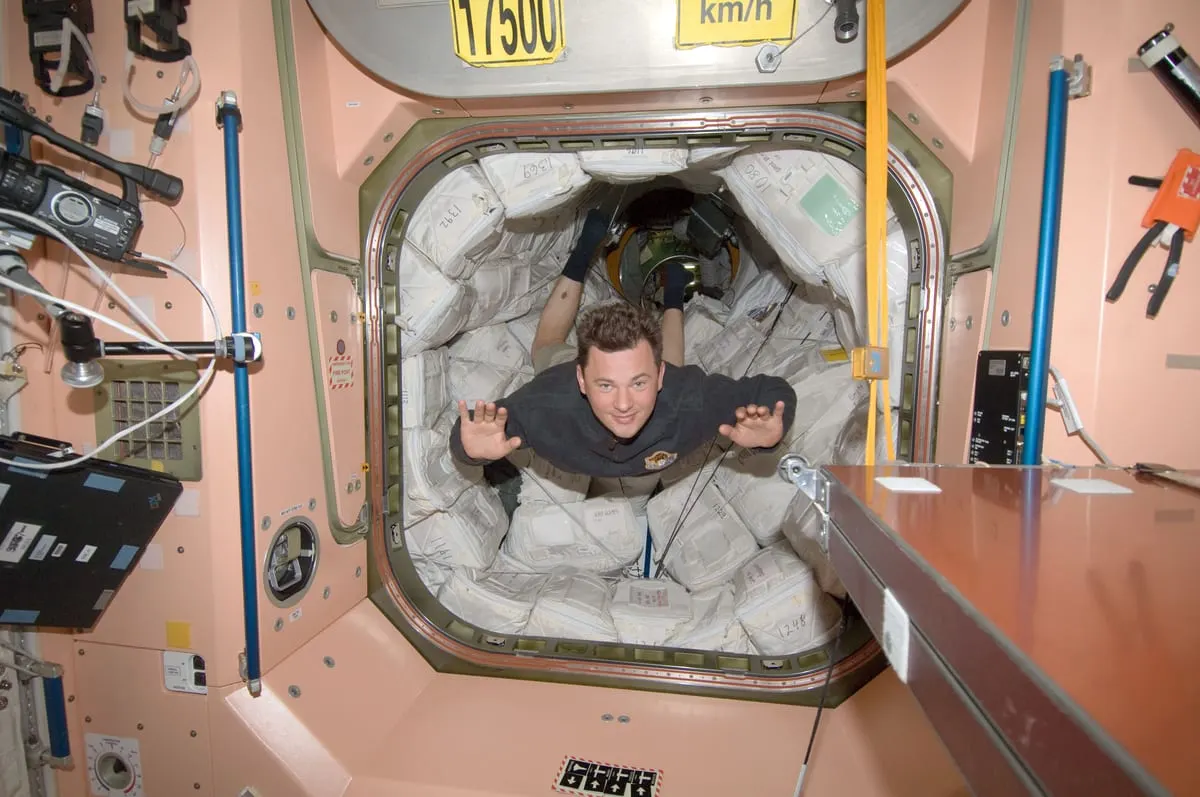
An astronaut climbs into a capsule on launch day one height and climbs out, months later, measurably taller. Flight surgeons expect it and plan around it. It is not a growth spurt, and it is not a trick of the tape measure. Why do astronauts grow taller in space? It comes down to the human spine doing something it can only do when the planet stops pressing on it.
Gravity has been shrinking you all along
Start with a fact about your own body. Right now, gravity is squeezing your spine. Stacked between each of your vertebrae is a soft, water-rich disc, and your body weight presses down on those discs all day, compressing them a little. That is why you are slightly taller first thing in the morning than you are at night: a night spent lying down takes the load off and the discs spring back, then a day on your feet squashes them again.
Take that everyday squeeze and remove it entirely. In orbit, in continuous freefall, there is no felt gravity pressing down on the spine at all. Freed from the load it has carried every waking second on Earth, the spine lengthens and straightens out, and the astronaut gets taller, by up to about 3 percent of their height (Scientific American). For a six-foot astronaut, that can mean gaining close to two inches (Space.com). It is the morning-stretch effect, dialed up and held for months.
In orbit, the spine unfolds
The change comes on fast, in the early part of a mission rather than creeping up over time, and it sticks around as long as the astronaut stays weightless. As one NASA description puts it plainly, when the spine is no longer exposed to the pull of Earth's gravity, the vertebrae can expand and relax (Scientific American). The column that gravity keeps slightly compressed on the ground simply opens up in space.
Worth keeping straight: the 3 percent figure is the upper end, not what happens to everyone, and "growing taller" here means the spine stretching, not bones actually getting longer. Nothing is being built. The astronaut is being un-squished.
The catch nobody pictures: it hurts
A two-inch stretch sounds like a fun souvenir from orbit. It is not. Lengthening the spine puts strain on the surrounding muscles, ligaments, and nerves, and many astronauts develop back pain during their missions. The bigger problem comes after they land. A NASA study found that crewmembers face more than four times the usual risk of a herniated disc in the period after returning to Earth (ScienceDaily). The spine that stretched out in space has to recompress under gravity, and that transition is where injuries cluster.
There is a second, quieter problem: the muscles that brace the spine waste away in orbit. In the same study, the deep supporting muscles of the lower back shrank by roughly 19 percent over a mission, and had only partly rebuilt a month or two after return (ScienceDaily). A taller spine wrapped in weaker muscle is a spine asking for trouble. The lead researcher, Dr. Douglas Chang, framed the work as groundwork for going further: "this could provide helpful physiological information to support a manned mission to Mars" (ScienceDaily). On a multi-year trip, what space does to the spine stops being a curiosity and becomes a serious problem to solve.
The textbook reason might not be the whole story
Here is where it gets genuinely interesting, and where good science admits what it does not know. The tidy explanation you will read almost everywhere is that the spinal discs, relieved of pressure, soak up water and swell like sponges, pushing the vertebrae apart. It is a satisfying picture. It may also be wrong, or at least incomplete.
When NASA researchers actually scanned astronauts' spines with MRI before and after long missions, they did not find the consistent disc swelling the popular story predicts. The disc-height changes they measured were small and inconsistent, and the team concluded that more work was needed to figure out what is really driving the increase in height (Spine). The height gain is real and measurable. The exact tissue-level reason for it is still being worked out. So the honest version is: astronauts get taller because the unloaded spine lengthens, and the precise mechanics of how are an open question rather than a closed case.
And then it goes away
Whatever the fine details, the effect is strictly a loan, not a gift. Once an astronaut is back on Earth, gravity gets straight back to work compressing the spine, and their height returns to normal over a span of days to a few months (Scientific American). Nobody comes home permanently taller. The body re-shrinks to the height gravity allows.
It is also worth not confusing this stretch with the other famous way space reshapes the body. The puffy "moon face" and skinny "bird legs" astronauts get are a separate effect entirely, caused by fluids redistributing toward the head once gravity stops pulling them down into the legs (NIH). That is plumbing. The height change is architecture. Two different things happening to the same floating body.
Put it all together and the takeaway is oddly humbling. The height printed on your ID is not just "how tall you are." It is how tall you are after a lifetime of gravity quietly compressing you. Send a person where that force lets go, and the body unfolds a little, taller and achier and not entirely sure why, until it comes home and gravity, patient as ever, presses it back down to size.
Keep wondering: more about life in orbit in how astronauts sleep in space, the brutal environment just outside the walls in how cold is space, and the surprising answer to what space smells like.

Join the conversation
Comments are reviewed before they appear. Be kind and stay curious.
Loading comments…