
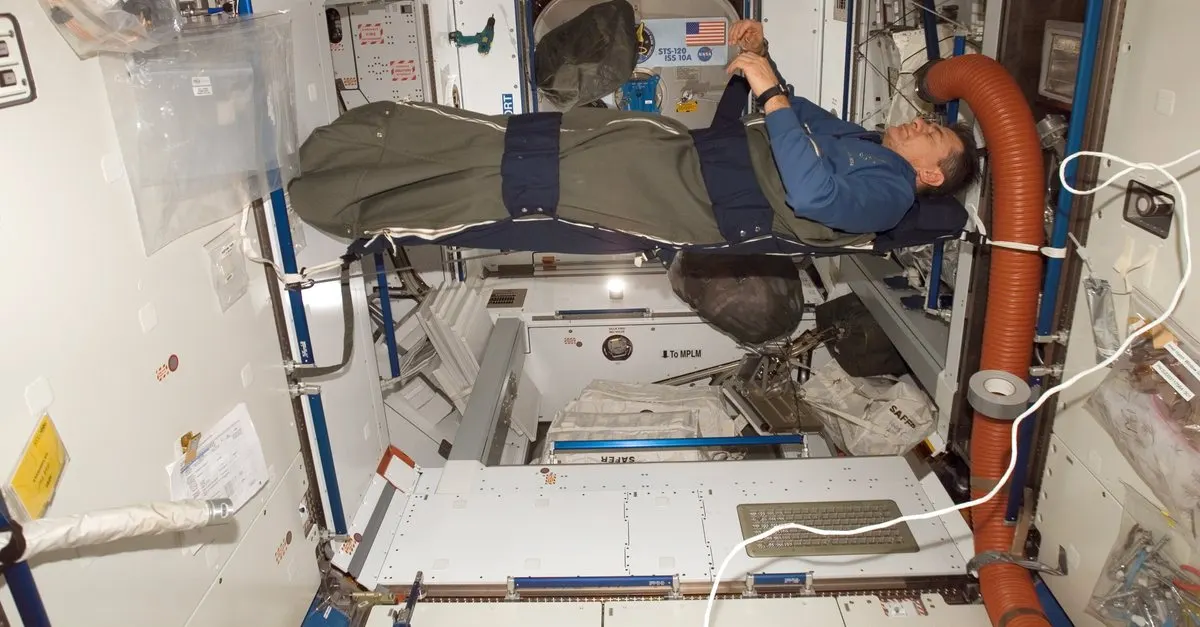
Sixteen times a day, the sun explodes over the horizon for an astronaut on the International Space Station. Sixteen sunrises, sixteen sunsets, every single day. Now try falling asleep on that schedule. How do astronauts sleep in space? It starts with a sleeping bag bolted to a wall and ends with a surprising number of prescription bottles.
Zipped into a bag strapped to a wall
Astronauts sleep in private crew cabins about the size of a phone booth, each one fitted with a sleeping bag they tether to a wall, the floor, or the ceiling. The cabin air has a character all its own, since space itself reportedly smells like seared steak once it drifts inside on the suits. In microgravity those words mean nothing anyway. The bag clips to anchor points using a set of cords so the sleeper doesn't drift loose and bump into equipment or another crew member overnight. Astronauts climb in, zip up, and float gently inside the restraints. The U.S. sleeping bag on the International Space Station uses up to eight attachment cords, and crew can pick how many they want and where to clip them, depending on how snug they like to feel.
There's no up or down. As the Canadian Space Agency puts it, sleeping on the floor is exactly as comfortable as sleeping on the wall, because gravity isn't there to vote.
Why your arms won't stay down
Watch footage of a sleeping astronaut and you'll see something eerie. Their arms drift up and forward, hovering in front of the chest like a sleepwalker's. That's not restlessness. It's the neutral body posture, the relaxed shape your body settles into when no gravity pulls on it. Knees bend slightly, the spine straightens, and the arms float to about shoulder height. On Earth your mattress and your own weight hold your arms down. In orbit, nothing does, so they rise on their own and stay there all night.
There's a practical worry too. In weightlessness, exhaled air doesn't rise and disperse the way warm breath does on Earth. Carbon dioxide can pool in a slow bubble around a sleeper's head, so crew cabins are positioned near air vents to keep fresh air moving across their faces while they rest.
The 16-sunrise problem
The Space Station laps the Earth roughly every 90 minutes, which means the crew sees about 16 sunrises and 16 sunsets every 24 hours. Your body runs on a roughly 24-hour internal clock, the circadian rhythm, and it takes its strongest cues from light. Flood it with a new dawn every hour and a half and that clock has no idea what time it is.
To impose order, the whole station runs on a single agreed time zone, Greenwich Mean Time, splitting the difference between mission control in Houston and the one outside Moscow. Crew get a scheduled sleep block of about 8.5 hours. To shut out the relentless light and the constant hum of fans and pumps, astronauts wear sleep masks and earplugs. NASA has even swapped the station's old fluorescent lights for tunable LEDs that shift color and brightness through the day to nudge the body clock back toward something Earth-like, a system researchers describe in a NASA lighting study.
What the largest sleep study in orbit actually found
Here's the part that surprised even the people who study it. In 2014, sleep scientist Laura Barger and colleagues published the biggest study of spaceflight sleep ever attempted, in The Lancet Neurology. Using sleep logs and wrist actigraphy, they tracked 64 astronauts across 80 Space Shuttle missions and 21 astronauts on Station missions, logging more than 4,000 nights of sleep on Earth and over 4,200 nights in space.
The crews were scheduled for 8.5 hours. They got nowhere near it. In that study dataset, Shuttle astronauts averaged about 5.96 hours a night and Station astronauts about 6.09 hours. And to get even that, they reached for help: roughly 75 percent of Station crew used sleep medication during their missions, and Shuttle crew took a hypnotic drug on about half their nights in orbit. "Sleep deficiency is pervasive among crew members," Barger said. The catch is that these drugs can leave someone groggy, and a Station alarm can demand a sharp, awake response within 30 seconds. A half-asleep crew member is a real safety problem, which is exactly why the study called for better ways to earn sleep instead of medicating for it.
A bedroom moving at five miles a second
Sit with the strangeness for a moment. While that astronaut sleeps, zipped into a bag with their arms drifting up in the dark behind a sleep mask, maybe deep in the kind of dream science still can't fully explain, their bedroom is traveling around the planet at about 17,500 miles per hour. They will cross every time zone on Earth several times before the alarm goes off. The body, that stubborn machine tuned over millions of years to a turning planet, has to be tricked, scheduled, and sometimes chemically coaxed into resting through it. We built a place where humans can live above the sky, and the hardest part turned out to be the oldest thing we do.
Keep wondering: the same restless light that wrecks an astronaut's sleep comes from a star that won't last forever, so read what happens when the Sun dies, then zoom out to ask how big is the universe, and look up to learn why do stars twinkle when seen from the ground but shine steady from orbit.



Join the conversation
Comments are reviewed before they appear. Be kind and stay curious.
Loading comments…