
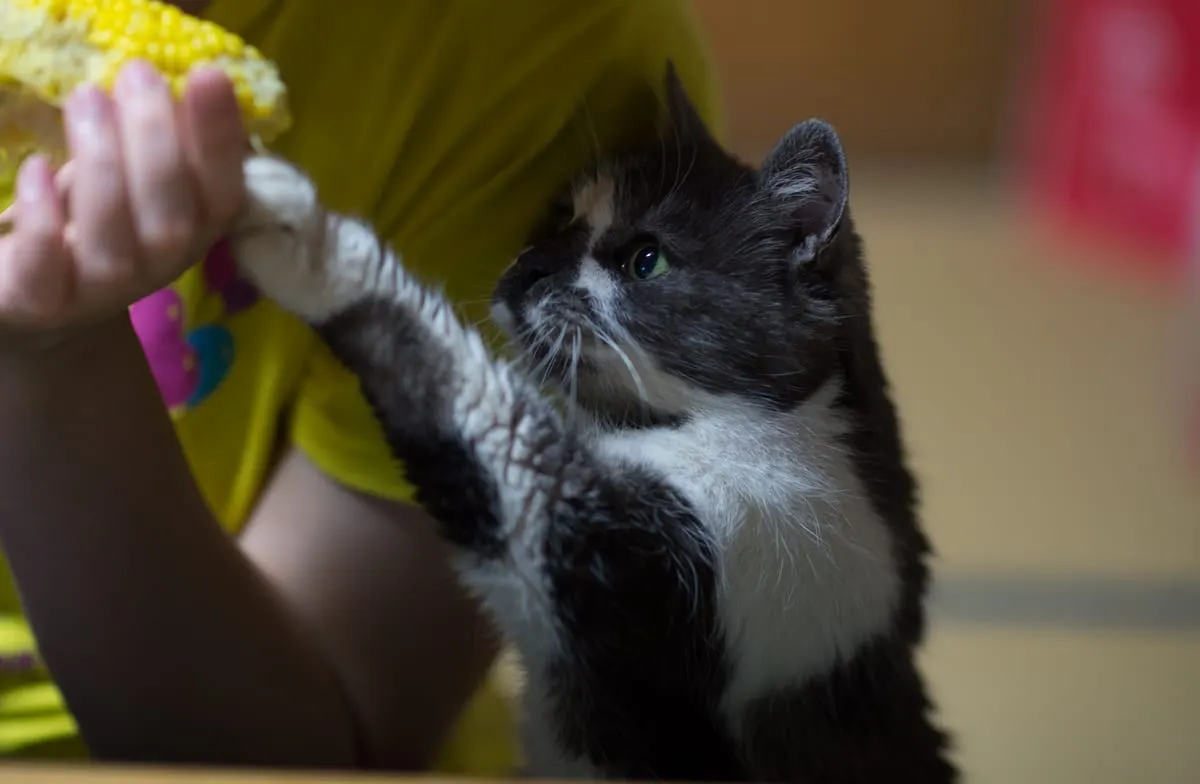
Your cat hops onto the table, locks eyes with you, and very deliberately taps your water glass closer to the edge, and then off it. It looks like a calculated act of feline villainy. It feels personal. It almost never is.
It's a hunt, not a grudge
So why do cats knock things over? For most cats it comes down to three overlapping reasons, and none of them is spite: a hunting instinct, a curious set of paws, and the discovery that knocking something off gets a rise out of you. Your cat isn't plotting against your crockery. It's running ancient predator software on a houseplant and a coffee mug.
The instinct part is the engine. Even a well-fed indoor cat is wired to hunt, and a small object that wobbles, rolls, or skitters when touched is irresistible to that wiring, because it behaves like prey (PetMD). A cat bats at it to see what it does. Will it move? Will it run? Is it alive? The shove off the table is the test.
Sensitive paws, asking questions
A cat's paws are not just feet. The pads are packed with sensory receptors that read texture, temperature, and pressure, which makes the paw a sensitive tool for exploring the world (TICA). When a cat taps, nudges, and pushes an object, it's gathering information: how heavy is this, how does it move, what happens next (PetPlace). Sometimes the answer is "it falls off the table with a satisfying crash," and from the cat's point of view, that's a result.
And you always give it a reason
Here's the part owners train into their cats without realizing it. The first time a glass hits the floor and you leap up, rush over, and make a fuss, you've taught the cat something valuable: this move summons the human. Cats are fast learners, and as the cat behavior consultant Marilyn Krieger puts it, "it doesn't take long for them to figure out that when they begin pushing a glass closer to the table's edge, their favorite people respond" (PetMD). Even being told off can count as a reward, since to an under-stimulated cat almost any reaction beats being ignored.
That's also the clue to stopping it. A cat with enough play, hunting-style toys, and stimulation has less reason to manufacture its own entertainment (Zoetis Petcare), and a calm non-reaction takes the payoff out of the game. Move the breakables, ramp up the play, and don't give the performance an audience.
So the next time your cat eyeballs you and sends a pen clattering to the floor, try not to take it personally. It isn't a message. It's a tiny predator testing its prey, with a paw built to investigate and a human it has learned will always, always look.
Keep wondering: the same predator wiring explains why cats love boxes and why cats sleep so much, and the desert past behind why cats hate water.
Join the conversation
Comments are reviewed before they appear. Be kind and stay curious.
Loading comments…