
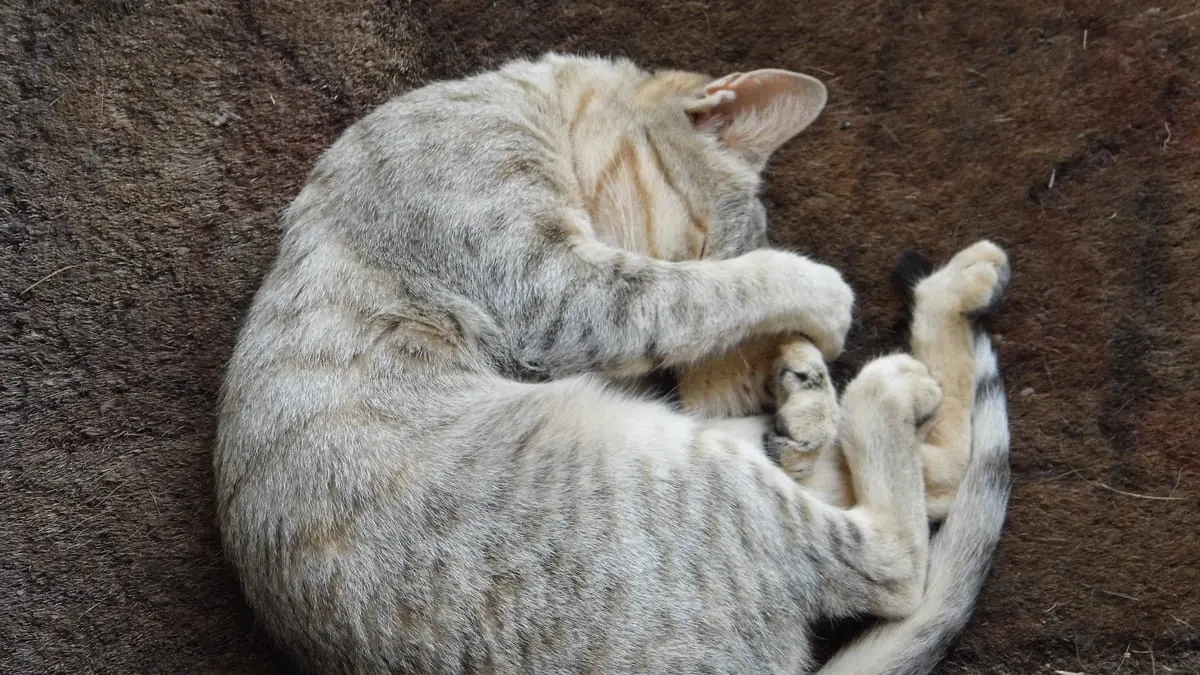
A healthy house cat spends more of the day asleep than awake, and it does this every day of its life. In almost any other animal that pattern would read as illness. In a cat it reads as contentment, and it is really something sharper than either: a working strategy, inherited and never switched off.
Sleep is a hunter's budget
Why do cats sleep so much? The honest answer is unglamorous: sleep is how a small ambush predator pays for the handful of violent seconds that actually feed it. Most adult cats sleep somewhere between 12 and 18 hours a day, and surveys put a large share well past even that, with roughly 40 percent clocking more than 18 hours (Sleep Foundation). Kittens and old cats push it higher, closer to 20. Your cat is not bored or sad. It is running a strategy that worked for its wild ancestors and never got switched off.
It helps to remember that the animal on your couch is the same basic machine as a lion, just shrunk and brought indoors. Big cats are champion sleepers too, lions famously resting up to 20 hours when prey is scarce. The pattern across the cat family is the same: hunt hard, then rest hard. A house cat with a full bowl still keeps the resting half of that deal, even though the hunting half has been quietly retired.
Most of that sleep is barely sleep
Here is the detail that changes how you watch the napping. The bulk of a cat's "sleep" is light dozing, not the deep, dead-to-the-world kind. When researchers finally recorded ordinary house cats with a gentle, noninvasive version of the electrodes used on human sleep patients, the cats spent only about a fifth of their sleep in REM, the deep dreaming stage, and the rest in drowsiness and lighter non-REM sleep (Journal of Mammalogy). Vets put the same idea in plainer numbers: only around a quarter of feline sleep is genuinely deep (PDSA).
That light doze is doing real work. A cat in it keeps its ears swiveling toward sounds and can go from flat to airborne in well under a second. That half-armed rest is also why a cat is so picky about where it does it, gravitating to snug, walled-in spots, the same instinct behind why cats are drawn to boxes. The body looks switched off; the alarm system stays armed. Dr. Katherine Houpt, who ran the animal behavior clinic at Cornell's veterinary college, describes cats as keeping two major sleep periods, or epochs, at night, with lighter naps scattered across the day (Cornell Feline Health Center). The famous "cat nap" is exactly that: a short, shallow rest you can interrupt with a can opener three rooms away.
Built around dawn and dusk
Cats are not really day animals or night animals. They are crepuscular, with two activity peaks, one near dawn and one near dusk, the hours when the small birds and rodents they evolved to hunt are also on the move (Sleep Foundation). That schedule is why your cat detonates into life at 5 a.m. and again at twilight, and treats the long middle of the day as dead time.
The economics underneath it are simple. Stalking, sprinting, and pouncing are expensive, and a cat is an obligate carnivore that lives entirely on the protein it catches. In the wild there is no guarantee the next pounce lands, so the safest move between hunts is to spend as little energy as possible. Sleep is the cheapest setting a body has. A cat that sleeps the afternoon away is not wasting the day. It is saving it for the moment that matters.
This is the same animal that will knead your lap like dough the instant it wakes, then demand dinner as if it had been working a double shift. From the cat's point of view, it has. The whole design assumes long stretches of stillness punctuated by all-out effort, and the stillness is the larger part by far.
What a cat does in REM
Now the strange part. For the fifth or so of sleep that is genuinely deep, a cat drops into REM, the same vivid stage in which humans dream. We know what is probably happening in there thanks to a set of experiments from the late 1950s and 1960s by the French neuroscientist Michel Jouvet, who studied sleep largely in cats. Normally the brain paralyzes the body during REM so a sleeper does not act out what is in their head. When Jouvet disabled that one safety switch in cats, they began to move in their sleep: still fully asleep, they prowled, swatted, and bit at things that were not there (Scientific American).
Read that again. Given the chance to act out their dreams, the cats prowled and struck at the air, doing exactly what cats do. The behavior that defines the species is so deeply wired that it surfaces even when the lights are out and the body is supposed to be parked. Your cat is not just resting up for the next hunt. On some level, in the deep end of its sleep, the predator never fully clocks off.
So the long, smug, sunlit naps are not a sign of a lazy animal. They are the resting half of a predator built for a feast-and-famine life it no longer has to live. The bowl is always full now, and the cat sleeps on anyway, because the part of it that decides such things is still out on the savanna, waiting for dusk.
Keep wondering: the same cat that sleeps sixteen hours a day will meow almost entirely at you and barely at other cats, cools itself nothing like a panting dog, and shares its deep, dreaming sleep stage with your own brain.

Join the conversation
Comments are reviewed before they appear. Be kind and stay curious.
Loading comments…