
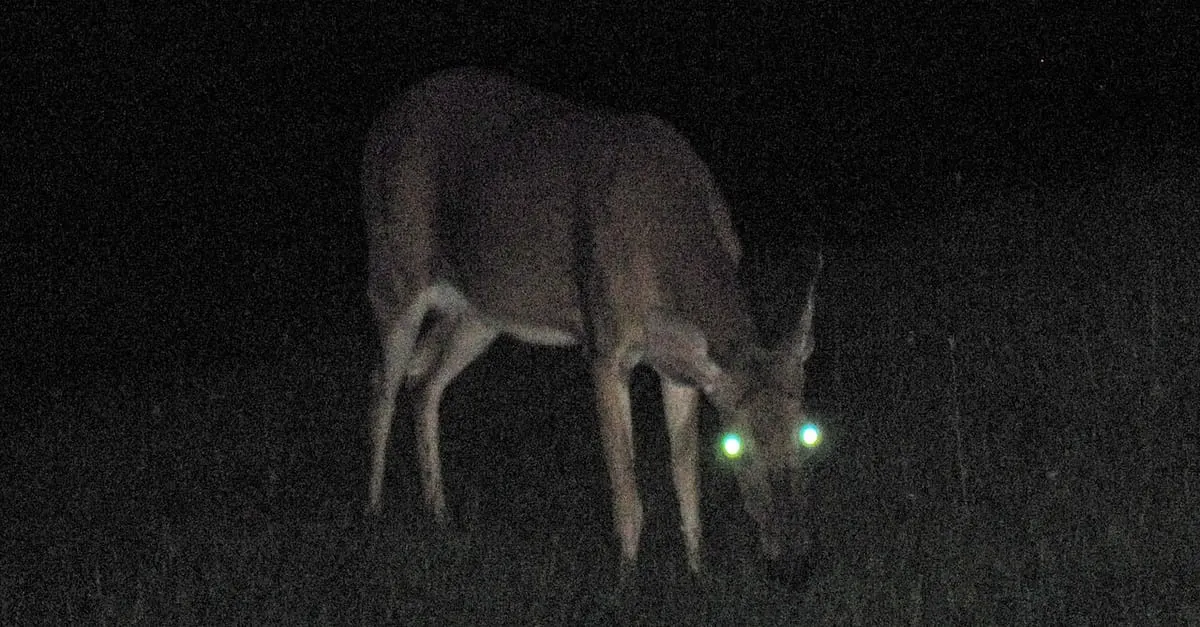
You crest a hill at night, and there it is: a deer planted in the middle of the road, head up, eyes blazing, utterly still. Your instinct says it should run. It doesn't. We turned that moment into a figure of speech for panic, but the real explanation has nothing to do with fear or foolishness. The deer is doing the only sensible thing an animal with its eyes can do.
A deer in headlights is briefly blind, not frozen by fear
The deer may not see you clearly, because its night-tuned eyes have just been flooded with light, and once a headlight hits a deer it may barely make out anything beyond the beam (Federal Highway Administration review). To understand why a little light can disrupt its vision so completely, you have to start with how good that vision is in the dark.
Deer are crepuscular. They are built to move at the edges of the day, and the Maine Department of Inland Fisheries and Wildlife notes they are "typically most active around dawn and dusk" (Maine Department of Inland Fisheries and Wildlife). That low-light lifestyle shaped their eyes into superb dim-light instruments, and like any instrument tuned to a whisper, they overload when someone suddenly shouts.
The eye is an amplifier with no off switch
Three features stack up to make a deer's eye a night-vision machine. First, the retina is crowded with rod cells, the photoreceptors that handle dim light. According to zoologist Dr. Jochen Langbein, deer carry "close to 10-fold the number of rod cells" relative to cones, and rods are roughly a thousand times more light-sensitive than the color-detecting cones (IFLScience). Second, their pupils open extremely wide to scoop up every available photon.
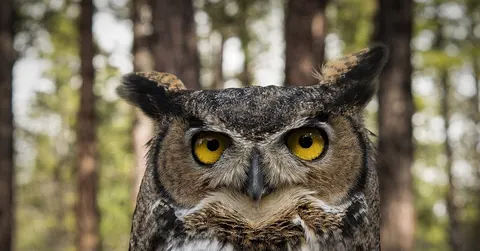
Third, and most striking, is the layer behind the retina called the tapetum lucidum. It works like a mirror: light that slips past the photoreceptors on the way in gets bounced back through the retina for a second chance to be detected (ScienceABC). That reflection is exactly the eerie glow you see in your headlights, the same trick that makes a cat's eyes shine and lets owls turn their heads and hunt in near-total dark. The same mirror that makes a deer's eyes shine is what doubles the light hitting an already light-hungry retina.
Now picture a headlight on full beam landing on all of that at once. The wide pupils are open, the rod cells are primed, and the tapetum sends a second wave of light back through. The result is a flood, a sensory overload that the eye has no fast way to shut down.
Why the lights blind it instead of just dazzling it
The chemistry seals it. Rod cells see in the dark using a pigment called rhodopsin, which is sensitive enough to register very dim light. A sudden bright light overwhelms that night-adapted system, and until the eye adjusts the animal's vision can be temporarily impaired (Federal Highway Administration review). It is the same washout you feel when someone flicks a light on in the middle of the night, except the deer's eye is far more sensitive, so the effect can be far worse. Even our own eyes lean on a reflex here, which is part of why we blink, but a deer's pupils cannot clamp shut quickly enough to defend against the surge.
So in the seconds that matter most, the deer may not be able to see the car, the lane lines, or anywhere safe to run clearly. Bolting at speed into a visually confusing scene is a dangerous response to the thing that is about to hit it.
Freezing is the smart move, not the dumb one
Here is the part that flips the cliche. A deer whose vision is overwhelmed may stop. Holding still is a prey-animal reflex that can help an animal go unnoticed by a predator while it figures out what is happening (ScienceABC). Faced with a roaring, visually confusing unknown, the deer may freeze while its eyes recover, a process that can take several seconds it usually doesn't have.
Read that way, "deer in the headlights" is not a story about a panicking animal that lost its nerve. It is an animal running its best ancient program against a threat that program never evolved to handle. Cars are about a century old. Deer eyes are millions of years older, and they are exquisitely good at exactly the wrong thing for this one situation.
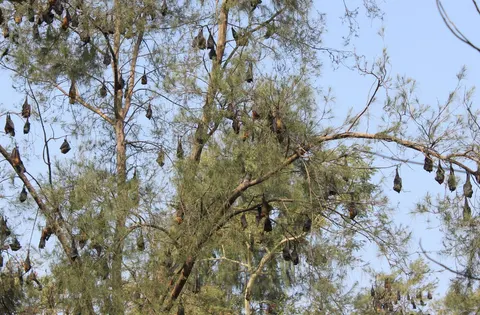
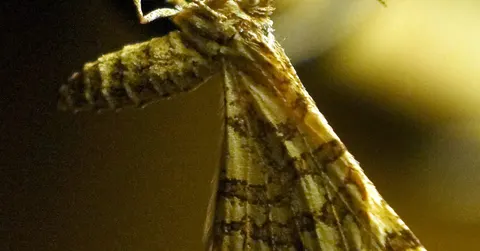
It is the same theme you find all over the animal world: a sense honed for one job gets ambushed by a modern light. Moths spiral into porch bulbs for reasons just as misfired, while bats hang upside down and own the dark with their own dramatic tricks. The deer's only mistake is being too good at seeing in the dark.
Keep wondering: meet a master of the dark in why owls can turn their heads so far, chase another trick of light in why the sky is blue, and learn why our own eyes flicker shut in why we blink.
Join the conversation
Comments are reviewed before they appear. Be kind and stay curious.
Loading comments…