
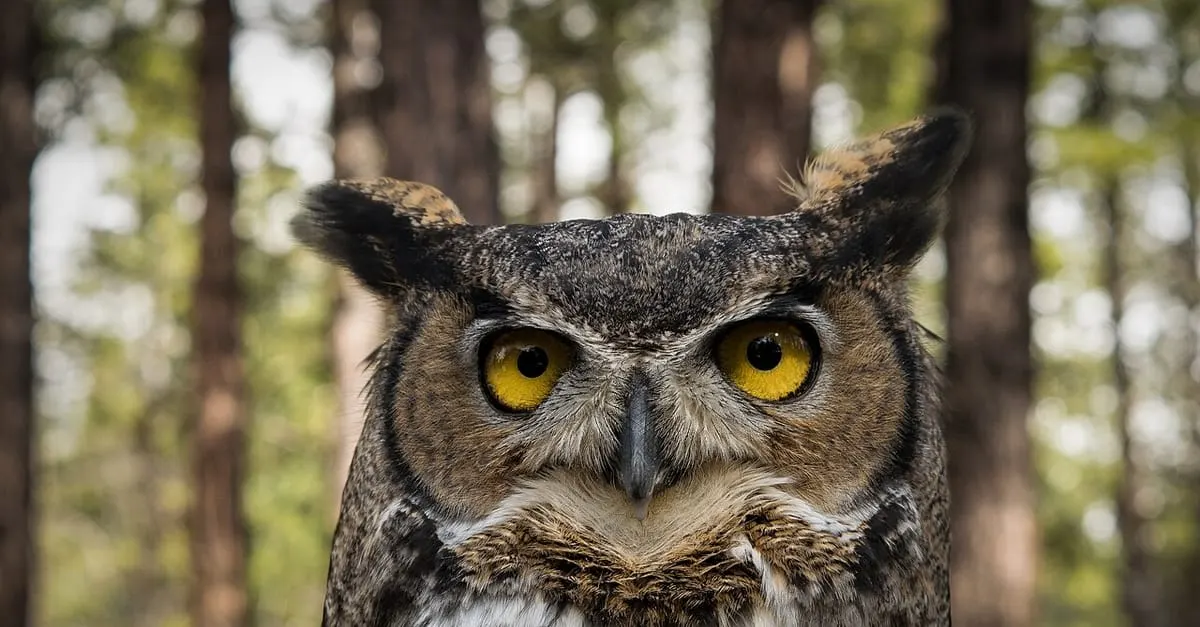
You watch an owl on a branch, and its body stays dead still while the face glides round to stare straight behind it. It looks impossible, a little eerie, like the head is on a turntable. There is a reason owls do this party trick, and a second, stranger reason it does not kill them.
Owls turn their heads because their eyes cannot move
An owl swivels its head because its eyes are fixed tubes locked into the skull, so the only way to look in a new direction is to point the whole face there (National Geographic). Your eyes are little balls riding in their sockets; you flick them side to side without moving your head at all. An owl cannot. Its eyes are enormous, elongated cylinders crammed so tightly into the front of the skull that there is no space and no muscle left to roll them. The eye is essentially bolted in place.
That design is a deliberate trade. Those oversized tube eyes are built to drink in faint light, which is exactly what a night hunter needs. The cost is that the owl loses the quick darting glance the rest of us take for granted. We barely notice how much work our roving eyes do, the same way we barely notice why we blink. An owl gets none of that for free. To follow a mouse rustling off to one side, it has to turn its head, and to keep watch all around its perch, it has to turn that head a very long way.
How far is "so far"? Beyond 270 degrees, not all the way around
Barn owls have been measured rotating their heads more than 270 degrees (Barn owl study). The researchers found that large turns combine yawing and rolling movements across different regions of the neck. That is enough to turn the face behind the body, but it is not a continuous 360-degree spin.
No owl rotates a clean 360 and keeps going like a screw. At the end of its range, it has to unwind and come back the other way. The bird simply moves so smoothly, and holds the rest of its body so rigidly, that your eye misses the return trip.
The flexibility starts in the neck itself. An owl has 14 vertebrae in its neck, double the seven that you and a giraffe both carry (Schlitz Audubon Nature Center). More bones mean more joints, more hinge points, and a neck that bends and twists in ways ours never could. That long, hidden, S-shaped neck is usually buried in fluffy feathers, so the owl looks like a round ball with a face, which makes the head movement seem even more uncanny.
This is a recurring trick in the animal world: when one part of the body cannot do a job, another part is rebuilt to take over. A creature with no legs still gets around, as how snakes move without legs shows, and a hummingbird that cannot soar instead beats its wings into a blur, which is the story behind how fast hummingbirds flap their wings. The owl's version of that trade is fixed eyes and a neck that can reach almost anywhere.
The real puzzle: why the twist doesn't starve the brain
Here is the part that had scientists genuinely stuck. In a human, cranking the neck around that hard would pinch and tear the arteries feeding the brain. Owls do it constantly without harm, and for years nobody could explain how. A team of medical illustrators and imaging experts at Johns Hopkins finally worked it out by injecting dye into the vessels of owls that had died naturally, then scanning and dissecting the necks (Johns Hopkins Medicine).
They found a stack of clever adaptations. The bony canals in the neck that carry the main artery are about ten times wider than the artery itself, leaving room for the vessel to shift and slacken instead of stretching tight during a turn (Johns Hopkins Medicine). That artery also enters the neck higher up than in other birds, giving it extra slack. And at the base of the skull, small connecting vessels and little blood reservoirs let blood pool and reroute, so the brain keeps its oxygen even if one path gets squeezed mid-twist. The work was striking enough to win a first-place spot in a National Science Foundation visualization challenge and appear in the journal Science.
In short, the owl is not just flexible. Its entire plumbing is rebuilt around the fact that it has to keep wrenching its head about. The same body that forces the owl to turn its head has quietly evolved to make all that turning safe.
So the next time an owl rotates its face to watch you cross a room, remember what you are actually seeing. Not a horror-film special effect, but a creature that traded movable eyes for movable everything-else, and built a neck that can take it.
Keep wondering: the same bird talks in the dark in why owls hoot, another night creature solves its world upside down in why bats hang upside down, and for a body that bends in ways ours cannot, see how snakes move without legs.
Join the conversation
Comments are reviewed before they appear. Be kind and stay curious.
Loading comments…