
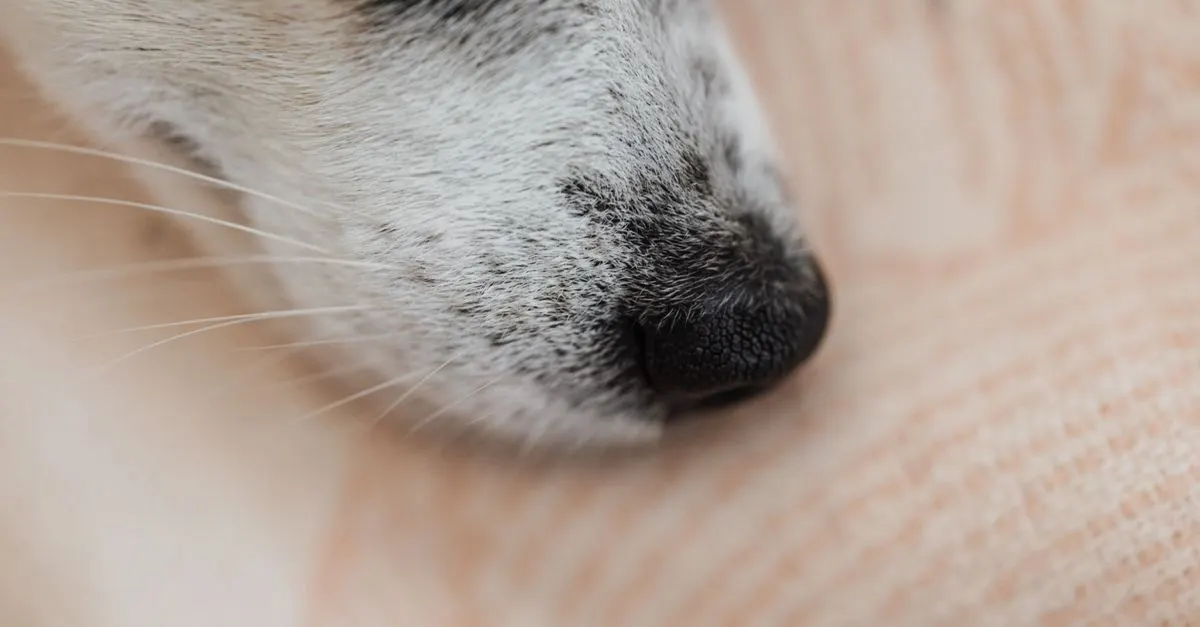
Everyone knows the feeling: that cold, damp nudge against your hand or your cheek, the dog's nose doing what dogs' noses do. It's so familiar that most people file it under "cute" and move on, or worry about it the moment it turns dry. But the wet on a dog's nose isn't an accident, and it isn't decoration. That little patch of cold, slick skin is working three jobs at once, and the third one sounds like science fiction.
Mostly, it's about smell
Here's the main reason dogs have wet noses: moisture makes them better at smelling. Scent travels as tiny molecules floating in the air, and a damp nose grabs them. The thin film of mucus and saliva on the surface traps those molecules and dissolves them, concentrating the smell right where the dog's olfactory sensors can read it (VCA Animal Hospitals). A dry nose lets a lot of that information drift past. A wet one catches it like flypaper.
This is also why dogs lick their noses so often. Each lick re-wets the surface, and it sweeps the captured scent molecules back toward the vomeronasal organ, a second smell detector in the roof of the mouth that specializes in heavy, important odors like the chemical signals other animals leave behind. The nose collects; the tongue delivers.
It's also how a dog keeps cool
Dogs barely sweat. They have a few sweat glands in their paw pads and almost nowhere else, so they can't shed heat through their skin the way you do. That leaves them a short list of cooling tools, and the wet nose is on it. As moisture evaporates off the nose, it pulls heat away from the blood in the vessels just under the surface, cooling it a little (VCA Animal Hospitals). It's a small effect next to panting, which does most of the heavy lifting, but on a hot day every bit counts, and the nose chips in.
So part of the moisture is mucus, made by glands inside the nose, and part is plain saliva from all that licking. Between the two, a healthy dog keeps its nose damp most of the time without ever thinking about it.
The part that sounds made up
Now the strange one. In 2020, researchers in Sweden and Hungary noticed something odd: the bare tip of a dog's nose, the rhinarium, runs about five degrees colder than the rest of the dog's body. Why would the body bother keeping one little patch of skin pointedly cold? They suspected it was a clue, and they were right.
They trained dogs to tell two distant objects apart using nothing but the faint heat radiating from them, and the dogs could do it from more than a meter away. Brain scans backed it up, showing the dogs' brains responding to weak warmth (Scientific Reports, 2020). The cold wet nose, it turns out, is a heat sensor. And the coldness is the whole point: cold tissue picks up faint infrared radiation far better than warm tissue, the same way a cold hand feels the warmth of a fire more sharply (Science, AAAS).
Only one other mammal on Earth is known to sense heat this way, the vampire bat, which uses it to find the warm blood vessels under a sleeping animal's skin. Your dog may carry a watered-down version of the same power, useful once for tracking the body heat of prey, now mostly aimed at finding the warm spot on the couch.
So the next time a cold nose finds your hand in the dark, think about what it's actually doing. It's tasting the air for scent, bleeding off a little heat, and quietly reading the warmth coming off your skin, all at the same time. And if it's dry for an afternoon, don't panic. Noses dry out after naps and sunbathing and wet back up on their own, and dryness alone says very little about a dog's health.
Keep wondering: a dog's body is full of quiet engineering, from how panting keeps it cool to what a tail wag really means and why dogs lick you in the first place.



Join the conversation
Comments are reviewed before they appear. Be kind and stay curious.
Loading comments…