
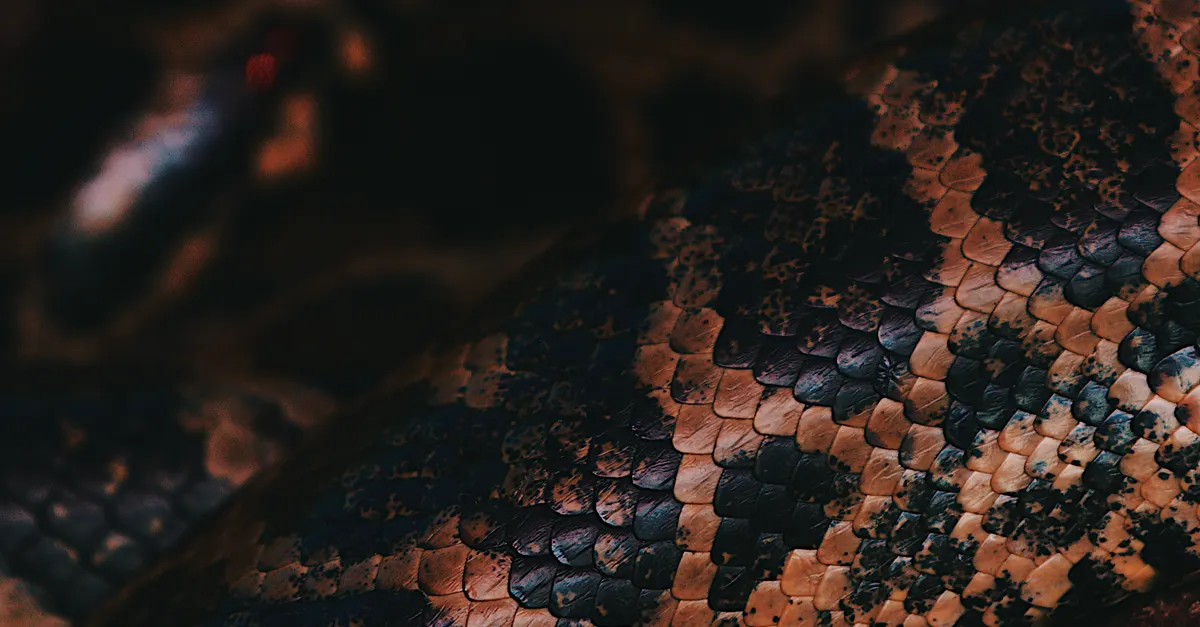
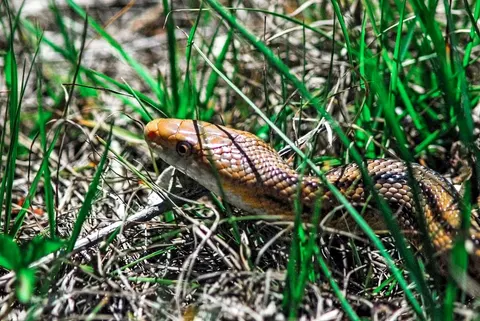
You find it in the grass: a snake, complete from nose to tail, ghostly and dry and perfectly hollow. Every scale is there, the eyes are there, even the round caps that covered them are there, and yet the whole thing is empty, a paper-thin husk of an animal that has slid away. It's one of the strangest things you can stumble on outdoors. So why does a snake leave its entire skin behind?
Because the old skin can't grow with it
Here's the main reason snakes shed their skin: they're outgrowing it. A snake's outer layer is made of tough keratin, the same stuff as your fingernails, and like a fingernail it doesn't stretch (Britannica). Your skin grows along with you, quietly replacing itself cell by cell. A snake's outer layer can't. As the snake's body gets longer and thicker, that rigid skin becomes a suit two sizes too small, so the only fix is to grow a new, bigger layer underneath and throw the old one off all at once. The shed does some housekeeping too: the discarded skin carries away worn tissue and any parasites, like mites, that had latched on (Live Science).
How often it happens tracks how fast the snake is growing. A typical snake sheds somewhere between four and twelve times a year, and young snakes, growing fastest, shed most often, sometimes every few weeks (Forest Preserve District of Will County). The very first shed can come within hours of hatching.
The days the snake goes "blue"
A shed doesn't happen out of nowhere. For days beforehand, the snake grows a fresh layer of skin under the old one, and a thin film of fluid seeps in between them to loosen the bond. You can watch it happening in the most unsettling place: the eyes.
Snakes have no eyelids. Each eye is sealed behind a clear, fixed scale called the spectacle, or brille. When that loosening fluid creeps in under the spectacle, the eye clouds over into a milky, bluish haze, and the whole snake takes on a dull, dusty look (Live Science). Keepers call this going "in the blue." The snake's vision drops to a blur, so it does what any half-blind animal would: it hunts less, hides more, and gets jumpy, more likely to strike at something it can't quite see. Then, a few days before the shed, the eyes clear again, the haze drains away, and the snake is ready.
Peeled off like a wet sock
When it's time, the snake goes looking for something rough, a rock, a branch, a piece of bark, and rubs its snout against it until the old skin splits, usually right around the mouth or nose. Then it simply crawls forward out of itself. As it pushes ahead, the old skin catches and rolls backward, turning inside out as it goes, sliding off the body exactly the way you'd peel a wet sock off your foot (Britannica). In a healthy shed the whole thing comes off in one connected piece, eye caps included, which is why the husk you find in the grass is so eerily complete.
One last surprise: that ghostly skin is colorless. A snake's color and pattern live in the deeper skin that stays on the body, not in the layer it sheds. So the husk is a perfect translucent cast of the animal, scale for scale, with all the color drained out, a clear shell the snake stepped out of and left behind. Find one, hold it up to the light, and you're holding the exact shape of a snake that has already moved on, a little bigger than it was the day before.
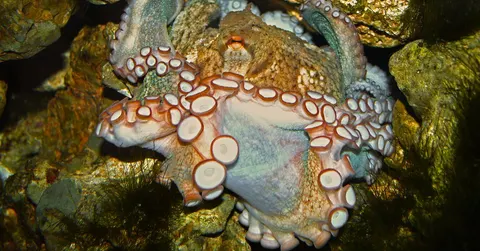
Keep wondering: snakes are full of strange engineering, from how they move with no legs at all to the long lives of their reptile cousins in why turtles live so long, and the skin tricks reach their peak in how an octopus changes color.

Join the conversation
Comments are reviewed before they appear. Be kind and stay curious.
Loading comments…