
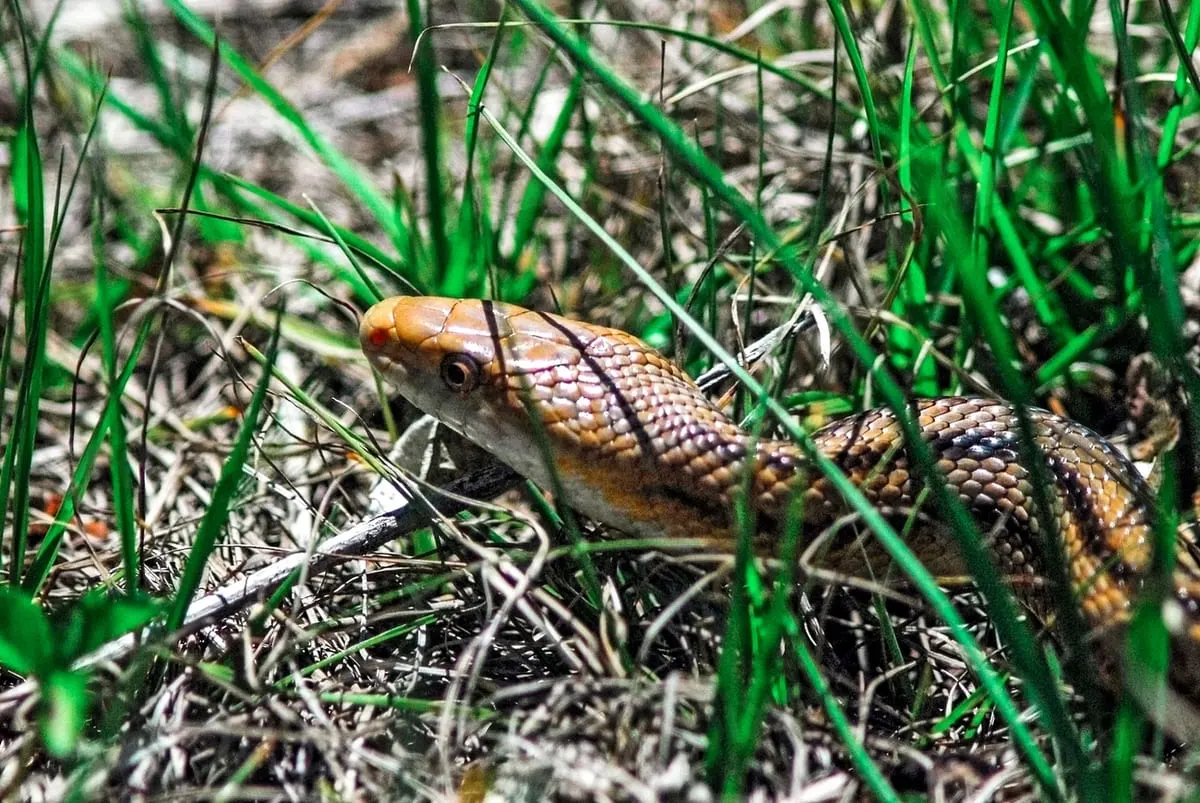
A snake crosses your path and just flows, no legs pushing, no wheels turning, nothing visibly doing the work. It is one of the most quietly impossible-looking things in nature. But there is no magic in it. How do snakes move without legs? Not by magic, it turns out, but with four distinct techniques, plus a trick hidden in the snake's own skin, the same skin it sheds whole every few months.
The short answer: a whole body that pushes
A snake has no limbs to step with, so it turns its entire body into the limb. By bending and flexing along its length and pressing those bends against the ground or against objects, it generates forward thrust. The piece that makes it actually go somewhere, rather than just wriggle in place, is its belly. A snake's underside is covered in wide, overlapping scales that grip in one direction and slide in another, converting all that bending into travel.
A body built to bend
None of this works without an extraordinary skeleton. Where you have around 33 vertebrae in your spine, a snake has hundreds. A single Burmese python skeleton documented by the Florida Museum of Natural History had 338 vertebrae and a combined 872 ribs and vertebrae (Florida Museum of Natural History). Each joint can flex a little, and a long chain of small flexes adds up to a body that can curve smoothly anywhere along its length, with muscles to drive every bend.
The four main ways a snake gets around
Snakes do not have one way of moving. They have a whole toolkit of gaits, grouped into four main modes, and they pick the right tool for the ground (Jayne, 2020).
- Lateral undulation, the classic serpentine glide. Waves of side-to-side bending travel from head to tail. It works best when each bend can press against something solid, a rock, a stick, a bump, so the snake pushes off those points, with the body following the exact path its head took, like train cars tracing the engine (University of Louisiana). On a smooth, featureless floor it is far less efficient, though some snakes can still manage it.
- Concertina, the accordion. The snake bunches part of its body into tight bends to wedge and grip, anchors, then extends the rest forward and re-grips. It is slow but powerful, and it is how snakes move through narrow tunnels and climb.
- Rectilinear, the straight-line creep. No side-to-side bending at all. Instead the belly skin and scales ripple, lifting and pulling forward, then setting down and pulling the body over them. Big, heavy snakes like pythons and large vipers use it to advance in a slow, eerie straight line.
- Sidewinding, the desert special. On loose sand, the snake throws its body sideways in loops, touching down in just a few spots and rolling the lifted parts forward. It leaves disconnected J-shaped tracks and moves diagonally, which stops it from slipping.
The secret is in the scales
Whatever gait a snake uses, the reason a wriggle becomes forward motion is friction, and not ordinary friction. A snake's belly scales are built to grip in one direction and glide in another. Studied by mathematicians and engineers at New York University, this turns out to be the key. As researcher David Hu put it, "these scales give the snakes a preferred direction of motion, which makes snake movement a lot like that of wheels, cross-country skis, or ice skates" (ScienceDaily).
Skis slide forward freely but bite when you push back, and that one-way grip is exactly what lets a skier climb. A snake's belly works the same way: it resists sliding backward and sideways while slipping easily forward, so every push against the ground nudges the animal ahead instead of just spinning its wheels. On flat terrain the snake even shifts its weight along its body, pressing down where it wants grip and lifting where it wants to glide.
It is the kind of elegant, low-tech engineering that shows up again and again in animal bodies, like the soft-bodied wizardry behind how octopuses change color or the spring-loaded strike in how hard a mantis shrimp can punch.
The myth of the walking ribs
One last thing to clear up, because it is repeated everywhere: snakes do not normally "walk" on their ribs like rows of little legs. In ordinary slithering, the thrust comes from the whole body pushing sideways against points of resistance, not from ribs striding forward. Only in slow rectilinear creeping does anything leg-like happen, and even then it is the belly scales and the muscles under the skin doing the work, not the ribs marching. The snake is not faking legs. It found a completely different solution.
Keep wondering: a legless body that outmaneuvers most legged ones is one of evolution's neatest tricks, in the same league as an octopus rewriting its own skin and the question of whether any animal is truly immortal. More at Life on Earth.


Join the conversation
Comments are reviewed before they appear. Be kind and stay curious.
Loading comments…