
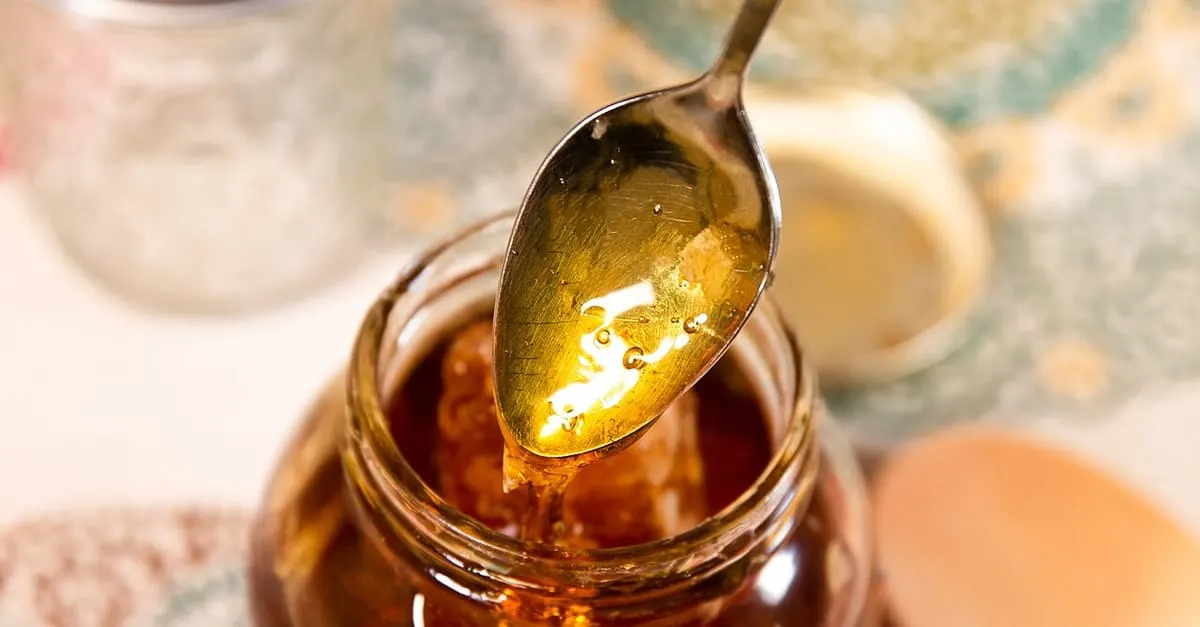
Open a jar of honey that has been sitting in the back of your cupboard for years and it is, almost certainly, perfectly fine. No mold, no sour smell, no fuzz. Try that with bread, milk, or a peach and you know how it ends. So why does honey never spoil while everything else in the kitchen is racing toward the trash? The short answer is that bees, without meaning to, built one of the most hostile places on Earth for a microbe to land.
Honey doesn't spoil because almost nothing can live in it
Honey resists rotting because microbes basically cannot grow in it, thanks to its very low water, very high sugar, and acidity (Smithsonian Magazine). Spoilage is really just microbes eating and multiplying inside your food. Take away their ability to live and the food sits there, unbothered, sometimes for a very long time.
The first weapon is dryness. Flower nectar starts out 70 to 80% water, but finished honey usually carries only about 18% (Wikipedia). Bees do the drying themselves, fanning their wings over the comb to evaporate the excess until the syrup is thick and concentrated. A bacterium needs liquid water to function, and honey has barely lent it any.
The sugar literally pulls the water out of invaders
Now stuff that little bit of water with sugar. Honey is supersaturated, holding far more dissolved sugar than the same amount of plain water ever could (Wikipedia). That creates a brutal osmotic squeeze. Sugar is hygroscopic, meaning it grabs water from whatever is near it, so when a bacterium or a fungal spore drifts into honey, the surrounding sugar drains the moisture straight out of the cell (Smithsonian Magazine).
A microbe that lands in honey isn't poisoned so much as wrung dry, like a sponge squeezed in a fist. It is the same trick we use when we cure meat or pack fruit in sugar to make jam. Honey just comes by it naturally. The same physics is behind a lot of everyday science, from why salt melts ice to the way water behaves when it changes form in why ice floats.
Bees add acid and a dash of disinfectant
Dryness and sugar would be enough on their own, but honey piles on two more defenses. It is acidic, with an average pH near 3.9, sour enough to discourage most things that would try to grow in it (Wikipedia). Amina Harris of the Honey and Pollination Center at UC Davis puts the working range between roughly 3 and 4.5, "and that acid will kill off almost anything that wants to grow there" (Smithsonian Magazine).
Then there is the bee's own contribution. Bees carry an enzyme called glucose oxidase, and as they process nectar it breaks down into gluconic acid and a small amount of hydrogen peroxide, the same compound you might dab on a scrape (Smithsonian Magazine). That trace of peroxide works quietly against anything trying to take hold. If you have ever wondered why bees make honey in the first place, this preservative chemistry is part of the payoff: a food store that keeps through the long, flowerless winter.
The famous tomb honey is mostly a myth, but the principle holds
You have probably heard that archaeologists pulled jars of honey from ancient Egyptian tombs and found it still edible after 3,000 years. It is a great story, and it gets repeated everywhere. It also does not hold up. Wikipedia's review of the claims is blunt: no edible honey has actually been found in an Egyptian tomb, and every case that made the rounds turned out to be some other substance or just chemical traces (Wikipedia). So treat the "3,000-year-old snack" line as folklore. What is real is the shelf life itself. As long as its water content stays around 18% or below, honey has an indefinite shelf life, in the hive or in your pantry (Wikipedia).
Notice the word sealed. Honey's superpower has an exposed flank. Because that same hungry sugar pulls water from the air, an open jar in a steamy kitchen can slowly absorb enough moisture for wild yeasts to wake up and ferment it (Smithsonian Magazine). Keep the lid on and the water out, and the fortress holds.
Crystals aren't rot, and a real warning for babies
One last source of false alarms is crystallization. Over time the glucose in honey settles into tiny crystals and the jar turns cloudy and grainy. That is not spoilage. Honey crystallizing does not mean it has expired, and crystallized honey is perfectly safe to eat (Wikipedia). To bring it back to liquid, set the jar in warm water and stir until the crystals melt.
There is, however, one group that should never eat honey, and that is infants. Honey can contain dormant spores of a bacterium called Clostridium botulinum that an adult gut handles without trouble but that can cause infant botulism in a baby's immature system. The FDA puts it plainly: honey is not safe for children less than a year old, because it can carry the organism that causes that illness (U.S. Food and Drug Administration). The CDC agrees and warns against honey before 12 months, including in food, water, or on a pacifier (Centers for Disease Control and Prevention). Spore-proof against most threats is not the same as sterile.
So honey doesn't cheat death so much as refuse to host it. It is too dry, too sweet, too sour, and faintly antiseptic, which leaves a microbe nowhere to gain a foothold. Bees made that food to feed a hungry hive through a flowerless winter, sealed it in wax, and we get to raid the leftovers thousands of years later. The one thing they cannot do for you is keep the lid on.
If you liked this, why bees make honey covers the insects that pull it off, and the same water-grabbing chemistry shows up again in why salt melts ice.


Join the conversation
Comments are reviewed before they appear. Be kind and stay curious.
Loading comments…