
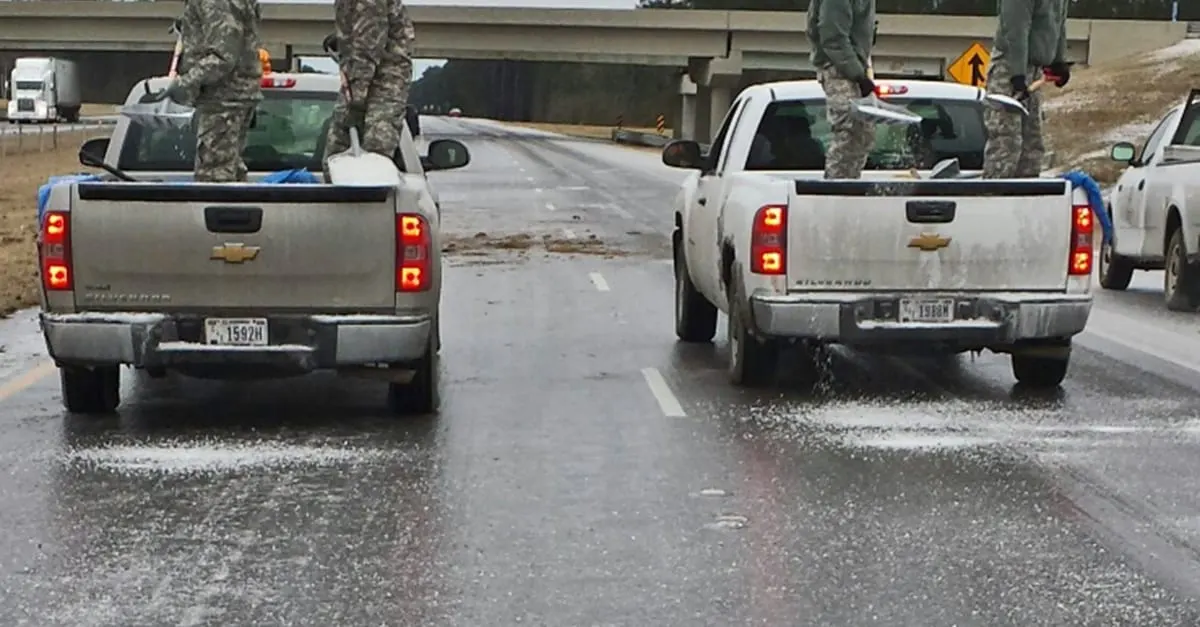
The salt trucks come out before the storm does. They lumber down the road in the gray hours, throwing a hiss of grit across the asphalt, and by the time the snow falls the worst of it never sticks. Scatter a handful of the same coarse salt on an icy front step and you can watch the sheet go slushy and then wet within minutes, even though the air is still well below freezing. The same chemistry runs in reverse out at sea, and it is why the salty ocean has to get colder than a freshwater pond before it freezes. So why does salt melt ice when the thermometer says everything should stay frozen?
Salt gets in the way of freezing
Ice is never perfectly dry. Even a frozen sidewalk carries a microscopically thin film of liquid water on top, with molecules constantly leaving the solid and rejoining it. Drop salt onto that film and it dissolves, splitting into sodium and chloride ions that scatter through the water. Those ions crowd the surface and block water molecules from settling neatly back into the rigid ice crystal (Scientific American). Fewer molecules can refreeze, more keep melting, and the balance tips toward liquid.
The proper name for this is freezing-point depression: add any dissolved substance to water and you lower the temperature at which it can freeze (Chemistry LibreTexts). Pure water freezes at 0 degrees Celsius, or 32 degrees Fahrenheit. Salty water might not freeze until several degrees colder. So on a road sitting at, say, minus 5 Celsius, pure ice is perfectly happy staying solid, but salty water at that same temperature is above its new freezing point. It has no choice but to melt.
Arthur Pelton, a chemical engineer at the University of Montreal, put the mechanism plainly: with salt dissolved in the water, "the rate at which water molecules attach to the ice surface is decreased, mainly because the concentration of water molecules in the liquid is lower" (Scientific American). The ice keeps shedding molecules at its usual pace, but fewer come back. The puddle wins.
Why the melting feeds itself
Here is the part that makes a single scatter of salt do so much work. The moment some ice melts, the new liquid water dissolves more of the salt grains sitting in it. That saltier water has an even lower freezing point, so it melts still more ice, which dilutes the salt, which dissolves more salt, and on it goes. A little brine spreads under the ice and lifts it off the road, which is why a salted patch turns to dark slush from the bottom up.
It is also why the melting feels almost backward to the touch. Dissolving salt and melting ice both pull heat out of their surroundings, so a fresh slush of salt and ice gets colder, not warmer. That is the same chemistry behind a hand-cranked ice cream churn, where ice packed with salt drops below 0 Celsius and freezes the cream in the inner can.
The point where salt gives up
Salt cannot lower the freezing point forever. Water will only hold so much dissolved salt, and a fully saturated brine stops freezing at about minus 21 degrees Celsius, roughly minus 6 Fahrenheit (Wikipedia: Freezing-point depression). That is the floor in theory. In practice rock salt quits long before it, because the melting slows to a crawl in deep cold. Crews treat ordinary salt as effective only down to about minus 6 to minus 10 Celsius, roughly 21 to 14 Fahrenheit (Wikipedia: Road salt). Below that, scattering it mostly just buries grit in the bright packed snow.
When the cold gets that serious, road departments switch chemicals. A calcium chloride solution resists freezing down to around minus 52 Celsius, and the salt grabs moisture out of the air and gives off heat as it dissolves, so it bites faster (Wikipedia: Calcium chloride). Magnesium chloride and brine sprays fill in the milder gaps. The blue or pink pellets sold for sidewalks are usually one of these, not plain salt, which is why they keep working on a morning when the cheap white stuff just sits there.
There is something satisfying about the whole arrangement. A truck dribbles a few pounds of rock per stretch of road, the chemistry quietly rearranges which water molecules are allowed to freeze, and a city full of cars stops sliding. The ice never knew it was beaten by a colligative property.
Keep wondering: the crystal that salt is busy disrupting is the same open lattice that explains why ice floats; all that road water started overhead, which raises the question of how much a cloud weighs; and the light glinting off a salted, slushy street travels the same path that makes the sky blue.


Join the conversation
Comments are reviewed before they appear. Be kind and stay curious.
Loading comments…