
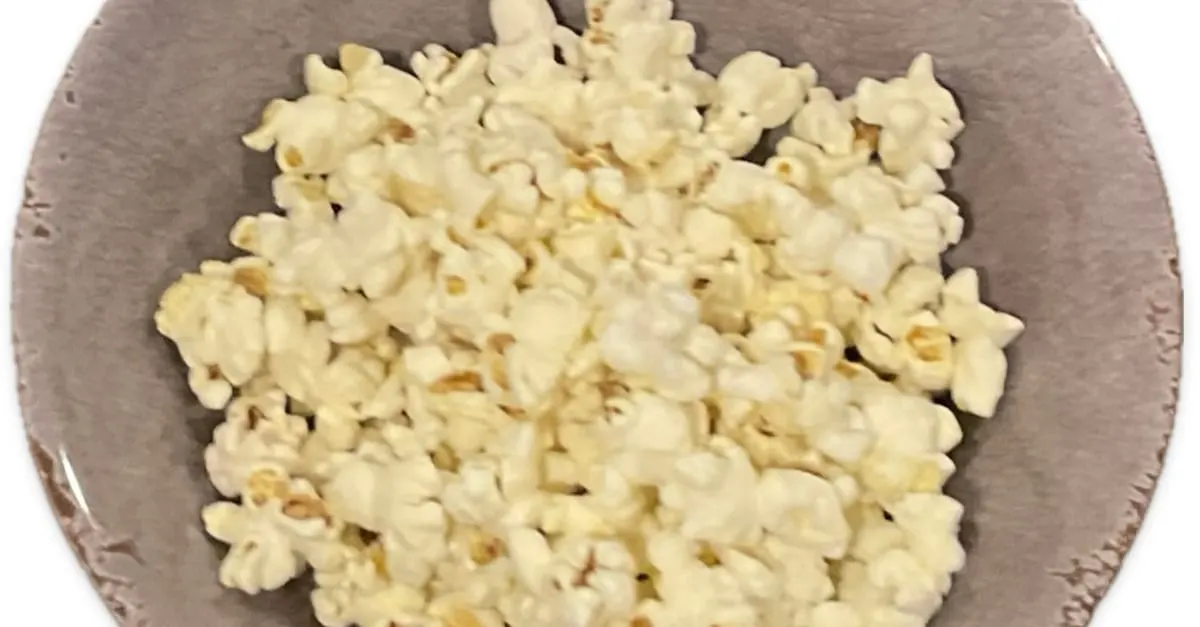
Hold a single popcorn kernel between two fingers. It feels like a hard little bead, dense and dry. It is actually a tiny pressure cooker, sealed and loaded, waiting for heat. So why does popcorn pop? Because that bead is built to fail in exactly one spectacular way, and a few hundred degrees later it turns itself inside out.
A sealed shell with a drop of water inside
Popcorn pops because every kernel is a sealed pressure cooker with two parts that matter. The outside is a hard, mostly waterproof shell called the pericarp, and the inside is packed with starch and a small amount of water, around 14 percent of the kernel's weight (Scientific American). The shell is the trick. It is nearly nonporous, so when you heat the kernel, the water trapped inside has almost nowhere to go.
Turn up the heat and that water becomes steam, the same phase change that drives why it rains. The steam wants to expand, the shell won't let it, and pressure starts climbing inside a space the size of a peppercorn. The pericarp holds, and holds, behaving like the wall of a pressure vessel. According to the Carolina Knowledge Center, it can retain pressurized steam up to about 9.2 atmospheres, roughly 135 pounds per square inch, before it gives way (Carolina Knowledge Center). That is several times the pressure in a car tire, packed into a single seed. It is the same basic setup as the trapped pressure behind how volcanoes erupt, just shrunk down to something you can hold.
What 180 degrees does to a kernel
The breaking point is sharp. In 2015 the physicists Emmanuel Virot and Alexandre Ponomarenko heated kernels carefully and watched what happened. At 170 degrees Celsius only about a third popped. By 180 degrees Celsius, around 356 degrees Fahrenheit, almost all of them did, 48 out of 50 in their test (Journal of the Royal Society Interface). That is the temperature where the steam pressure inside finally beats the strength of the shell.
When the pericarp ruptures, everything changes in a few thousandths of a second. The pressure drops to nothing, the superheated steam flashes outward, and the starch inside, which the heat has turned soft and gelatinous, expands into that sudden empty space. It foams up and flips inside out, the dense interior becoming the airy white flake. A popped kernel ends up something like 40 to 50 times the volume it started with (Carolina Knowledge Center). The hard bead is gone. What's left is mostly the cooled, frozen shape of an explosion.
Why only one kind of corn does this
You can heat sweet corn or field corn all day and never get a pop. Only popcorn, the variety Zea mays everta, has a pericarp strong enough to do the job (Scientific American). Its shell is much stronger and more nonporous than the hull on ordinary corn, so it can trap steam long enough for the pressure to build instead of leaking out the side (Carolina Knowledge Center). The water has to stay put too. A kernel that has dried out below its ideal moisture, or one with a tiny crack in the shell, just vents steam and stays hard. Those are the duds rattling around at the bottom of the bowl.
The pop is not the shell breaking
Here is the part that surprised even the researchers. You'd assume the noise is the hull cracking open, the way a balloon bang is the rubber tearing. It isn't. Virot and Ponomarenko matched the sound to their high-speed footage and found the pop doesn't line up with the shell rupturing at all. It lines up with the release of water vapor a moment later, the trapped steam venting into the air like a tiny whistle going off (The Royal Society). The crack opens the door. The pop is the steam rushing through it.
There's something I find genuinely satisfying about that. The loudest part of popcorn isn't the violence of the shell failing. It's the breath of water that was hiding inside the whole time, escaping all at once. A bowl of popcorn is a few hundred of those little breaths, each one a kernel that held its pressure right up until it couldn't.
Keep wondering: that water turning to vapor is the same phase change that fills the sky, which is part of how much a cloud weighs; water plays another structural trick when it freezes into an open crystal, which is why ice floats; and the light bouncing off that fresh white flake gets its color the same way the air does, namely why the sky is blue.

Join the conversation
Comments are reviewed before they appear. Be kind and stay curious.
Loading comments…