
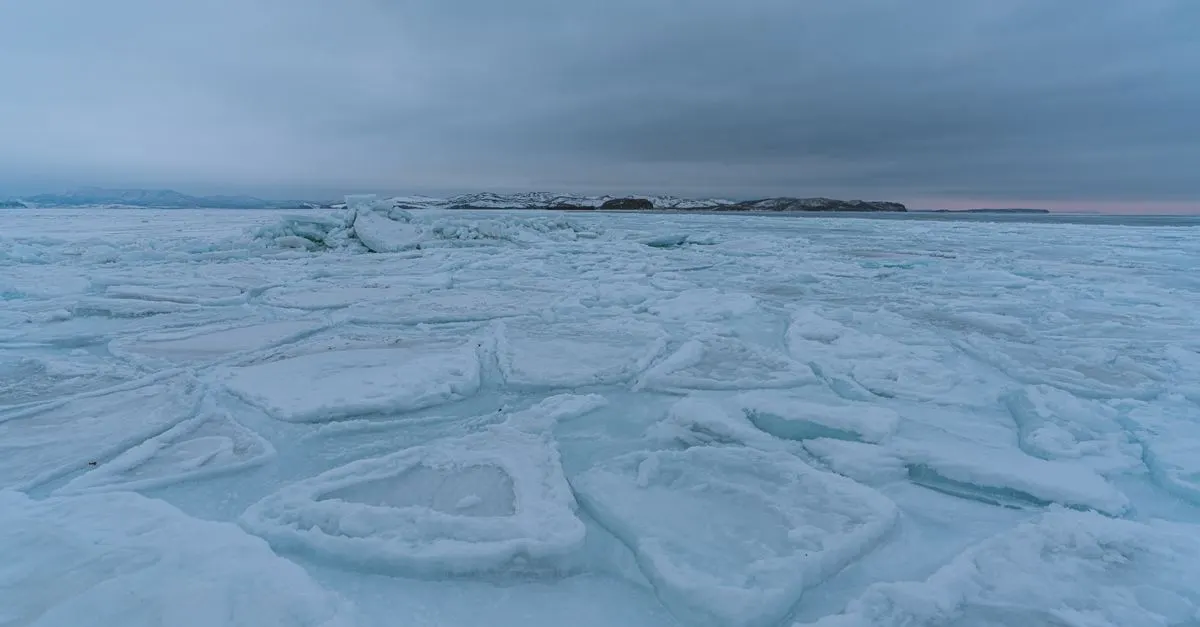
A person standing on the Arctic Ocean in February is standing on the ocean. Not on rock, not on a shelf jutting out from land, but on the sea itself, gone solid underfoot, with kilometres of black water still moving along underneath. So, does the ocean freeze? It does. It just refuses to do it the way a pond does.
The surface freezes at about -1.8 degrees Celsius, and only the surface
Sea ice is frozen ocean water, and seawater at typical polar salinity starts turning into it at about -1.8 degrees Celsius (28.8 degrees Fahrenheit) rather than at zero. The number tracks the salt. For every 5 PSU of salinity, the freezing point drops about 0.28 degrees Celsius, so a polar ocean sitting near 32 PSU has to be chilled almost two degrees below the point where a puddle would harden (NSIDC). It is the same reason a scatter of grit clears a driveway, which is a small chemistry story of its own in why salt melts ice, and the salt itself has been piling up in the sea for a very long time, as the ocean's saltiness explains.
Cold that deep is common at the poles, so freezing happens, and a lot of it: at some point in the year, sea ice covers at least 15 percent of the ocean. NOAA puts the average coverage at roughly 10 million square miles of the planet under ice (NOAA). But it is a skin. The average temperature of all the water in the ocean is about 38.3 degrees Fahrenheit, well clear of freezing, and the deep stays that way. Heat only escapes at the top, currents keep hauling warm water poleward, and the crust under the ocean is thin enough that a good share of the planet's internal heat leaks up into the water from below (West Texas A&M). The deep ocean is cold and dark, but it is not going to freeze.
There is a quiet oddity in how the surface gets there. Fresh water is at its heaviest around 39.2 degrees Fahrenheit and then turns strange, growing lighter as it cools further, which is the twist behind why ice floats. Seawater does not play that game. It just keeps getting denser all the way down to its freezing point (NOAA).
The ice shoves the salt back out
Here is the part that catches people. Salt does not freeze. As the first ice crystals appear, needles called frazil about 3 to 4 millimeters across, they expel salt into the water around them and grow as nearly pure fresh water (NSIDC). The ocean freezes, and what it makes is not frozen seawater so much as frozen water with the sea left behind.
Not all of it escapes at first. New ice is genuinely salty, because concentrated droplets of brine get trapped in pockets between the crystals (NSIDC). Then time goes to work. The brine sinks under gravity, pressure breaks the pockets open, summer meltwater flushes them through. Ice four or more years old is nearly free of brine, and by then most multiyear ice is fresh enough to drink once melted. Polar expeditions have long used it as their water supply.
An iceberg was never ocean at all
The floating white things at the poles are not one category. Sea ice forms, grows, and melts entirely in the ocean. Icebergs, glaciers, and ice shelves float in the ocean but originate on land (NSIDC). An iceberg started as snow, got squeezed into glacier ice over centuries, slid to the coast, and broke off. It was fresh from the beginning. It never had salt to reject.
The two poles also freeze in opposite shapes, because their geography is inverted. The Arctic is an ocean basin largely surrounded by land, so its ice is penned in and much of it survives the summer to become thick multiyear ice. The Antarctic is a continent surrounded by ocean, so its ice spreads outward with nothing to stop it, stays thinner, and along parts of the coastline melts away completely each summer. The scoreboard follows: between 1981 and 2010, Antarctic sea ice averaged a maximum of 18.6 million square kilometres against the Arctic's 15.5 million, then shrank to a minimum of 2.8 million against the Arctic's 6.3 million (NSIDC). Antarctica builds more ice and keeps less of it. That asymmetry is why the Arctic carries more weight in climate work: far more of its ice is still there through the summer, sitting in the sunlight (NSIDC).
Which leaves a fact worth sitting with. Millions of square kilometres of the polar ocean spend the winter as a slab of nearly fresh water, floating on the saltiest thing on Earth, having sorted itself out on the way down. Nobody designed that. It falls out of the plain refusal of salt to join a crystal.
Keep wondering: the salt that gets rejected here had to come from somewhere, which is why the ocean is salty; the lid only works because ice floats; the water under it is deeper than most people picture; and the animals wintering below it manage a trick of their own, namely how fish breathe underwater.

Join the conversation
Comments are reviewed before they appear. Be kind and stay curious.
Loading comments…