
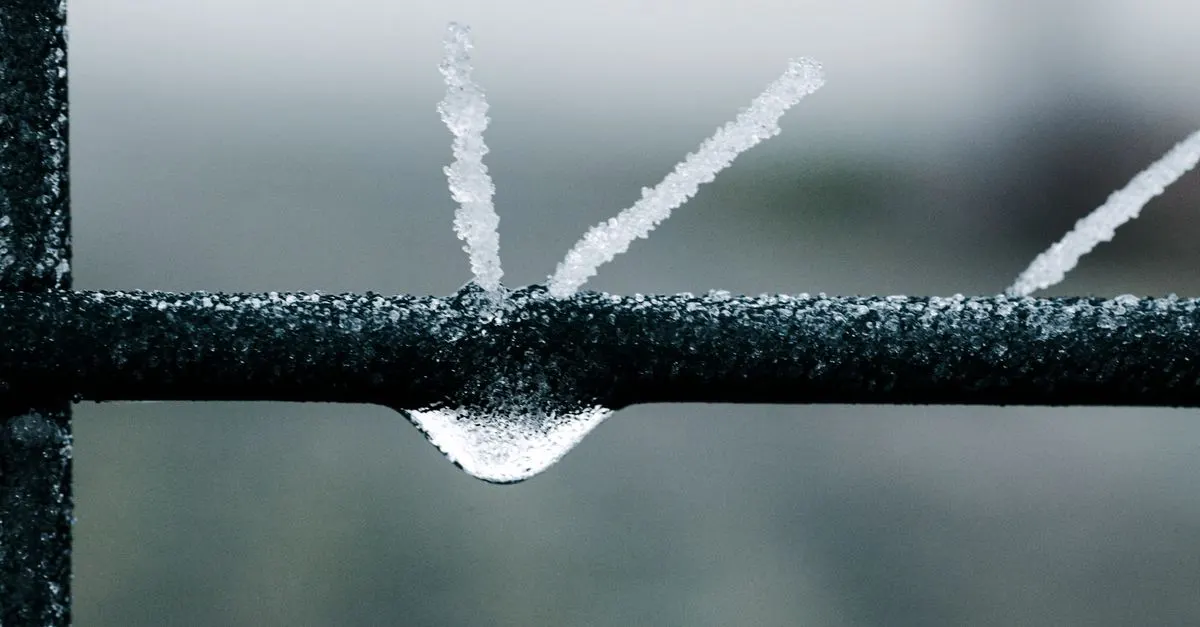
Everyone knows the scene. A dead-of-winter playground, a frozen flagpole, a triple-dog-dare, and one kid who is about to learn some physics the hard way. The tongue goes on, the tongue does not come off, and the bell rings with him still attached. It is a great gag because it is completely true. A warm, wet tongue really will weld itself to cold metal, and the reason is the same one that makes a metal railing feel so much colder than the wood beside it.
Your tongue freezes to the metal because the metal steals heat faster than you can replace it
Your tongue sticks to cold metal because metal is such a fast heat conductor that it drains warmth from your wet tongue quicker than your body can resupply it, and the thin film of saliva freezes into ice that bonds the two surfaces together. As Gizmodo puts it, the metal is "literally sucking the warmth from your tongue faster than your body can supply it" (Gizmodo). Your tongue is coated in saliva, which is almost entirely water. Chill that water past its freezing point and it does what water always does. It turns to ice.
The key word is fast. Your body is constantly pumping warm blood into your tongue, trying to hold it at a comfortable temperature. Touch something mildly cool and your blood wins easily, keeping the surface above freezing. But metal is in a different league at moving heat. The moment your tongue lands on a below-freezing pole, heat pours out of it so quickly that your blood supply loses the race, and the saliva at the contact point drops below freezing before your body can rescue it.
The ice grips the pores of both surfaces
Once that film of spit freezes, you are no longer touching metal. You are touching ice, and the ice is touching you. Saliva does not freeze as a smooth pane of glass. It freezes down into the microscopic pits and pores on the surface of your tongue and on the metal, then sets solid. Now you have ice keyed into both surfaces at once, like grout that has hardened in the gaps of two facing tiles. As earth.com describes it, "the thin layer of moisture on the tongue freezes almost instantly," and that frozen layer becomes the glue (Earth.com). Your tongue is unusually good at getting caught because it is soft, very wet, and riddled with tiny crevices for the ice to grab.
This is also why the metal has to be genuinely below freezing. A cold-but-not-frozen pole on a brisk autumn morning will feel unpleasant and pull heat from your tongue, but it cannot freeze the saliva, so nothing bonds. Drop the metal below the freezing point of water and the same touch becomes a trap.
Why metal and not wood
A wooden fence post in the same yard, at the same temperature, will not catch your tongue, and that is not luck. Wood is a poor heat conductor, well over a hundred times worse than steel at moving warmth around. Touch frozen wood and it sips heat from your tongue slowly enough that your blood keeps pace and the saliva stays liquid. Metal drains heat hundreds of times faster, fast enough to win before your body reacts. It is the exact same property behind why a metal table leg feels colder than the wooden top, only here the consequence is a frozen tongue instead of a sensation. Anything that conducts heat well and sits below freezing will do it: a swing-set chain, a steel gate latch, an ice cube tray, the metal of a car door handle.
The safe way to get free
If it happens, do not pull. The frozen bond is strong, and yanking does not break the ice cleanly. It rips the soft tissue of your tongue instead. One experiment using pig tongues found that pulling tore the tissue in 54 percent of attempts, and the harder the pull, the worse the tear (Earth.com). The fix is heat, not force. Pour warm (never hot) water over the spot where your tongue meets the metal, or have someone breathe warm air onto it. The warmth melts the ice that is doing the gluing, and within a few seconds the tongue slides off on its own, no harm done (Earth.com). In a pinch, even your own warm saliva or breath, given a little patience, will thaw the bond.
So the dare from the movie is real, and so is the lesson. There is nothing magic or sticky about cold metal. It is just very, very good at pulling heat, and a tongue is just very, very wet. Put the two together below freezing and the water in between does the only thing it can. Like the ice cube that floats in your drink, it is ordinary water following ordinary rules, right up until it has your tongue.
Keep wondering: the same heat-flow trick explains why metal feels colder than wood when both are the same temperature, why salt melts ice on a frozen sidewalk, and why mint feels cold in your mouth even though nothing got colder.




Join the conversation
Comments are reviewed before they appear. Be kind and stay curious.
Loading comments…