
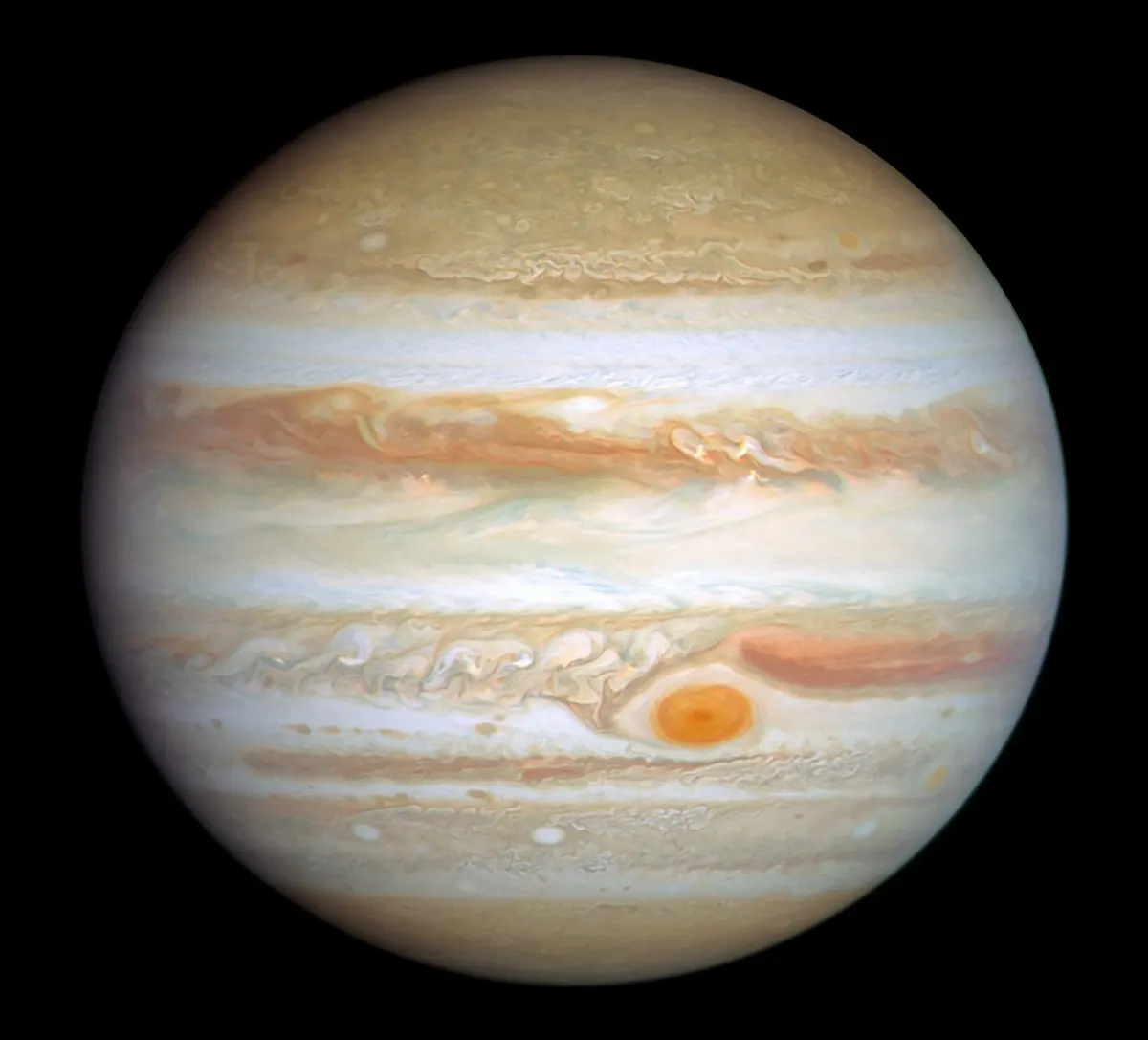
Ask how many moons Jupiter has and you will get a different answer depending on the month. In 2023 the standard figure was 95. By March 2026, NASA's official tally had climbed to 101, and within weeks another batch of discoveries pushed the working catalog to 115. The planet did not grow any moons. We just keep finding ones that were always there, faint and far out, waiting for a sharp enough telescope.
Jupiter has 101 officially recognized moons, and the count keeps rising
Jupiter has 101 moons officially recognized by the International Astronomical Union as of March 2026 (NASA Science). The very latest catalog, kept by the IAU's Minor Planet Center, lists 115 known moons as of April 2026 after 18 small ones were confirmed that spring (Wikipedia). Whichever number you use, the shape of the answer is the same: four of those moons are real worlds, and all the rest are tiny.
That gap between "101 officially recognized" and "115 known" is not a contradiction. It is the lag between spotting something and signing off on it. A new object has to be tracked across multiple nights, its orbit pinned down, and its discovery checked before the IAU formally adds it to the list. So the recognized count trails the raw count of objects astronomers are confident about. Both keep climbing.
Four worlds, and a swarm of leftovers
Here is the part the headline number hides. Jupiter's moons split into two completely different populations.
At the top sit the four Galilean moons: Io, Europa, Ganymede, and Callisto. Galileo Galilei found them with a homemade telescope in 1610, and seeing four points of light circle another planet was one of the first hard blows against the idea that everything orbits Earth. These four are huge. Together they hold roughly 99.997 percent of all the mass orbiting Jupiter (Wikipedia). Everything else, all 90-plus other moons, makes up the remaining sliver.
Those others are not worlds in any familiar sense. The non-Galilean moons are all less than 250 kilometers across, and most are far smaller than that, lumpy chunks of dark rock a few kilometers wide. Many of the newest finds are only about three kilometers in diameter, the size of a small mountain. They orbit on wide, tilted, often backward paths, which is the giveaway that Jupiter did not make them. It caught them.
Why the number keeps going up
Jupiter is the heavyweight of the solar system, more than twice the mass of every other planet combined, and that gravity is a net. Over billions of years it has snagged passing asteroids and comet fragments and pulled them into long, loose orbits. These captured objects are what astronomers call irregular moons, and they are the reason Jupiter's tally has no obvious ceiling.
Finding them is the hard part. A three-kilometer rock half a billion kilometers away reflects almost no sunlight, so these moons sit at magnitudes around 22 to 26, far too dim for the eye or a backyard scope. They only show up in long exposures on the largest survey telescopes, and even then they look like faint smudges drifting against the stars. As detectors improve and new sky surveys come online, the smudges that used to slip through keep getting caught (EarthSky).
So when someone says Jupiter gained moons in 2026, that is not quite right. The moons were already there. What changed is that we finally had a camera good enough to see them. There is no reason to think 115 is the end of it.
The four that matter: each one is strange in its own way
Strip away the swarm and you are left with four moons worth knowing by name, because each is a destination in its own right.
Io is the most volcanically active world in the solar system, dotted with hundreds of volcanoes, some throwing lava fountains dozens of kilometers high (NASA Science). It is yellow and orange and constantly resurfacing itself, a moon that looks like a pizza left too long in the oven. Why a moon should be this geologically violent is the best story in the whole system, and I will get to it.
Europa is the quiet one with the secret. Beneath a shell of ice, NASA reports strong evidence of a saltwater ocean holding about twice as much water as all of Earth's oceans put together (NASA Science). That makes it one of the most promising places to look for life beyond Earth, which is exactly why the Europa Clipper spacecraft was sent to study it. A frozen moon smaller than our own may be hiding the largest body of liquid water in the inner solar system.
Ganymede is the giant. At about 5,260 kilometers across it is the largest moon in the solar system, bigger than the planet Mercury, and it is the only moon known to have its own magnetic field (NASA Science). That field wraps the moon in the same kind of invisible force that makes a compass needle swing and lights up auroras around its poles. Ganymede, too, is thought to hide an underground saltwater ocean, possibly more water than sits on Earth's whole surface.
Callisto is the battered elder. It is Jupiter's second-largest moon and one of the most heavily cratered objects we know of, a surface so ancient and undisturbed that it has barely changed in billions of years. If Io is constantly repaving itself, Callisto is the opposite: a frozen record of every impact it ever took, much like the way our own Moon keeps its scars.
Io is squeezed until it melts
Io should not be on fire. It is a rocky ball roughly the size of our Moon, and a body that small should have cooled into something dead and quiet long ago, the way our Moon did. Instead it is the most volcanic place we have ever found.
The reason is a gravitational tug-of-war. Io is caught between Jupiter's enormous pull on one side and the precisely timed pulls of Europa and Ganymede on the other (NASA Science). Those competing forces stretch and flex the moon as it orbits, kneading it like a stress ball. The internal friction from all that flexing, called tidal heating, generates so much heat that Io's interior partly melts and erupts. It is not heat left over from when the moon formed. It is heat being manufactured right now, every orbit, by Jupiter squeezing one of its own moons.
That single mechanism explains the whole split between Jupiter's two moon populations. The four big ones are close enough and massive enough to be worked over by Jupiter's gravity into active, oceans-and-volcanoes worlds. The hundred small ones are too distant and too light to feel any of it, so they stay frozen and inert, just orbiting in the dark.
The honest answer to how many moons Jupiter has is that the question has a moving target for an answer. Pick a date and you can give a number, but the number is really a measure of how good our telescopes were that year. What does not move is the gap between the four worlds and everything else: a giant planet with a handful of moons remarkable enough to send spacecraft to, surrounded by a slowly growing cloud of rubble it caught and never let go. Somewhere out there, right now, are Jovian moons nobody has photographed yet.
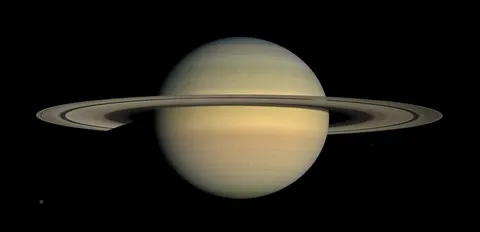
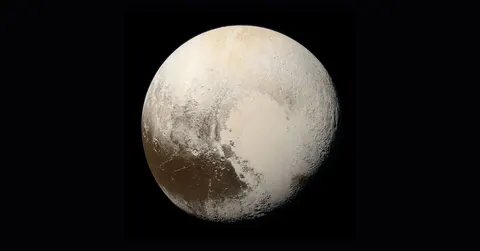
Keep wondering: find out what Saturn's famous rings are actually made of, why Pluto got kicked out of the planet club, and how the Moon ended up so heavily cratered.
Join the conversation
Comments are reviewed before they appear. Be kind and stay curious.
Loading comments…