
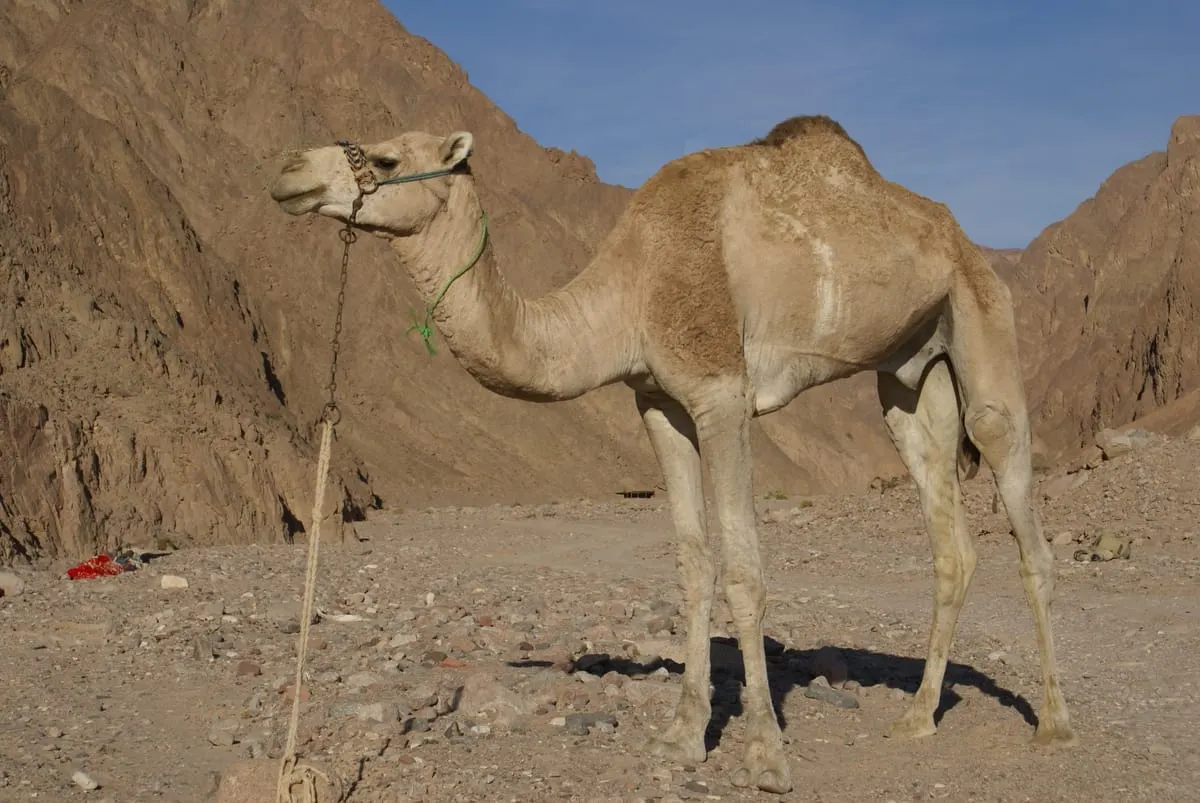
Almost everyone learns the same fact about camels in school, and almost everyone learns it wrong. The hump, we are told, is where the camel stores water for the long trek across the desert. It is one of those tidy animal-shape stories that turns out to be wrong, in the same family as the idea that giraffes grew long necks just to reach tall leaves. It is a tidy story. It is also false, and the truth is more interesting than the myth.
Fat, not water
So why do camels have humps, if not to carry water? To carry fat. The hump is a dense reserve of fat, an energy bank the camel draws on when there is nothing to eat (Library of Congress). In a place where a meal might be days or weeks apart, that stored fuel is what keeps the animal going. With a full hump, a camel can survive for months on very little food (Live Science). The hump is a fuel tank, not a canteen.
You can actually read the gauge. As a camel uses up the fat, the hump deflates and flops over to one side instead of standing tall, then refills once the animal eats well again (San Diego Zoo). A drooping hump is a camel running low. And the count gives away the design: a dromedary carries one hump, a Bactrian camel carries two, but in both it is the same thing, fat held in reserve.
The clever part is keeping the fat in one place
There is a second reason the fat sits in a hump rather than spread under the skin, and it is probably about heat, not hunger. One leading explanation is that a thick layer of fat all over the body would act like a winter coat, trapping warmth the camel needs to shed in the desert sun. By piling its fat into one hump instead, a camel may keep the rest of its body leaner and better able to lose heat (Live Science). The hump is insulation parked where it does the least harm.
This is also where the water myth sneaks back in, dressed up as science. Burning fat does release a little water as a byproduct, which sounds like it might justify the old story. It doesn't. In desert heat, pulling in the extra oxygen needed to burn that fat makes the camel breathe out more water than the reaction produces, so the trade runs at a loss (FAO). The fat is for energy. The faint dribble of "metabolic water" is a rounding error, not a survival strategy.
So how does a camel actually beat thirst?
If the hump is not the secret to going without water, what is? A different toolkit entirely. A dehydrated camel can drink a staggering volume in one go, refilling its body in a single long session at a water hole (San Diego Zoo). Between drinks, it hoards what it has: its urine comes out thick and concentrated, its droppings are nearly dry, and it lets its body temperature climb through the day instead of sweating the moisture away. Each of those is a small water-saving trick, and together they let a camel cross ground that would kill most mammals.
Notice that none of it involves the hump. The animal we built an entire myth around for its water turns out to manage water everywhere except the famous lump on its back. The hump was never the canteen. It is the lunchbox, and the camel just happens to wear it where we could all see it and guess wrong.
Keep wondering: another animal turns heat management into a party trick in why flamingos stand on one leg, desert engineering shows up again in how snakes move without legs, and the body's own cooling system is the whole story behind why dogs pant.
Join the conversation
Comments are reviewed before they appear. Be kind and stay curious.
Loading comments…