
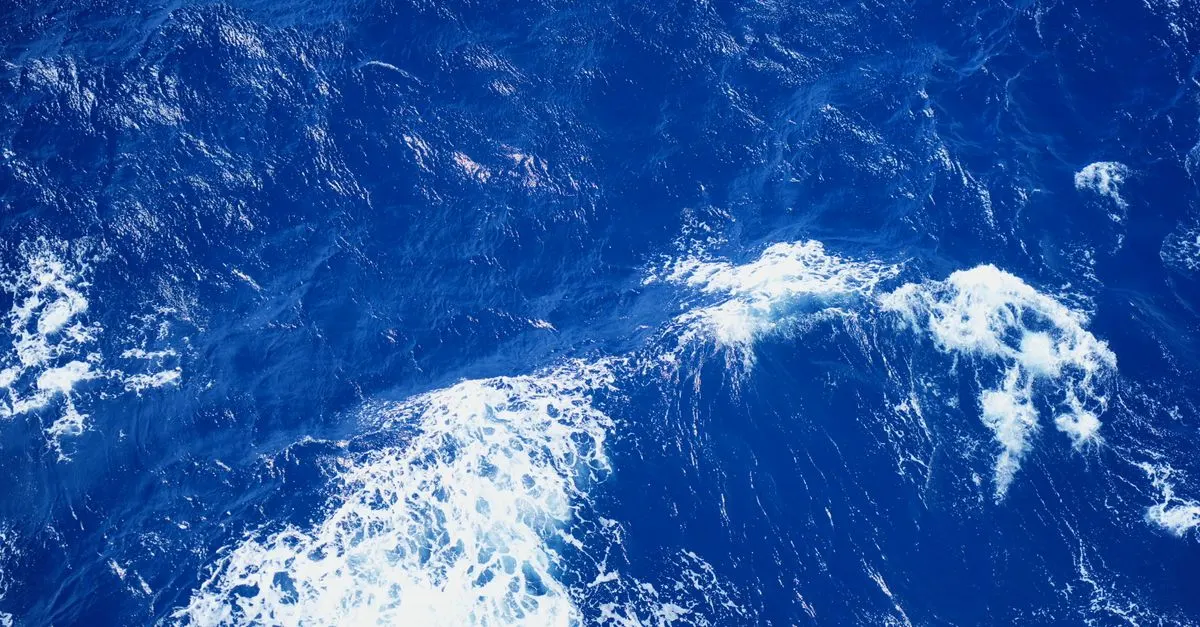
Everyone learns the same tidy answer as a kid: the ocean is blue because it reflects the blue sky. It sounds obvious, it feels right, and it is wrong. Scoop a deep enough bathtub of perfectly clean water under a cloudy gray sky and it will still come out faintly blue. The sky is not doing the work. The water is.
The water absorbs red light and keeps the blue
The ocean is blue because water itself absorbs the red end of sunlight and lets the blue end through. White sunlight is a mix of every color, and as it sinks into the sea the water acts like a filter, absorbing colors in the red part of the spectrum and leaving behind the blue part for us to see, according to NOAA. Reds, oranges, and yellows get soaked up fast. Blue is what survives, scatters around, and bounces back to your eye. That blue is a property of the water, the same way grass is green or a lemon is yellow. It is not borrowed from the sky.
The sky does chip in a little. At a low, glancing angle the surface behaves partly like a mirror, so a calm sea on a clear day can pick up some of the sky's color. But that reflection is a thin top layer on an effect that runs all the way down. Strip the sky away entirely and deep clean water is still blue.
Why the sky-reflection idea refuses to die
The myth survives because the sky and the sea really do look blue together, so it is easy to assume one is copying the other. Scientific American puts the relationship plainly: the color of the ocean and the color of the sky are related but occur independently of each other. They reach the same blue by two different routes. The sky is blue because tiny air molecules scatter short blue wavelengths in every direction, which is the story behind why the sky is blue. The ocean is blue because water absorbs the long red ones. Same end color, completely different mechanisms.
The clean test is to remove the sky. A crevasse in deep glacier ice glows blue. A thick column of pure water in a white-lined tank glows blue. There is no sky overhead in either case, and the color shows up anyway. The blue was never a reflection. It was always the water.
What "absorbing red" actually means down in the molecules
Here the story gets stranger than the textbook version. Most colored things you know, a ruby, a leaf, a stop sign, get their color from electrons jumping between energy levels when light hits them. Water does not. Water's blue comes from the molecule physically vibrating.
An H2O molecule is two hydrogens bonded to an oxygen, and those bonds stretch and bend like springs. When a particle of red light hits the water, its energy gets used up setting those bonds into highly excited vibrations, what physicists call high overtone and combination states of the molecule's nuclear motions. The red photon is absorbed; the molecule jiggles harder. Blue light, with the wrong energy to trigger that jiggle, passes through untouched. This is the explanation the chemists Charles Braun and Sergei Smirnov established, and the takeaway is simple: because the absorption is in the red end of the spectrum, one sees blue, the complementary color.
What makes this genuinely rare: blue water is the only known example of a natural color caused by vibrational transitions. Almost every other color in nature comes from electrons. The ocean's blue comes from trillions of water molecules shaking off the red part of the sunlight.
There is even a way to prove it. Heavy water, the same molecule but with heavier hydrogen atoms, vibrates more slowly, so its absorption shifts out of the visible range and heavy water comes out colorless. Make the springs heavier and the blue disappears. That is about as direct as evidence gets that the color is the vibration.
Why one ocean is navy, the next is turquoise, the river-mouth is brown
If the blue belonged to the sky, the ocean would be roughly one shade everywhere the sky is clear. It obviously is not, and the reasons all come back to the water and what is floating in it.
Depth is the first knob. Red light gets absorbed within the first few meters, so the longest wavelengths vanish first and only blue and violet penetrate deep, per Woods Hole. The deeper and clearer the water, the more thoroughly the reds are stripped and the more intense the blue. The open ocean's near-black navy is just a very long filter doing a very complete job, which is part of how dark it gets at the bottom of the ocean.
Shallow tropical water flips that. The light only travels through a thin layer, so not every red wavelength is gone yet, then it bounces off the sandy bottom and turns the water a brilliant blue. Short trip plus bright floor is what gives you that postcard turquoise.
Then there is the stuff in the water. NOAA notes the sea can take on green, red, or other hues as light bounces off floating sediments and particles. Phytoplankton are the big one. These drifting microbes carry green chlorophyll that absorbs some wavelengths and reflects others, so a bloom can turn whole stretches of sea green or even reddish. Silt and sand washing off the land reflect the longer wavelengths and turn the water brown. The bluest water on Earth, the clear open tropics, is blue precisely because it is nearly empty, with almost nothing in it but water doing its quiet trick on the sunlight.
So the color of the sea is really a readout of what is dissolved and drifting in it, from plankton to the mineral salt that is why the ocean is salty. Sailors and satellites both use it that way: a hue map of the ocean is a map of where life is blooming and where rivers are dumping their mud. The blue is the baseline, the water being water. Everything off-blue is a fingerprint of something else riding along.
Next time someone tells a kid the sea is blue because it mirrors the sky, you can hand them the better answer. The water is not copying anything. Down in every drop, the molecules are catching the red light and shaking it off, and the blue that is left is the ocean's own.
Keep wondering: the sky pulls its blue from a totally different trick in why the sky is blue, the same absorb-and-scatter logic explains why your veins look blue under your skin, and once you are picturing all that water in motion, see what actually makes ocean waves.



Join the conversation
Comments are reviewed before they appear. Be kind and stay curious.
Loading comments…