
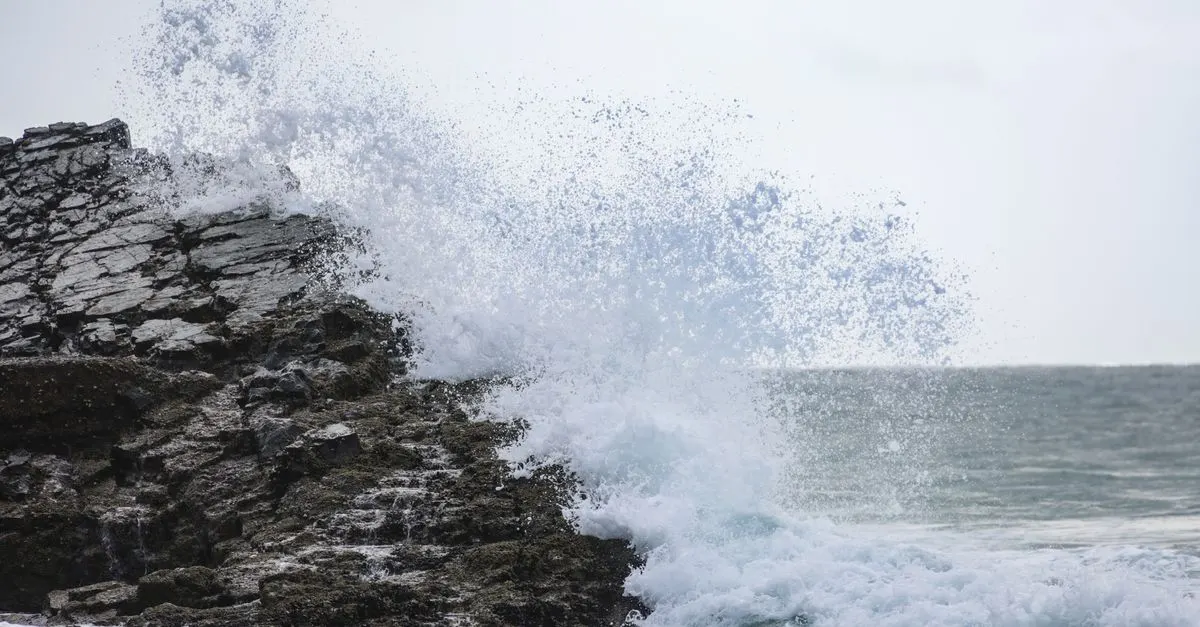
Take all the salt dissolved in the ocean, lift it out, and spread it evenly over the planet's land, and it would pile up more than 500 feet deep, about the height of a 40-story building. All those dissolved ions also make seawater a far better conductor than fresh water, which shapes what happens when lightning strikes the ocean. That salt has been gathering for billions of years, and almost none of it started out in the sea. So why is the ocean salty, when the rivers that pour into it every day run fresh enough to drink?
The ocean is salty because rivers wash dissolved rock into a basin with no drain
The ocean is salty because rain slowly dissolves minerals out of rock on land, rivers carry those dissolved salts to the sea, and evaporation takes the water back out while leaving the salt behind to build up over geological time (USGS). On top of that, hot vents on the seafloor add their own load of dissolved minerals. The result is water that's about 35 parts per thousand salt, meaning roughly 3.5 percent of its weight is dissolved salt. It's a slow accumulation, not a single event. The ocean has simply been collecting salt for a very long time.
How rain turns into salt: rock, acid, and rivers
It starts in the sky. Rain isn't pure water. As it falls, it picks up a little carbon dioxide from the air, which makes it slightly acidic due to carbonic acid. That mild acid is the key. When this faintly sour rain lands on rock, it does two jobs at once: it physically wears the rock down, and it chemically attacks it, breaking minerals loose.
Those freed minerals don't stay as solid grit. They dissolve into the water as ions, electrically charged particles small enough to travel invisibly in solution. The rainwater, now carrying its mineral cargo, trickles into streams and rivers and then to the ocean. Every river on Earth is doing this, every day. Add it all up and rivers deliver an estimated four billion tons of dissolved salts to the ocean annually.
The two ions that dominate are chloride and sodium, the exact pair that make up ordinary table salt. Together they account for over 90 percent of all the dissolved ions in seawater, which is why the sea tastes like a watery version of what's in your kitchen shaker.
Why the rivers stay fresh while the sea turns salty
Here's the part that trips people up. If rivers are constantly dumping salt into the ocean, why don't the rivers themselves taste salty?
They actually do carry salt, just in amounts far too small to notice. The difference is what happens next. Rain keeps refilling rivers with fresh water, so the trickle of salt never gets a chance to concentrate. A river is a moving conveyor belt, always being topped up and always emptying out.
The ocean is the opposite. It's the end of the line, the basin that collects all of the salt and minerals from all of the rivers that flow into it, with no river leading back out. Salt checks in, but it can't easily leave. So while any single river stays fresh, the place all of them drain into keeps getting saltier.
Then evaporation does the concentrating. The sun heats the surface and lifts water into the air as vapor, which eventually falls back as rain to start the cycle again, the same hydrologic loop that feeds the rain in the first place. But evaporation is picky. It takes the water and leaves the salt sitting in the sea. Fresh water cycles in and out; salt just piles up.
The salt that comes from below, not above
Rivers get most of the credit, but they aren't the only supplier. A surprising amount of ocean salt is delivered from underneath, by the seafloor itself.
In places where Earth's crust is cracking apart, ocean water seeps down into the cracks and gets heated by magma. Superheated and chemically aggressive, that water strips metals and minerals straight out of the surrounding rock, then jets back up through hydrothermal vents loaded with dissolved iron, zinc, copper, and more. It's the same volcanic plumbing behind the eruptions that build new crust, only happening in the dark a couple of miles down. The continents weather salt into the sea from above; the seafloor leaches it in from below.
The part that surprises people: the ocean has held steady for tens of millions of years
You'd expect a basin that's been collecting salt for billions of years, with no drain, to keep getting saltier and saltier until it turned to brine. It hasn't. Ocean salinity has stayed close to the same for an enormous stretch of time.
The reason is that salt is also leaving, just not the obvious way. Some of it sticks to tiny clay particles that sink and settle into seafloor mud. Some gets locked into new minerals forming on the bottom. Some is pulled out by living things building shells and skeletons. And the same hydrothermal systems that add minerals also pull others out of the water. Add up all these exits, and they roughly match what rivers and vents bring in. Scientists call this a steady state: a substance is in balance when it's added and removed at about the same rate. By that math, the oceans have been in a steady state for at least 100 million years.
That changes the whole picture. The ocean isn't a bucket slowly filling with salt. It's more like a sink with the tap running and the drain open at the same time, holding a steady level. The turnover is glacially slow: at the rate rivers deliver it today, it would take about 70 million years just to double the sodium already dissolved in the sea. An atom of salt washing off a mountain today could still be drifting in the water long after that mountain is gone.
So the saltiness you taste isn't the leftover of one ancient flood or a number still climbing toward some limit. It's a balance held in place across deep time, rivers and vents feeding salt in at one end while clay, rock, and living shells quietly carry it out the other. The ocean is salty for the same reason a river is fresh: it's all about what flows in, what flows out, and what gets left behind when the water turns to vapor and floats away.
Keep wondering: if the sea fascinates you, find out why the ocean looks blue when the water in your hand is clear, what actually sets the waves rolling, and why ice floats on top of all that salt water instead of sinking.
Join the conversation
Comments are reviewed before they appear. Be kind and stay curious.
Loading comments…