
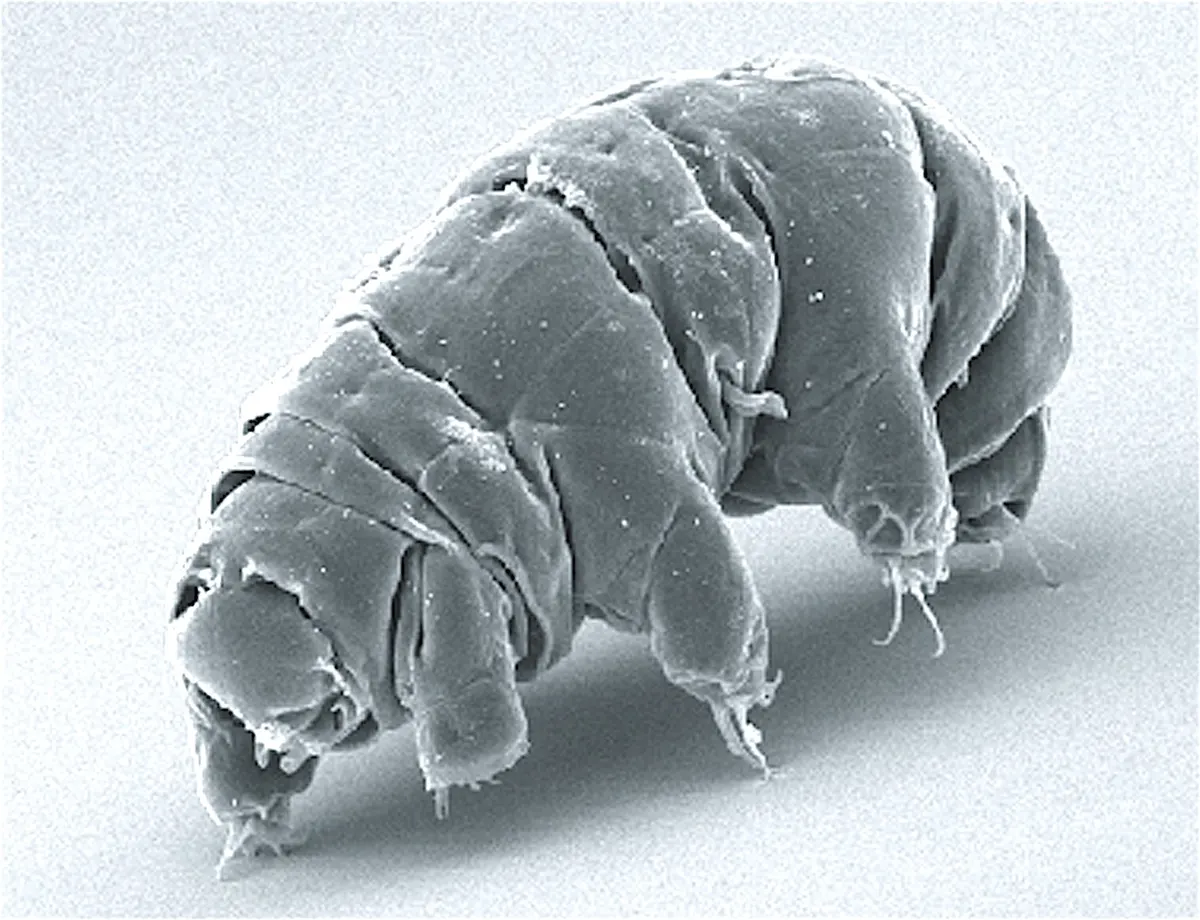
The toughest animal on Earth dies of old age in about six weeks. Everything you have heard about what a tardigrade can live through is true, and not one bit of it makes it immortal. Put one in a dish of clean water, with plenty of food and nothing hunting it, and it will die of nothing in particular inside about six weeks. Both of those sentences are true, and the gap between them is where the immortality myth lives. So are tardigrades immortal? No. The reason why is stranger than a yes would have been.
Tardigrades die of old age, and it does not take long
Tardigrades are not immortal. An active, hydrated water bear is an ordinary short-lived animal: it ages, it wears out, and it dies, usually inside a couple of months. What makes it look deathless is a dormant state called the tun, in which its metabolism drops so close to zero that the calendar stops applying. That is a pause, not an escape. The clock comes off the wall for a while and then goes straight back up, still ticking, still counting down.
The only proper life-history study ran out at 58 days
The number people actually want is a lifespan, and it is surprisingly hard to find, because almost nobody has watched a tardigrade from hatching to death. One researcher did. In a 2003 study in Zoological Science, Suzuki reared the carnivorous tardigrade Milnesium tardigradum on agar plates at a constant 25 C, fed daily on rotifers, and tracked the animals through their entire life cycle. They matured at the third instar. The fastest developer laid its first clutch 12 days after hatching. Fourteen females produced 343 eggs between them, in 50 clutches averaging 6.9 eggs each.
The longest-lived female made it to 58 days after hatching, laying 41 eggs along the way. The average across all individuals raised in that colony was 40 days.
Forty days. Fed on schedule, at a comfortable temperature, in a dish with no predators, no drought, and no competition. That is the best case, not the worst one. Plenty of insects outlive that without anyone calling them indestructible. A tardigrade in a real patch of moss, stabbing plant cells and sucking out the contents between dry spells, does not get such an easy run.
There is a caveat, and it matters. Nobody knows the lifespan of a wild tardigrade, because wild tardigrades keep vanishing into dormancy. Animal Diversity Web notes the speculation that several rounds of drying out could stretch a water bear across more than six years of calendar time. Six years. That is the generous, hypothetical, spent-most-of-it-unconscious estimate for the animal the internet keeps calling immortal.
The tun stops the clock, it does not smash it
When the water goes, a tardigrade pulls in its legs, expels almost all of its body moisture, and curls into a barrel-shaped husk. The chemistry of that trick, the protective sugars and the glass-like proteins that hold its cells in place, is a story in itself. For the immortality question, only the arithmetic matters.
Ageing is damage that accumulates while you run. Oxidation, misfolded proteins, broken DNA, the slow cost of being a chemical reaction. Stop the reaction and you stop the bill. A tun is not aged by the years it spends dry, in the same way that a paused film is not made longer by the time you leave the room. Time passes for the moss. It does not pass for the animal inside it.
Frozen in 1983, crawling again in 2014
The case that launched a thousand headlines is a good one, and it is worth getting right. In Cryobiology in February 2016, Megumu Tsujimoto, Satoshi Imura, and Hiroshi Kanda reported reviving tardigrades from an Antarctic moss sample collected in November 1983 and kept at -20 C ever since. The sample was thawed in May 2014, after 30.5 years. Two individuals of the species Acutuncus antarcticus recovered, and one egg hatched. The previous verified record for a frozen tardigrade was 8 years.
Read the fine print, though. One of the two revived animals, SB-1, needed about two weeks before it could crawl and eat properly. It then laid 19 eggs, of which 14 hatched, and the first one took 19 days to do it, far longer than normal. The other animal, SB-2, never fully recovered and died 20 days after rehydration. One of the two adults came back slow, the other did not really come back at all. The egg did better than either: it hatched into a juvenile that grew up with no damage anyone could see, and went on to lay eggs of its own.
And here is the part that gets skipped, and it applies to the healthy hatchling just as much as to the battered adult: SB-1 did not live for 30 years. It was absent for 30 years. When it woke up it had roughly the same handful of weeks left that any water bear gets, and so did the juvenile that had never been awake at all.
Even the pause has an expiry date
If dormancy were truly free, a tun would keep indefinitely. It does not. In PLOS ONE in 2023, Roszkowska and colleagues dried four tardigrade species and checked on them for up to 240 days, which is the closest thing we have to a controlled test of the question.
For the first 60 days, most species came back at better than 80%. At 120 days, two of them, Macrobiotus pseudohufelandi and Paramacrobiotus experimentalis, still managed 86 to 97%. Then the floor fell out. By 240 days, Echiniscus testudo returned at 3% and Pseudohexapodibius degenerans at 1%. The macrobiotids held on at 38 to 43%. Recovery also got slower the longer the animals stayed dry, though not in a neat straight line.
Eight months of dryness kills most of a population of the world's most indestructible animal. Note how far that is from the popular picture, in which a water bear waits out the centuries and strolls off unbothered. The authors are blunt about the folklore, too: the anecdotal reports of tardigrades reviving after 15 or 20 years were not made under strict laboratory conditions. The Antarctic moss worked for a different reason, and it is Tsujimoto's team who explain it: their sample sat at a steady -20 C, and they read the long survival as a consequence of the minimal oxidative damage that stable frozen storage allows. Dormancy is a preservative, not a guarantee, and preservatives have a shelf life.
An active water bear is killed by a warm afternoon
Here is the fact that ends the argument. Ricardo Neves and colleagues, writing in Scientific Reports in 2020, heated Ramazzottius varieornatus collected from roof gutters in Nivå, Denmark, and measured what it took to kill them. Desiccated specimens were formidable: 50% mortality at 82.7 C over a one-hour exposure. Stretch that to 24 hours and the figure dropped to 63.1 C.
Active, hydrated animals hit 50% mortality at 37.1 C. Acclimating them first bought 0.5 C.
Thirty-seven degrees is human body temperature. It is a hot afternoon in a rain gutter. The most famously unkillable animal on the planet, going about its normal business, dies at roughly the temperature of your own hand.
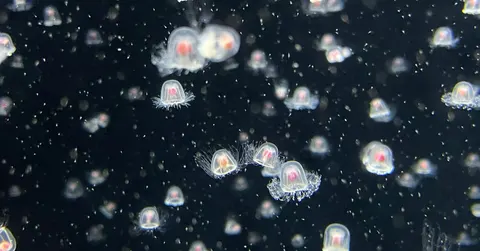
So no, tardigrades are not immortal, and the myth gets the achievement backwards. If you want an animal that genuinely refuses to age, the jellyfish that rewinds itself into a polyp is the one to look at, and if you want raw duration, that record belongs to clams and sponges. The water bear is playing a different game entirely. Its gift is not more life. It is the ability to be gone for thirty years and come back having lost nothing but the time.
Keep wondering: the tun is only half of what makes a water bear strange, the other half is how the mechanism actually works and what one eats when it is awake, and if it is real agelessness you are after, a jellyfish already solved it.
Join the conversation
Comments are reviewed before they appear. Be kind and stay curious.
Loading comments…