
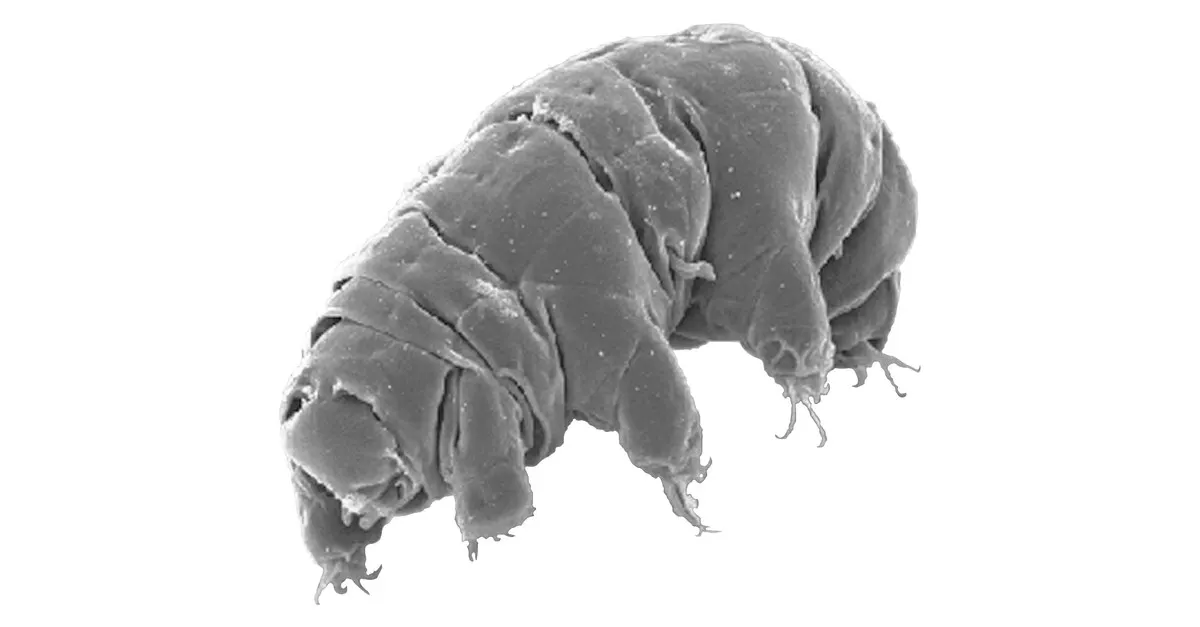
It's smaller than a grain of salt, looks like a chubby eight-legged gummy bear, and lives in the film of water on a patch of moss in your backyard. It is also, by almost any measure, the toughest animal that has ever lived. Scientists have frozen it, boiled it, blasted it with radiation, and flung it into the naked vacuum of space, and it came back to life. How do tardigrades survive space, an environment that kills almost everything else? Meet the tardigrade.
They shut down, and that saves them
Tardigrades survive space and other extremes by entering a death-like dormant state called a tun. They squeeze out nearly all their body water, all but switch off their metabolism, and flood their cells with protective molecules. In this suspended state they can endure vacuum, deep cold, intense radiation, and dehydration, then spring back to life when conditions improve. They aren't indestructible; they're masters of shutting down.
What a tardigrade actually is, and why drying out is its superpower
Tardigrades, nicknamed "water bears" or "moss piglets", are microscopic animals, usually less than a millimeter long, found everywhere from Himalayan peaks to deep-sea trenches to the moss on a city sidewalk. They normally live in water or in the thin layer of moisture around plants, where they feed by stabbing cells and sipping the fluid inside. And that's the catch: they need water to be active. So evolution handed them an extraordinary backup plan for when the water disappears.
When their environment dries out, a tardigrade pulls in its legs, expels up to about 95% of its body water, and curls into a shriveled, barrel-shaped husk called a tun. In this form its metabolism drops to a fraction of a percent of normal, so low it's barely detectable. The animal isn't dead, but it isn't really alive in the usual sense either. It's paused. And a paused organism is astonishingly hard to kill, because most things that harm life, heat damage, freezing ice crystals, chemical reactions, depend on an active, water-filled body to do their damage.
The survival toolkit
Going dormant is only half the story. Tardigrades also manufacture remarkable molecules to protect their cells while shut down.
As they dry out, they produce special sugars and a class of proteins unique to them. These molecules replace the missing water, forming a glass-like matrix inside the cell that locks delicate structures, proteins, membranes, DNA, in place so they can't unravel or shatter. It's a bit like packing fragile glassware in solid foam instead of loose in a box. When water returns, the matrix dissolves and the machinery of life clicks back on, sometimes within minutes.
They have a second trick for one of space's deadliest hazards: radiation. Tardigrades make a protein that physically shields their DNA, acting like a molecular umbrella against radiation that would shred the genetic code of most animals. Between dormancy and damage-control, they can shrug off doses of radiation hundreds of times higher than what would kill a human.
What they've actually survived
This isn't theoretical. In a 2007 experiment, scientists sent dried tardigrades into orbit and exposed them directly to the vacuum and radiation of open space for ten days. Many survived the vacuum, and some even produced healthy offspring afterward, the first animals ever shown to endure raw space and live. In the lab, tardigrades in the tun state have weathered temperatures near absolute zero, brief exposure to temperatures well above boiling, and pressures many times greater than at the bottom of the deepest ocean, the kind of pressure deep-sea fish are built to withstand.
Toughness that only works when you give up
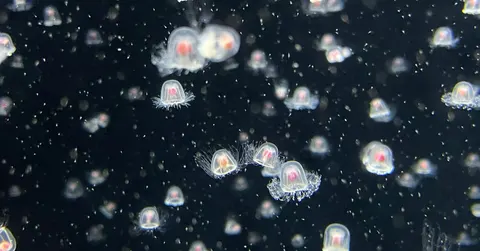
Here's the honest twist: a tardigrade going about its normal life is not especially tough. An active, hydrated water bear can be killed as easily as most tiny creatures. Its legendary invincibility only appears when it gives up on living, when it dries out, shuts down, and waits. Researchers have revived tardigrades from moss samples kept dry in a museum drawer for years. There are claims of specimens reanimating after decades. That still isn't true immortality, though, for an animal that genuinely cheats death, look to the jellyfish that can age in reverse. The lesson the toughest animal on Earth teaches is a strange and almost philosophical one: sometimes the way to survive the unsurvivable is not to fight it, but to stop, fold up, and patiently wait for the world to become livable again. The mightiest survivor in the animal kingdom wins by knowing exactly when to power down.
Keep wondering: tardigrades thrive in places that should be impossible, much like the creatures lurking where the ocean is deepest and darkest, some of which make their own light to survive.
Join the conversation
Comments are reviewed before they appear. Be kind and stay curious.
Loading comments…