
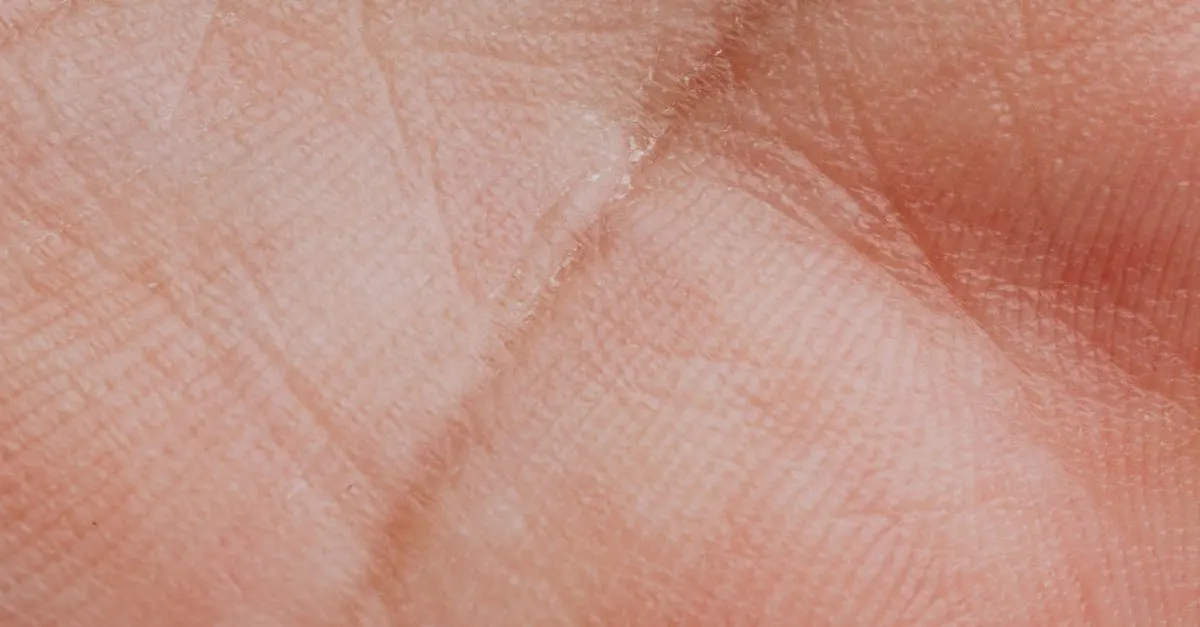
Two people can share every gene, the same face, the same stretch of DNA down to the last letter, and still leave different marks on a drinking glass. Identical twins are the closest thing nature makes to a copy of a person, so it feels obvious that the ridges on their fingertips would match too. They don't. Not exactly, and not even close enough to fool a fingerprint scanner.
No, and the reason is when fingerprints get made
Identical twins do not have the same fingerprints. They share almost the same DNA, which is why their prints tend to fall into the same broad family, the same arch, loop, or whorl, far more often than two unrelated people's do. But the precise pattern of ridges, the part that makes a print yours and only yours, isn't written in DNA at all. It takes shape in the womb, by chance, during a narrow window before birth (MedlinePlus Genetics). Your genes draw the blueprint. The womb prints the fine detail.
What your genes actually decide
Genes set the big structural facts of a fingerprint: the overall size, shape, and spacing of the ridges, and which of the three basic patterns your fingertip will carry (MedlinePlus Genetics). Because identical twins run on the same genetic code, they inherit the same starting plan, and it shows. In one analysis, identical twins shared the same fingerprint type about 74 percent of the time, against roughly 32 percent for fraternal twins (twin fingerprint study, PMC). At a glance, a twin's prints really do look like a sibling's.
That glance is where the resemblance ends.
What the womb decides
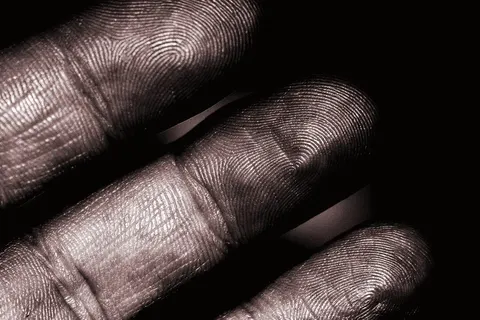
Fingerprints form early. The ridges begin developing in the third month of pregnancy and are fully set by the sixth (MedlinePlus Genetics). During that window, the skin on each fingertip grows in layers, and when the lower layer grows faster than the surface, the skin buckles and folds into ridges. Exactly where each ridge starts, stops, or splits comes down to the conditions around that one fingertip at that one moment: how the fetus is lying, how hard the uterine wall presses on the hand, the flow and density of the amniotic fluid, even the rate the finger bones are lengthening.
None of that is inherited, and none of it repeats. Twins share a uterus, but not an identical place inside it. They float in slightly different positions, press against different surfaces, move on their own schedules. Each fingertip is buckling under its own tiny weather system. The blueprint is the same; the printing conditions never are. That's why the minutiae, the ridge endings and the little Y-shaped splits called bifurcations, land in different spots on each twin.
A fingerprint scanner can tell them apart
Here's the detail that settles it. Researchers fed identical twins' prints to standard automatic fingerprint systems, the same kind used for security and ID, and the software told the twins apart almost as reliably as it told strangers apart, its error rate creeping up only slightly (twin fingerprint study, PMC). A machine that confuses two random strangers maybe six times in a hundred was tripped up by identical twins only a little more often. Shared DNA hands the software a harder puzzle, not an impossible one, because the fine ridge detail it keys on simply isn't the same.
So fingerprints sit in a strange category. Eye color, height, the shape of a face, all of these can be near-copies between identical twins. The pattern on a fingertip can't, because it was never really a genetic trait to begin with. It's a record of a place no one else has ever been: your own private corner of the womb, for a few weeks, before anyone knew your name. Why we have fingerprints at all is a separate question with its own surprising answer, but why yours are yours comes down to this. You weren't issued them. You grew into them, by chance.
Keep wondering: the body keeps other quiet records of how it was built, from why we have belly buttons to why people have different eye colors and why we have fingerprints in the first place.


Join the conversation
Comments are reviewed before they appear. Be kind and stay curious.
Loading comments…