
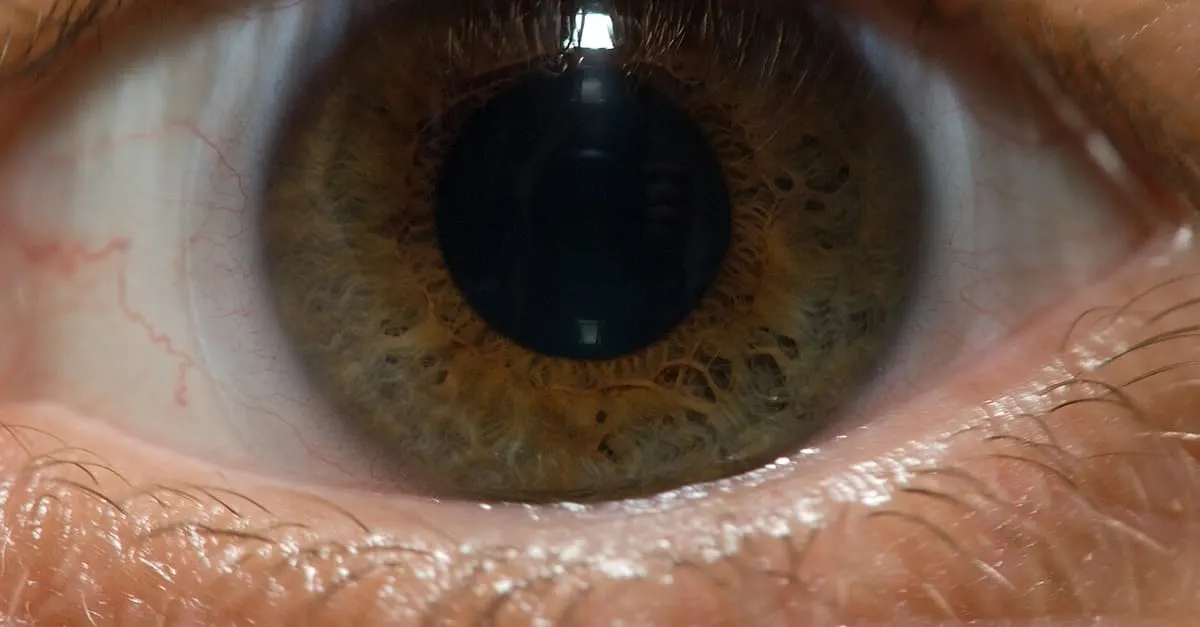
Line up ten faces and you will see brown eyes, blue eyes, a few greens, the odd hazel that can't make up its mind. Our eyes come in a wide range of colors, yet the color vision behind them is ordinary next to what a mantis shrimp carries. They look like completely different paint jobs. They are not. Almost the entire range of human eye color runs on a single brown pigment and a trick of light, and once you see how it works, "blue eyes" turn out to be one of the strangest illusions your body pulls off.
It is all one pigment, plus a trick of light
People have different eye colors because of how much melanin, a single brown pigment, sits in the front layer of the iris (MedlinePlus Genetics). That is the whole foundation. Pile in a lot of melanin and the iris drinks up most of the light that hits it, reflecting back a rich brown. Leave the front layer with little melanin and scattering becomes more visible. There is no blue dye in a normal human eye, while green and hazel appearances reflect a mixture of pigment and structure. More melanin or less of it, plus a bit of physics, creates much of the visible range.
Why brown is the planet's default
Brown is far and away the most common eye color on Earth, and that is because brown is the high-melanin setting. The pigment that browns an iris is the same melanin that colors skin and hair, and it does real work: high levels help shield the eye from the sun's stronger rays (American Academy of Ophthalmology). That protective edge is part of why brown eyes turn up most often in the hotter, sunnier parts of Africa and Asia, where strong light has been a constant for a very long time.
Brown is also the most common setting. The history of lighter eye colors is less certain than a single universal date suggests. A 2008 study proposed that a shared HERC2 variant associated with blue eyes arose roughly 6,000 to 10,000 years ago, but that is a hypothesis about one variant's emergence, not a verified census of every human at the time (University of Copenhagen study). It is the same melanin that darkens skin and hair, which is why a polar bear's skin is black for sun and warmth while ours tans.
Blue eyes are not blue at all
Blue eyes contain no blue pigment whatsoever (American Academy of Ophthalmology). The front layer of a blue iris has very little melanin, so more incoming light is scattered instead of absorbed. Short, tight blue wavelengths scatter the most strongly and bounce back toward you, while the longer reds get absorbed deeper in. The light that returns to your eye is missing much of its red and keeps more of its blue, and your brain reports "blue."
You have met this exact physics before. It is why the daytime sky is blue, and the Academy says outright that blue eyes get their color the same way water and the sky get theirs (American Academy of Ophthalmology). It is the same trick that makes veins look blue through your skin even though the blood inside is red. A blue eye is a structural color, built by scattering rather than by pigment. Strip the melanin out and the iris essentially becomes a tiny sky.
Green and hazel are the in-between cases. They have a modest amount of melanin layered over that same scattering, so the warm tint of the pigment and the cool blue of the scattered light mix into something greenish or amber-flecked. It is closer to why grass reads green than to any single green dye, a blend of what gets absorbed and what bounces back.
Why the inheritance is not a tidy chart
If you learned in school that brown beats blue in a simple one-gene game of dominance, you learned a useful fiction. Researchers used to think exactly that, but eye color turns out to be polygenic, run by many genes working together (MedlinePlus Genetics). Two of them on chromosome 15 do most of the heavy lifting. OCA2 carries the instructions for a protein that helps build and stock melanin, and a neighbor called HERC2 acts like a dimmer switch that turns OCA2's activity up or down (MedlinePlus Genetics). Quiet that switch and the iris makes less pigment, nudging an eye toward blue. A dozen or more smaller genes fine-tune the rest.
Because so many genes vote, the outcome is not perfectly predictable. MedlinePlus notes that although it is uncommon, two blue-eyed parents can have a brown-eyed child (MedlinePlus Genetics). The old chart usually works, but biology keeps the right to surprise you.
There is a lovely twist hiding in that HERC2 switch. A 2008 study from the University of Copenhagen proposed that many blue-eyed people share a HERC2 variant that may trace back to a common ancestor, probably 6,000 to 10,000 years ago (ScienceDaily). Blue-eyed people from Denmark, Turkey, and Jordan all carried the same small stretch of genetic code in the study, which supports a shared origin for that variant. It does not establish that every blue-eyed person descends from one single founder or that the date is settled.
The same pigment, dialed up and down
So the rainbow of human eyes is mostly an illusion of variety. Underneath, it is one brown pigment turned up to full for brown eyes, dialed almost to zero for blue, and parked somewhere in the middle for green and hazel, with light scattering doing the rest. We do not really come in many colors. We come in essentially one, and the eye's own structure invents the rest out of light.
If your eyes are blue, they run the same physics as a blue sky and as the veins that look blue under your skin. For a color that genuinely is a pigment story rather than a trick of light, grass is a good place to look.





Join the conversation
Comments are reviewed before they appear. Be kind and stay curious.
Loading comments…