
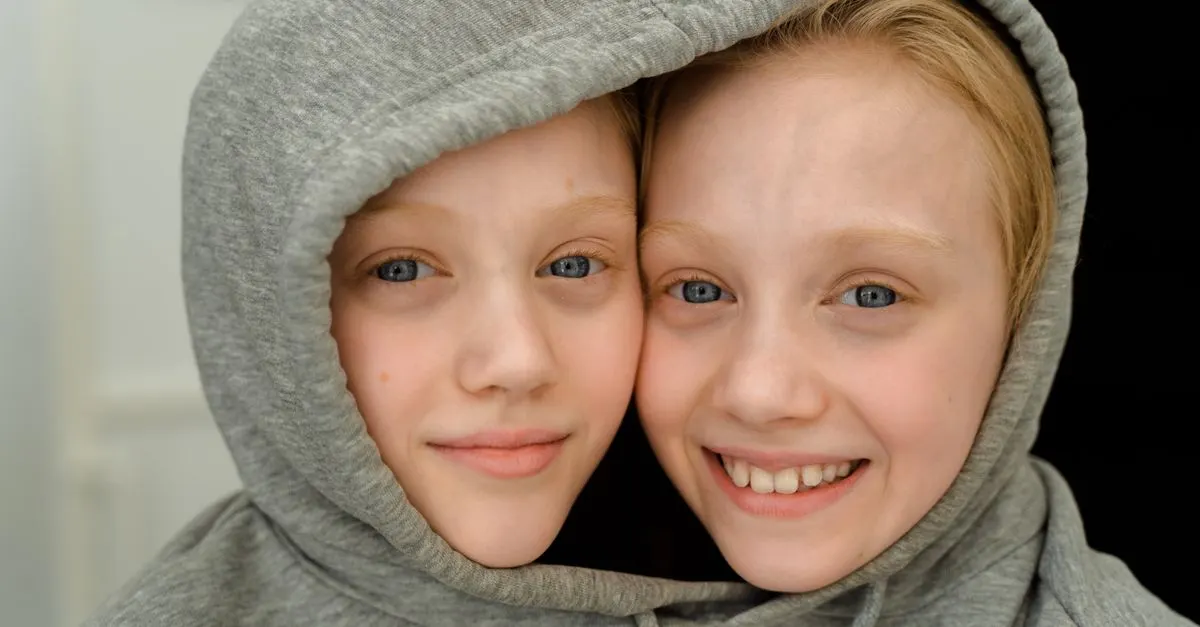
5.2. That is roughly how many DNA differences separate the average pair of identical twins, counted in mutations that appear within days of a single embryo splitting in two. Not zero. Do twins have the same DNA? Almost, and the size of that "almost" is the whole story. Which means the word sitting in front of "twins" has been quietly lying to all of us for about a century.
No, and the average gap is 5.2 mutations
Identical twins do not have the same DNA. They come from one fertilized egg that splits, so they start from the same genome, but they do not stay there. When deCODE Genetics sequenced 387 pairs of identical twins along with their parents, partners and children, the twins differed on average by 5.2 mutations that arose very early in development, and about 15 percent of pairs carried a substantial number of those mutations in only one twin (Jonsson et al., Nature Genetics, 2021). Near-identical is the honest description. Identical is marketing.
Fraternal twins are not close to the same question. They come from two eggs fertilized by two different sperm, so they share about 50 percent of their DNA, the same as any two siblings who happened to be born years apart (National Human Genome Research Institute). Everything below is about the identical kind, the ones that supposedly match.
"Identical" describes where they came from, not what they are
The technical word is monozygotic: one zygote, one fertilized egg, one starting genome. That is a claim about origin. It says nothing about what happens after.
And plenty happens after. A human body is built by cells copying themselves, over and over, for nine months and then for eighty years. DNA copying is extraordinarily good and still not perfect. Errors that you inherit from your parents sit in every cell you have; errors that happen later, during a cell division or after a bit of ultraviolet light, sit only in the cells descended from the one that made the mistake (MedlinePlus Genetics). The second kind are called somatic mutations, and everyone is carrying a private collection of them right now.
Twins are the only people on Earth where you can see that collection cleanly, because there is a control.
The 5.2 comes down to when the mistake happened
Picture the embryo a few days in. It is a small ball of cells, dividing, not yet two people. Somewhere in there a cell copies a stretch of DNA and gets one letter wrong.
Timing decides everything. If that error happens before the ball splits, and the mutated cell's descendants end up in both halves, both twins inherit it and they still match. If it happens after the split, or if the split parcels out the mutated lineage to one side only, that letter belongs to one twin forever. Every cell they grow from that point copies it faithfully. It is in their skin, their blood, their sperm or eggs.
That is what makes the deCODE work more than trivia. By sequencing the twins' parents and their children too, the team could work out which mutations existed before the twinning and which came after, and use them to trace how cells got handed out between the two embryos (deCODE genetics). The mutations became a timestamp. Read them right and you can reconstruct the first week of a person's life, decades later, from a blood sample.
What they read there was messier than the textbook picture. Sometimes a twin traced back to a single cell lineage in the pre-twinning cell mass. Sometimes a twin was built from several. The ball of cells does not divide down a neat seam into two equal teams; the cells get parceled out more or less at random, and how that lottery falls decides how far apart the two genomes start (Jonsson et al., Nature Genetics, 2021). Which is also why the 5.2 is only an average. Some pairs land much closer to a true copy. Some land considerably further.
There is a reason geneticists care about that number beyond curiosity. A century of twin research rests on treating identical twins as a natural experiment: same genes, so any difference between them must be the environment talking. If the genes are not quite the same on day one, that logic needs an asterisk. Small, but an asterisk.
Five letters out of three billion is nothing, statistically. It is also not nothing, because you only need one to land somewhere that matters.
The genome barely drifts, but the settings do
Sequence is only half of it. On top of the DNA sit chemical marks that decide which genes get read loudly, which get read quietly, and which get shut off entirely. Same text, different emphasis. That layer is epigenetics, and it does not hold still.
The clearest look at this came from a 2005 study of 40 identical twin pairs ranging from 3 to 74 years old. The youngest pairs were epigenetically similar. The oldest pairs were clearly distinct. In one comparison, the three-year-old twins had almost the same pattern of gene activity, while a fifty-year-old pair had, in the researchers' words, "extremely different expression profiles" (Fraga et al., PNAS, 2005). Fifty years of different food, different air, different jobs, different luck, all of it writing on the same book without changing a single letter.
So twins diverge on two tracks at once. A handful of typos in the text, and a lifetime of edits to how the text gets read. Neither one rewrites who they are, but together they explain why two people with one genome can end up with different heights, different health, and different faces at sixty.
None of this is the same as the fingerprint question, where twins genuinely do share every relevant gene and still get different prints, because fingerprint ridges are set by the random physics of the womb rather than by the genome at all. DNA and fingerprints diverge for completely different reasons. The fingerprints were never really genetic. The DNA was, and it still slipped.
A crime lab can tell them apart now
For decades, identical twins were a genuine hole in forensic science. Standard DNA testing looks at a couple of dozen locations in the genome, which is plenty to separate you from a stranger and useless for separating you from your twin. Both profiles come back the same. Cases stalled.
In 2014 a German lab closed the hole. Two identical twin brothers were in a disputed paternity case, and only one could be the father. The lab sequenced DNA from both twins' sperm and from the child's blood, deeply enough to catch mutations too rare for ordinary tests to see. It found five single-letter differences present in one twin and in his child, and absent in the other twin (Weber-Lehmann et al., Forensic Science International: Genetics, 2014). Those five letters were the answer. They had been sitting in the man's cells since he was a ball of cells, waiting.
Which is my favorite thing about this whole subject. The thing that finally distinguishes two identical twins is not their diet or their choices or the years they spent apart. It is a handful of typos made in the dark, in the first week, before either of them was a person, before there were even two of them to tell apart. Two brothers walked around assuming they were copies, and the proof they weren't had been written on day four. The same way why time seems to speed up as you get older or why some people are left-handed traces back to processes nobody chose, the line between two twins was drawn before anyone was watching.
Keep wondering: the body is full of small print nobody signed off on, from why identical twins have different fingerprints to why people have different eye colors and why some people are left-handed.

Join the conversation
Comments are reviewed before they appear. Be kind and stay curious.
Loading comments…