
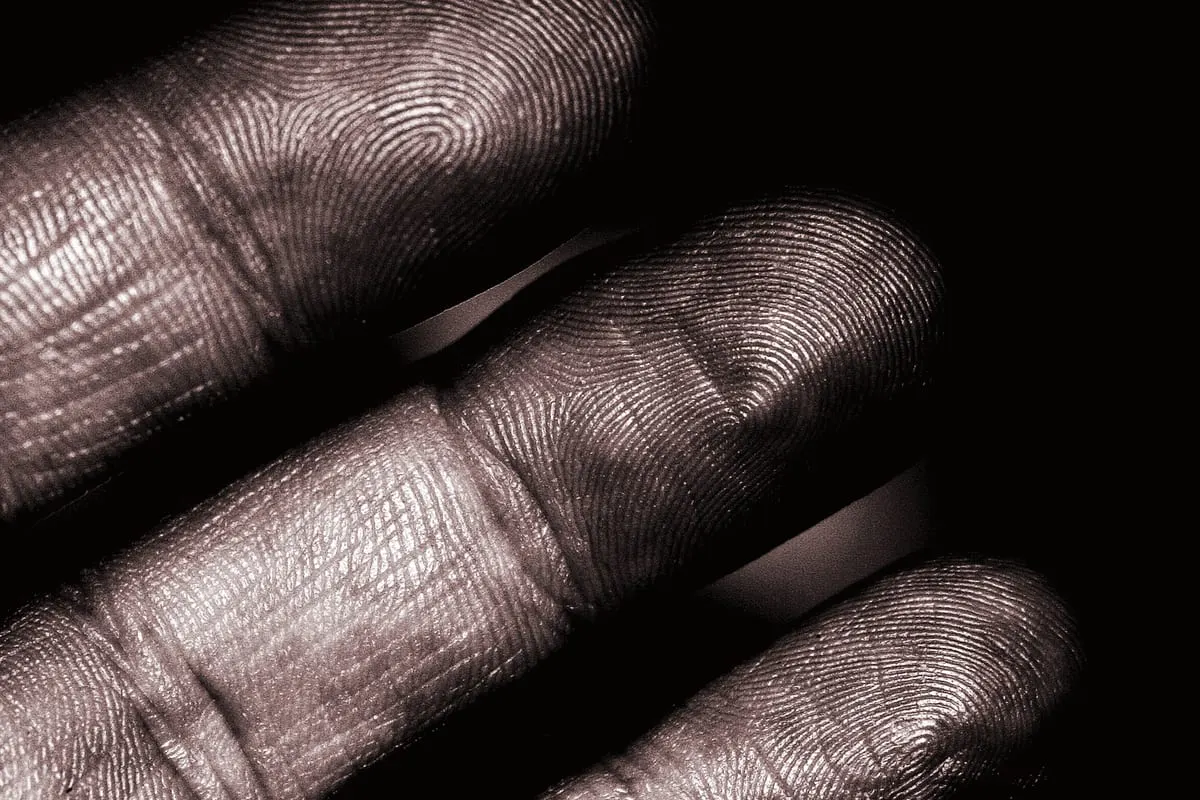
Press your thumb against a window and you leave behind a pattern no other human being on Earth shares, not even an identical twin. We are usually told these little ridges exist to help us grip. That answer, it turns out, is on shaky ground. Why do we have fingerprints, if not simply for grip? The real story includes a genuine, still-open scientific mystery hiding behind the most familiar thing on your own hand.
How a fingerprint gets drawn
Your fingerprints were finished before you were born, fully formed by about the sixth month of pregnancy (MedlinePlus). Earlier in that window, the deep basal layer of skin on each fingertip grows faster than the layers above and below it, and, caught in the squeeze, it buckles and folds into ridges, like a rug pushed against a wall.
A 2023 study finally worked out what choreographs those ridges. They form through a self-organizing chemical process, the same kind of reaction-and-spread system the mathematician Alan Turing proposed in the 1950s to explain patterns like leopard spots and zebra stripes. Three signaling molecules, in the shorthand WNT, EDAR, and BMP, push and pull on one another, and waves of ridge formation spread out from a few starting points on the fingertip. Where those waves collide decides whether you end up with an arch, a loop, or a whorl (Science News).
Why no two are alike
Genes set the broad outline, the rough size, spacing, and type of your pattern. But the final, intricate details are shaped by chance: exactly how your finger was positioned, the pressure on it, the timing of growth, the swirl of fluid around it in the womb. None of that is ever exactly repeatable.
That is why the classic test case fails so cleanly. As the NIH puts it, "even identical twins, who have the same DNA, have different fingerprints" (MedlinePlus). Same genome, different prints, because the pattern is finished by randomness, not just by DNA. And once set, it is yours for life: the ridges "remain the same throughout life," which is exactly what makes them so useful for identification.
So what are they actually for?
Here is where the familiar answer wobbles. For over a century, the assumption was simple: ridges add friction, friction helps you grip. Then researchers actually measured it. In tests dragging fingertips across smooth surfaces, the ridges turned out to reduce the skin's contact area by about a third, which would lower grip friction, not raise it (University of Manchester). The textbook explanation may simply be wrong.
The leading replacement idea is far more interesting: fingerprints are about feeling, not gripping. As your fingertip scans a surface, the ridges amplify and tune the tiny vibrations that travel into the skin. Those vibrations are picked up by sensors called Pacinian corpuscles sitting about two millimeters down, which are exquisitely tuned to exactly that range, sharpening your ability to feel fine texture (Scheibert et al.). Other live hypotheses include helping you grip wet surfaces by channeling water away, and protecting the skin so it can stretch without tearing.
The honest answer is that scientists have not settled it. We have known how to use fingerprints to catch criminals for over a hundred years, while only recently figuring out how they form, and still arguing about what they are for. It is a good reminder that some of the biggest unknowns are sitting right on the ends of your own fingers, the same way other everyday body puzzles, like why you cannot tickle yourself, turn out to be deeper than they look.
Keep wondering: your body keeps its secrets close, from the scar in why we have belly buttons to the reflex behind why you cannot tickle yourself and the unsolved question of why we dream. More at The Science of Us.

Join the conversation
Comments are reviewed before they appear. Be kind and stay curious.
Loading comments…