
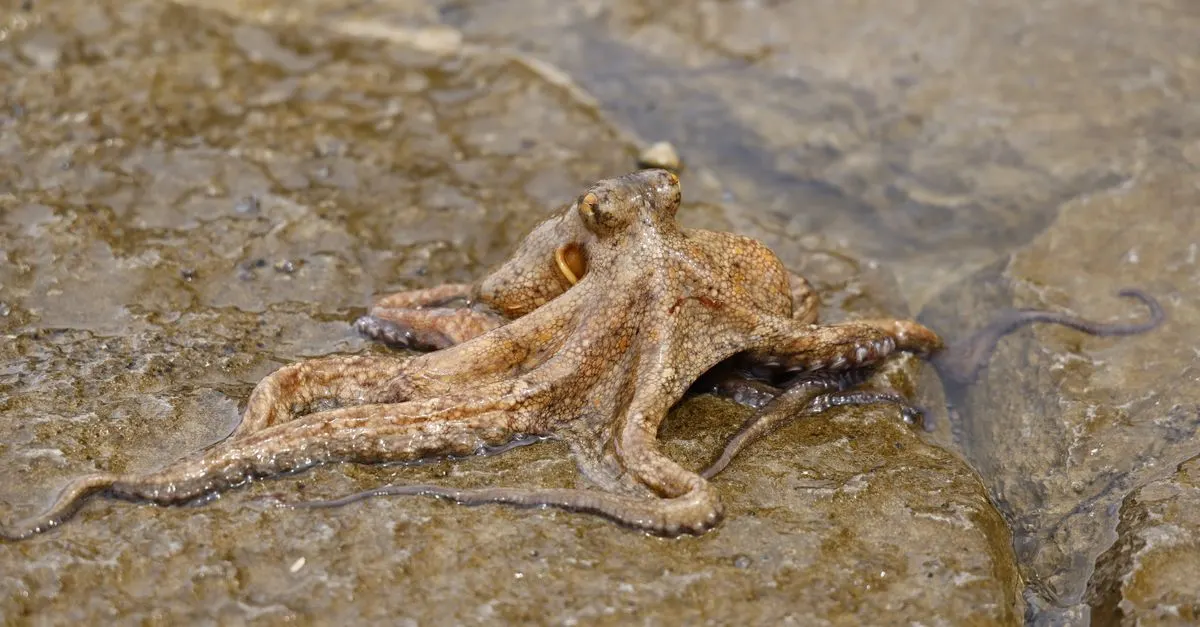
Does an octopus have three hearts? Count them and you get three. Count the ones still beating while it rockets across open water and you get two. The animal sprints on a stopped heart, which is a large part of why it would rather not sprint at all, and the arrangement says more about the animal than the number ever could.
Three hearts, and two of them work only for the gills
An octopus has three hearts: two branchial hearts, one tucked at the base of each gill, plus a single systemic heart that serves the rest of the body. The branchial pair takes blood that has already given up its oxygen and pushes it through the gills, where it picks up a fresh load. The systemic heart collects that reloaded blood and drives it out to the arms, the head, and the organs (Smithsonian Magazine). Two hearts for the gills, one for everything else.
Unlike most molluscs, cephalopods run a closed circulatory system, blood held in vessels the whole way round rather than sloshing through open spaces, and they run it at real pressure (Oellermann et al., 2015). M. J. Wells put probes into free-moving Octopus vulgaris and measured it: a resting animal beats 40 to 50 times a minute at 22C, with pressure in the dorsal aorta running about 40 cm of water at systole and 15 at diastole, climbing past 100 when the animal gets busy (Wells, 1979). That is a proper pumping system inside an animal with no bones to hang it on.
The blue blood is why one heart was never going to be enough
The three hearts exist to compensate for the cargo. Octopuses do not use haemoglobin. They use haemocyanin, a large protein that binds each oxygen molecule to a paired set of copper atoms (Oellermann et al., 2015). Copper plus oxygen is what turns the blood blue, the same way iron plus oxygen turns ours red. It is genuinely blue, too, unlike the veins under your skin, which only look that way because of how light gets through you.
The catch is how it is carried. Haemocyanin floats dissolved in the plasma rather than packed into cells the way our haemoglobin is, which caps how much of it the blood can hold before the plasma turns to syrup. Thin cargo needs more pumping, so evolution added pumps: one boost before the gills, one after. Three hearts is not a luxury. It is a workaround.
You will often read that copper blood is the better choice in cold, oxygen-poor water. The measurements say something more awkward. Haemocyanin's affinity for oxygen goes up as temperature drops, which means it grips the oxygen tighter and hands less of it over to the tissues exactly where the water is coldest (Oellermann et al., 2015). Antarctic octopuses have had to evolve their way around their own blood: Pareledone charcoti makes a haemocyanin with deliberately lowered oxygen affinity, carries a lot of it, and leans on the fact that near-freezing seawater holds plenty of dissolved oxygen to begin with (Oellermann et al., 2015). Blue blood works in the cold, but it works despite the chemistry rather than because of it.
The heart that switches itself off mid-escape
Now the strange part. In 1987, Wells and his colleagues recorded pressure and flow from the dorsal aorta of octopuses moving freely around a tank. Crawling around, everything scaled up sensibly: mean pressure, pulse amplitude, and flow all roughly doubled, while the beat frequency barely shifted, so the extra output came almost entirely from bigger strokes rather than faster ones. Then the animals jetted, and the recording went flat. Their words: jet propulsion is accompanied by cardiac arrest (Wells et al., 1987).
The reason is plumbing. Jetting means clamping the mantle and firing water out through the funnel, and the pressure that builds inside the mantle to do that is higher than the pressure the veins can push against. Blood physically cannot get back to the heart, so the heart has nothing to move (Wells et al., 1987). The escape stroke and the circulation are fighting for the same cavity, and the escape stroke wins.
An octopus can only borrow so much against that. The oxygen debt it can carry is small, roughly 22 millilitres of oxygen per kilogram, and Wells concluded that jetting more than a few metres is simply not available to it (Wells et al., 1987). That is why an octopus, given the choice, crawls. Swimming exhausts it (Smithsonian Magazine), and the exhaustion is not a matter of tired muscle so much as a heart that had to stand down for the duration.
Which reframes the whole animal. An octopus is not built to outrun anything, and its own circulation makes sure of it. Everything else it does instead, the color changes, the pouring through gaps, the sitting very still on a rock pretending to be the rock, is what you get when a creature with three hearts still cannot afford a chase.
Keep wondering: the same animal squeezes through impossible gaps in do octopuses have bones, vanishes in plain sight in how octopuses change color, and the gills doing all that work have company in how fish breathe underwater and why deep sea pressure doesn't crush fish.

Join the conversation
Comments are reviewed before they appear. Be kind and stay curious.
Loading comments…