
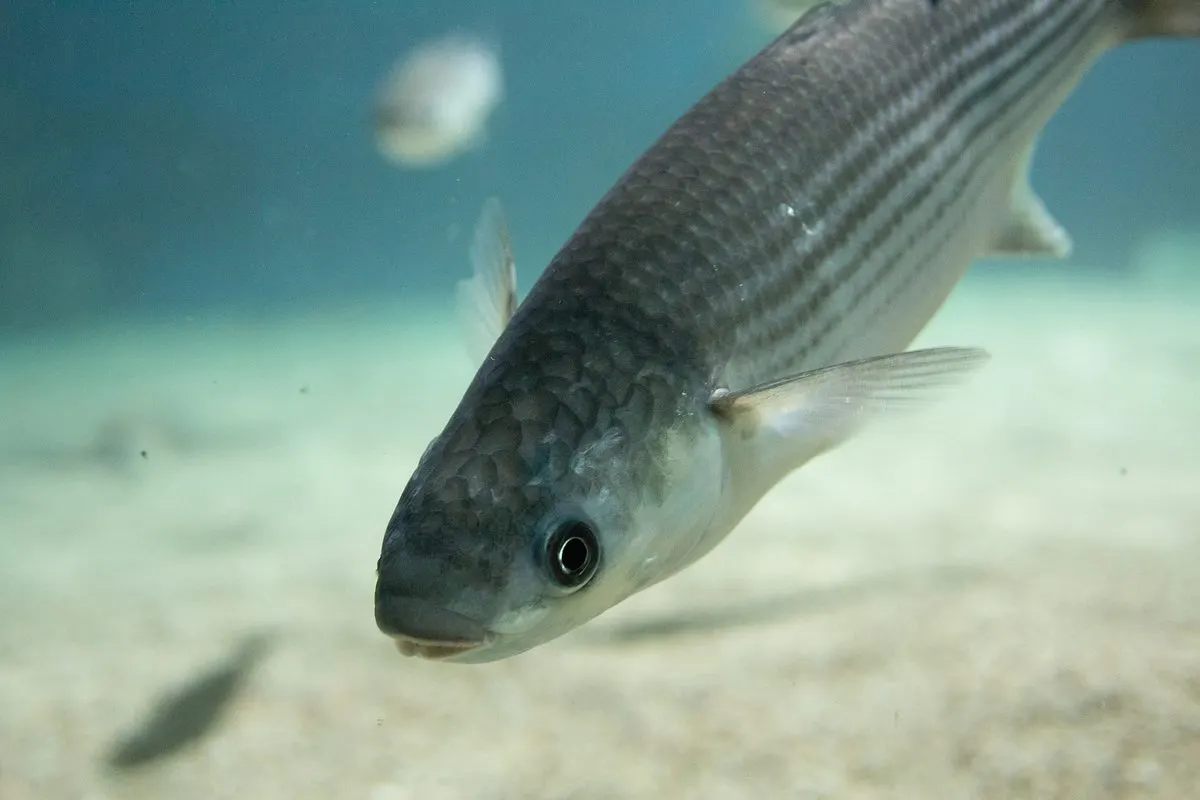
A fish in a tank is doing something you could never do: pulling a breath out of water. A diving bird cannot cheat that way, which is why it has to hold its breath and race back to the surface. How do fish breathe underwater, then? It is not magic and it is not cheating, it is one of the most elegant pieces of plumbing in biology. Fish do not extract the oxygen that is chemically bound up inside H2O. They breathe the free oxygen dissolved in the water, the same gas you breathe, just spread thin through a liquid. The clever part is how thoroughly they grab it.
The short answer: gulp water, strain out the oxygen
Watch a fish at rest and you will see its mouth and gill covers working in a steady rhythm. That is the breathing. The fish opens its mouth and draws water in, then closes it and forces the water back over its gills and out through the gill slits behind its head (AMNH). As the water passes the gills, oxygen crosses from the water into the fish's blood, and carbon dioxide passes the other way, out into the water. In, over, out. It is the same in-and-out logic as your lungs, just run on water instead of air, and turned into a one-way flow instead of a back-and-forth.
Water is a stingy place to breathe
To appreciate why gills are built the way they are, you have to know the problem they solve. Water is a terrible place to find oxygen. A given volume of water holds only a small fraction of the oxygen that the same volume of air does, often twenty to forty times less. A fish is trying to make a living on the dregs.
That constraint explains everything about gill design. A fish cannot afford to be wasteful or sloppy, the way an air-breather can be. It has to move a large amount of water across a very large surface and squeeze out as much oxygen as physically possible. Evolution's answer is a structure with enormous surface area, paper-thin walls, and a flow trick that borders on unfair.
Inside a gill: surface area stacked on surface area
Lift a fish's gill cover and you find a row of gill arches. Off each arch sprout rows of thin filaments, and along every filament sit thousands of microscopic folds called lamellae (Wikipedia). The folding is the point. By piling folds on filaments on arches, a fish packs a huge total surface area into a small space behind its head, all of it laced with tiny blood vessels lying just beneath a wall thin enough for oxygen to slip across by diffusion.
If you could unfold and flatten all the lamellae of a single fish, you would get a sheet far larger than the fish itself. That is the same strategy your own lungs use with their hundreds of millions of air sacs: when you need to move a gas across a membrane, you cheat by making the membrane gigantic and folding it up small.
The real trick: countercurrent exchange
Surface area alone would not be enough. The masterstroke is the direction of flow. In a fish gill, the water flows across the lamellae in the opposite direction to the blood flowing inside them. This is called countercurrent exchange, and it is the single cleverest thing about how fish breathe (FISHBIO).
Here is why direction matters so much. Imagine the blood and the water flowing the same way, side by side. Oxygen would diffuse from the oxygen-rich water into the oxygen-poor blood until the two evened out, and then transfer would stop. The blood could never end up holding more oxygen than the water beside it, so it would max out at roughly half the available oxygen, and a lot would flow straight back out, unused.
Now reverse the water. Blood that is already fairly well oxygenated, near the end of its run, meets fresh incoming water that is fully loaded, so oxygen still flows in. And blood that is nearly empty, just arriving, meets water that has already given up most of its oxygen but still has more than the blood does, so oxygen flows in there too. At every point along the gill, the water is always a little richer in oxygen than the blood right next to it. The gradient never disappears, and diffusion keeps running the entire length (FISHBIO). The payoff is dramatic: a countercurrent gill can pull up to about 90 percent of the oxygen out of the water passing over it, against the roughly 50 percent ceiling of a same-direction system.
Why a fish drowns in air
This is the cruel twist. Air is bursting with oxygen, far more than water ever holds, and yet most fish suffocate in it within minutes. The problem is structural, not chemical. Underwater, the gill filaments and their lamellae float apart, held open and spread out by the water around them. Lift the fish into air and that support vanishes. The delicate filaments collapse and clump together, the way the strands of a wet feather stick into a single useless point (AMNH). The vast surface area folds down to almost nothing, the blood vessels lose contact with the air, and the fish, surrounded by oxygen, cannot reach a molecule of it. A fish out of water does not run out of oxygen. It runs out of the working surface to absorb it.
The fish that broke the rules
Gills are the standard kit, but some fish live in water so warm, stagnant, or prone to drying out that gills alone will not keep them alive, so they evolved ways to breathe air.
- Lungfish have actual lungs connected to the throat and are the closest living fish relatives of land vertebrates. African and South American lungfish are obligate air breathers: they must surface to gulp air, and they will drown if held underwater, because their reduced gills cannot supply enough oxygen. African lungfish go further, burrowing into mud and sealing themselves in a mucus cocoon to breathe air and wait out a drought that dries their pond completely.
- Labyrinth fish, the group that includes bettas and gouramis, roughly 137 species, carry a folded, blood-rich structure called the labyrinth organ in a chamber above the gills. They rise to the surface, gulp a mouthful of air, and absorb oxygen straight from it, which is exactly how a betta thrives in a small, poorly oxygenated bowl.
- Mudskippers spend hours out of water on tidal flats, absorbing oxygen through their moist skin and the lining of their mouths, carrying a film of water with them like a portable gill.
These are not fish that "learned to breathe air" on a whim. They are fish whose ancestors lived where dissolved oxygen runs out, and the ones that could grab a breath at the surface survived.
The same dissolved oxygen that gills harvest is what lets life persist in the most surprising places, from a pond sealed under floating winter ice to the crushing dark explored in how deep is the ocean. A fish breathing in a tank is quietly running a chemistry trick we have never managed to copy with our own lungs.
Keep wondering: the same animals that breathe with gills also have to cope with why deep-sea pressure doesn't crush fish; the deeper you go, the stranger the residents, all the way down through how deep is the ocean; and some of those depth-dwellers make their own light, which is why sea creatures glow.



Join the conversation
Comments are reviewed before they appear. Be kind and stay curious.
Loading comments…