
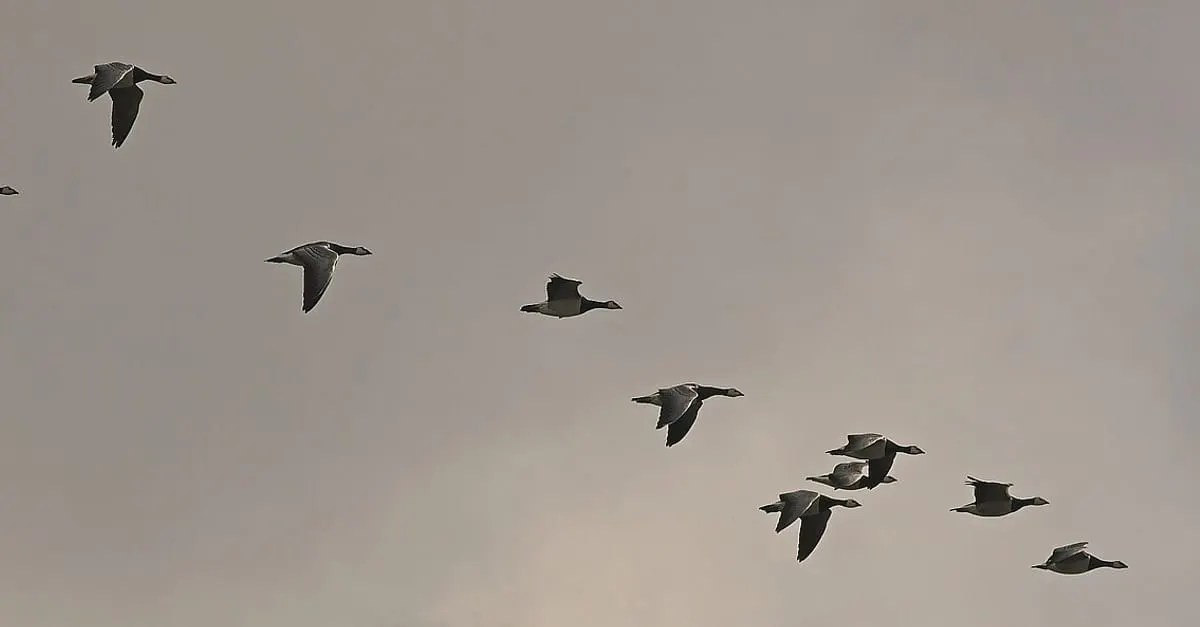
Look up on an autumn evening and you might catch them: a ragged line of geese cutting across the sky in that unmistakable V, honking as they go. It looks like a formation a flight crew would draw on a whiteboard. So why do geese fly in a V? The short answer is that formation flight can reduce travel costs for birds in helpful positions. Some birds use rising air from a neighbor ahead, and the shape may also help the flock stay coordinated, the same broad payoff that packs fish into tight schools.
Geese fly in a V to ride each other's slipstream
Birds in suitable positions can be helped by upwash from a bird ahead (Speakman and Banks, 1998). Here is the trick. A flapping wing does not just push air down to stay aloft. At the wingtip, the air curls into a small spinning vortex, and just behind and to the side of that wingtip the air can move upward. That rising column is called upwash. If a bird positions itself in it, the air can reduce the work needed to stay aloft, but the size of the benefit depends on the bird's position and timing.
So the goose behind does not fly directly in another bird's wake, where the air is being shoved down. It slides a little to one side, into the sweet spot of rising air off the leader's wingtip. Do that with a whole flock and you get a staggered diagonal line. Two of those lines meeting at a lead bird is the V you see.
The biologist Bret Tobalske put the feeling nicely. Riding the upwash, he told Audubon, is "like a surfer on a surfboard experiences upwash from a wave. It's energy in the environment that's helping to assist this bird behind it."
The savings are real, and they add up
This is not just a tidy story. A study of Greylag Geese measured 25 formations and found that the birds' positions varied widely. Across the formations observed, its aerodynamic model estimated a 26.5 percent saving in induced power and a 4.5 to 9 percent reduction in total flight costs (Speakman and Banks, 1998). Those figures belong to that species, study design, and range of positions, not to every goose or V formation.
The most striking evidence came in 2014, when scientists strapped tiny GPS and motion loggers to a flock of northern bald ibises being taught a migration route. Their data, published in Nature, showed the birds were not just loosely following each other. Each one positioned itself precisely where the upwash was strongest, and, remarkably, timed its wingbeats to match, flapping in sync so its own wings beat through rising air rather than sinking air. When a bird did end up directly behind another, in the bad downwash zone, it did the opposite and flipped its wingbeat out of phase to dodge the sinking air. The flock was, in effect, solving a fluid-dynamics problem in real time with its body.
Think about what that takes. The same physics that lets a heavy airplane stay in the sky is being read and exploited by a bird with no instruments, just a feel for the air pressing on its feathers. Birds are flying machines that long predate ours, and watching how fast a hummingbird beats its wings is a reminder of how much control of the air evolution has packed into a feathered body.
Why someone has to do the hard work up front
There is a catch built into the V. The bird at the very tip gets no upwash from a bird ahead, because there is no one there to throw it off. The leader may therefore face a higher aerodynamic cost in that moment, but the actual workload depends on position, wingbeat timing, wind, and the species being studied (Speakman and Banks, 1998).
Geese may share the burden by changing positions, but the timing and regularity of that behavior are not universal. A bird that moves from the lead into a trailing slot may gain aerodynamic help from the new position, while another bird takes the point. The details depend on the flock and species rather than following one fixed rotation rule.
The V is also how they stay together
Energy is the headline reason, but it is not the only one. The V is a beautifully practical shape for keeping a fast, spread-out group organized. Strung out in that diagonal line, every goose can see the birds ahead of it and hold its place, keeping the flock aligned and pointed the same way. Nobody is buried in the middle of a blind cluster.
That is probably where the honking comes in. The constant calling is thought to help the birds keep in contact and coordinate as they shift positions, likely cueing the moment a worn-out leader peels off and another moves up. It is a noisier kind of teamwork than the silent night-flight of an owl out hunting, but it serves the same end: a group acting as a single, coordinated thing.
So the answer to why geese fly in a V is really two possibilities braided together. Birds in suitable positions can use upwash from a neighbor ahead, reducing flight costs under the right conditions, while the line may also help flock members remain in contact. The next time a line of geese passes overhead, honking into the cold, you are not just watching birds. You are watching a moving solution whose exact benefits depend on the species, formation, and conditions.
Keep wondering: find out how a wing keeps an airplane in the sky, see just how fast a hummingbird flaps to hover, and learn why owls hoot in the dark.


Join the conversation
Comments are reviewed before they appear. Be kind and stay curious.
Loading comments…