
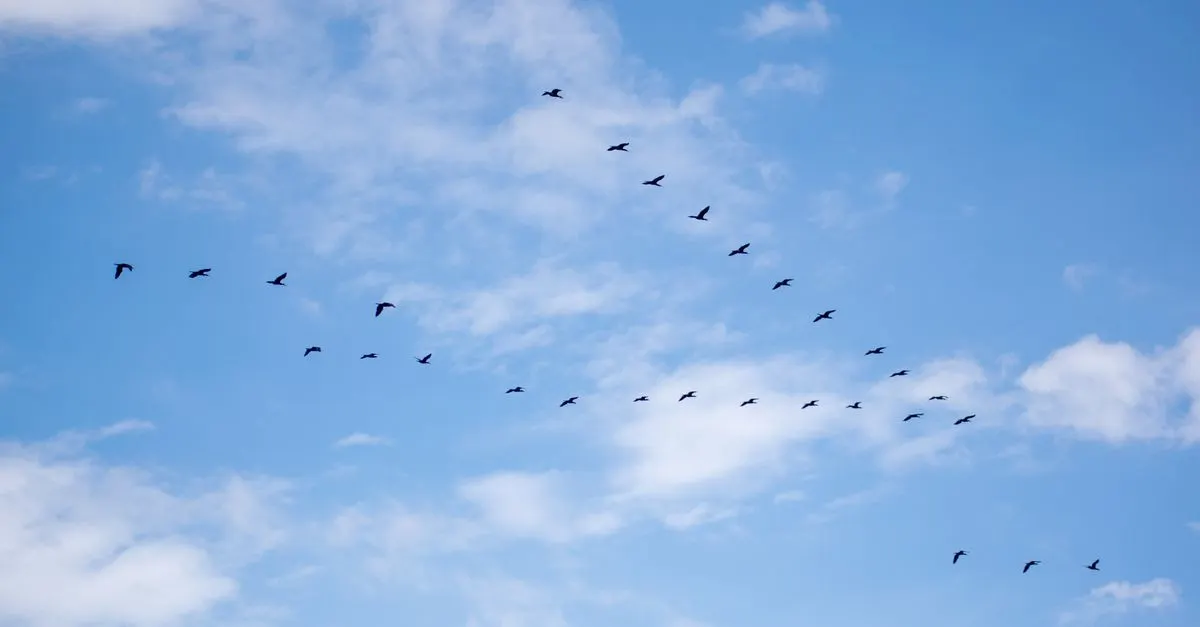
A young songbird hatched this summer has never seen the tropics. Its parents may already be gone, flown south weeks ahead of it. One night, with no map, no guide, and no memory of the route, it lifts off in the dark and heads for a patch of forest thousands of miles away that it has no way of knowing exists. And it gets there. The question is not really whether birds know where to migrate. It is how on earth a creature that has never made the trip already knows the way.
Birds find their way with a stacked toolkit, not one trick
A migrating bird does not navigate with a single magic sense. The bird carries a stacked toolkit, an inherited sense of direction layered with a sun compass, a star compass, a feel for Earth's magnetic field, learned landmarks, and even smell, and it cross-checks one against another as conditions change (Cornell Lab of Ornithology). No one cue is the answer. The redundancy is the answer. Take any single tool away and the others usually carry the bird through.
That is why migration has been so hard to pin down. Scientists kept looking for the one mechanism and kept finding another working alongside it.
The map you are born with
Start with the strangest part, because it is the most established. Many young birds make their first migration alone, and still go the right way. In classic experiments, naive birds raised in captivity, with no chance to follow an experienced adult, became restless at migration time and tried to launch in their species' correct direction. Researchers measured this by sitting birds in funnel-shaped cages, the ink on their feet leaving a smear of scratch marks on the paper that points where they kept trying to go.
What that reveals is an inherited program: a built-in heading and a built-in clock. The bird is wired to fly, say, southwest for a set number of weeks. Follow that instruction from the right starting point and you arrive in roughly the right place. It is less a map than a recipe, "this way, this long," handed down in the genes. Not every species relies on it equally. Geese, cranes, and other flock migrants often learn routes by following elders, which is one reason they travel in families.
A compass for the day and a compass for the night
A heading is useless without a way to find direction, so birds carry at least three compasses and switch between them.
The first is the sun. Birds read the sun's position and pair it with an internal clock, correcting for the fact that the sun drifts across the sky through the day. That time-compensated sun compass lets a daytime flier hold a steady bearing even as its reference point keeps moving.
The night shift is more beautiful. Birds that migrate after dark steer by the stars, and here is the lovely twist: they are not born knowing the constellations. As nestlings, they watch the night sky turn. Everything wheels around one still point, the celestial pole, and the young bird learns to read that fixed center as north. The classic demonstration came from Stephen Emlen, who raised indigo buntings under a planetarium sky and quietly changed which star the heavens rotated around. The birds took their direction from whatever point he spun the sky about, learning north from the rotation itself rather than from any particular star. Later work suggests birds can even pick up this star compass later in life if bad weather robbed them of the lessons as chicks, in the spring after their first autumn. It works much like the magnetic needle you can hold in your hand, except the needle is the whole sky.
The sense we do not have
Then there is the compass with no off switch, the one that works through cloud and pitch dark: birds can feel Earth's magnetic field. Put a bird in a closed box with no view of sun or stars and it still orients, and tweak the magnetic field around it and the heading shifts. That much is solid.
How the bird actually feels the field is the part still being worked out, and it is worth being honest about that. The leading candidate is a light-sensitive protein in the eye called cryptochrome, in particular a form named Cry4a. The idea is that blue light striking the protein kicks off a fleeting quantum reaction whose outcome is nudged by the magnetic field, which could let a bird, in some sense, "see" direction as a pattern laid over its vision. A second possible piece is tiny grains of magnetic iron mineral in the head, which might read the field's strength like a built-in gauge. But the exact receptor has never been confirmed. As one review of the science put it, researchers are still a long way from proving how birds perceive the magnetic field. Audubon's reporting lands in the same place: there are competing ideas and no settled answer on the mechanism. Magnetoreception is, oddly, the one sense for which biology still cannot point to the organ.
Memory, smell, and the long polish
The inherited recipe gets a bird into the right region. Getting it back to the exact same hedgerow, year after year, takes learning. On that first trip a bird builds a mental map of what it passes, the coastlines, rivers, and mountain ridges below, and adult birds are noticeably better, more precise navigators than first-timers, which is the fingerprint of experience. Smell turns out to matter too. For pigeons and many seabirds, blocking the sense of smell throws off their homing, though exactly which odors they read is not fully understood.
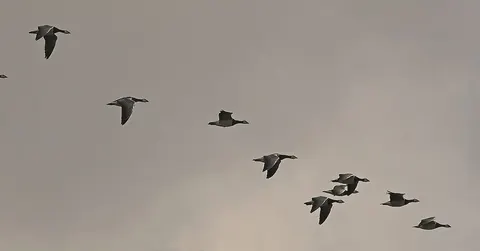
Stack it all up and the achievement comes into focus. A first-year bird flies a born-in heading, holds it by sun and stars, checks it against the magnetic field, and writes down landmarks as it goes, then spends the rest of its life refining the route until it can return to a single tree. It is not one miracle. It is half a dozen ordinary senses, calibrated against each other, doing something extraordinary together. The next time a skein of geese passes in a V, remember that the formation is only the flying. The knowing where to go is the real marvel.
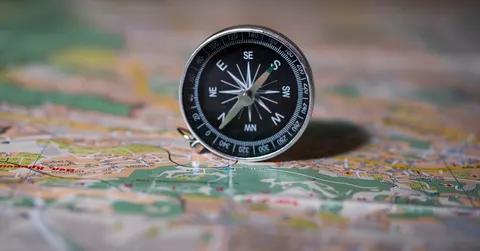
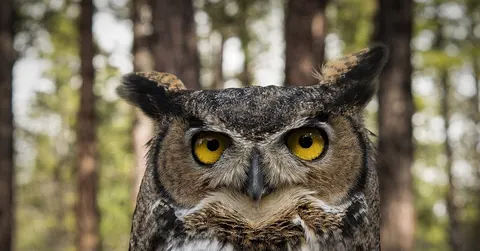
Keep wondering: see why geese fly in a V and what the shape actually does, then how a compass finds north, and why owls can turn their heads almost all the way around.

Join the conversation
Comments are reviewed before they appear. Be kind and stay curious.
Loading comments…