
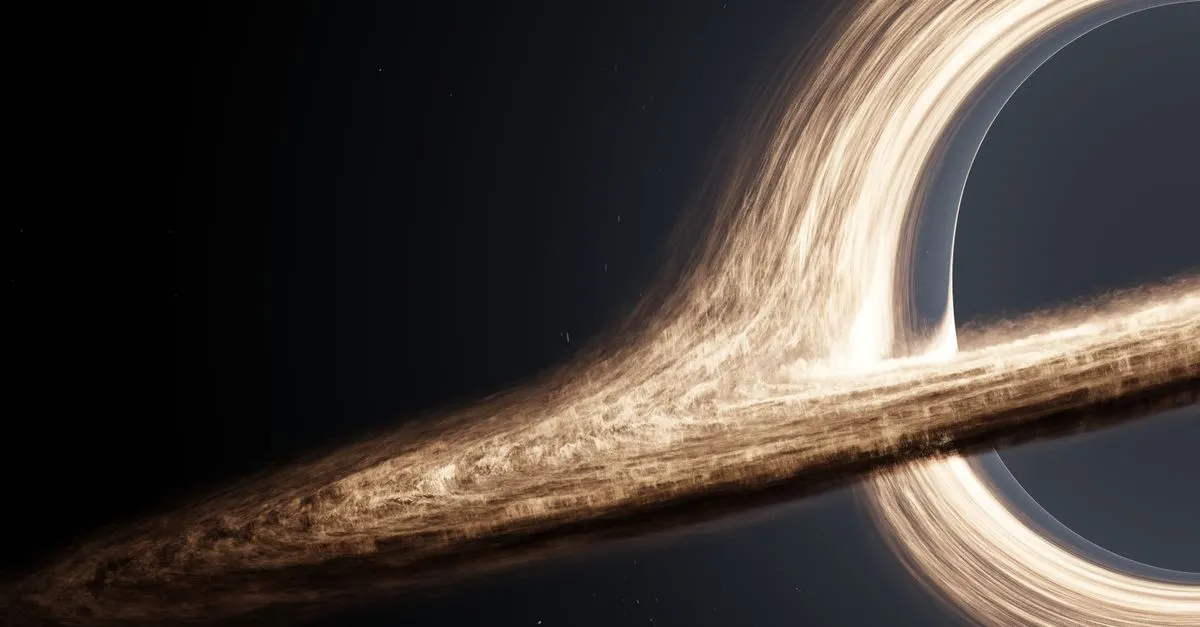
Some questions feel like they should have an answer hiding just out of reach, and this is one of them. "The other side of a black hole" sounds like a door you could walk through if you were brave enough. The honest version is stranger and, in a way, more thrilling: the wall is real, the door is theoretical, and the most exciting part is everything we cannot yet say.
Honestly, nobody knows what is on the other side
The truthful answer is that nobody knows what is on the other side of a black hole, and the physics suggests we may never be able to look. A black hole's edge, the event horizon, is a one-way boundary. Cross it and the escape velocity is greater than the speed of light, so nothing, not light, not a radio signal, not you, can climb back out to tell the rest of us what is in there (NASA). That is not a gap in our telescopes. It is built into the thing itself.
So when people say "the other side," they usually mean one of two ideas: what actually sits inside, or whether the hole opens onto somewhere else. Both are worth taking seriously. Just keep one foot on solid ground, because only one of them is settled science, and even that one comes with an asterisk.
Inside: a singularity, not a doorway
Follow the math of general relativity inward and it does not lead to a room or a tunnel. It leads to a single point at the center called a singularity, where all the fallen matter is crushed into a vanishingly small volume of essentially infinite density (NASA). Recent work suggests these central singularities are genuinely hard to avoid in our current theory (Quanta Magazine).
Something even stranger happens once you pass the horizon. According to general relativity, the roles of space and time effectively swap. The center stops being a place you could choose to avoid and becomes a moment in your future, as unavoidable as next Tuesday. There is no steering around it any more than you can steer around tomorrow. That is part of why "the other side" is such a slippery phrase: past the edge, the geometry of the situation is nothing like a normal room with a far wall.
Here is the catch most descriptions skip. A singularity is not really a "place where things become infinite." It is better understood as the place where general relativity itself breaks down and stops giving sensible answers (Quanta Magazine). The infinity is a sign that the theory has run out of road, the way a calculator flashing an error is not telling you the true answer is "error." So the most accurate thing to say about the deep interior is not "there is a singularity." It is "our best theory predicts a singularity, and our best theory knows it is out of its depth there."
The other side: white holes and wormholes
This is where the sci-fi version comes from, and the surprising part is that it starts in real equations, not movies.
A white hole is the theoretical mirror image of a black hole. A black hole only lets matter in. A white hole would only let matter out, pushing light and material away and refusing to let anything enter, like a black hole running backward in time (Wikipedia). It is a legitimate solution to Einstein's equations. It is also something no astronomer has ever observed, and no known natural process can actually produce one (Wikipedia). On paper it exists. In the sky, there is not a single confirmed example.
Connect a black hole to a white hole and you get the famous wormhole, also called an Einstein-Rosen bridge: a shortcut tunneling from one region of spacetime to another. General relativity genuinely allows it on paper (Space.com). But the same theory that allows it also predicts the bridge collapses almost instantly, far too fast for anything to cross, and physicist Kip Thorne has noted there are strong indications that wormholes a human could survive traveling through are forbidden by the laws of physics (Space.com). No wormhole has ever been found, either.
So "the other side could be another part of the universe" is not made up. It is a real possibility inside the math. It is just nowhere close to an observed fact, and the leading guess is that nature does not keep these doors open even if it can briefly draw them.
The misconception worth clearing up
The big trap is treating "valid solution to Einstein's equations" as if it meant "real thing that exists out there." Those are not the same claim. Equations describe what is allowed, not what nature actually builds. White holes and wormholes are allowed. So are plenty of arrangements the universe never bothers to assemble.
It is the difference between a recipe and a meal. A recipe being written down does not mean dinner is on the table. White holes and wormholes are recipes physicists can write out cleanly. Nobody has ever been served the meal.
Where the honest answer finally lands
Strip away the wishful thinking and you reach a genuinely exciting place, not a disappointing one. We can describe a black hole's edge with great precision. We can predict, right up to the doorstep, that an interior exists. And then our deepest theory of gravity stops being trustworthy, exactly where we most want to look.
Closing that gap is the job of a theory of quantum gravity, the long-sought marriage of general relativity and quantum mechanics that should take over where Einstein's equations fail and replace that infinite singularity with something we can actually describe (Quanta Magazine). We do not have that theory yet. That is not a footnote. It is the answer. "What is on the other side?" is, today, one of the cleanest open questions in physics, sitting at the frontier where our two best theories meet and neither one can finish the sentence.
Which is a strange kind of gift. Most mysteries shrink when you study them. This one keeps its shape, the same way the question does when you wonder how black holes eventually die or try to picture how big the universe really is.
Keep wondering: find out what would happen if you fell into a black hole and got close to that edge, learn how black holes die over unimaginable stretches of time, then zoom all the way out to how big the universe is.

Join the conversation
Comments are reviewed before they appear. Be kind and stay curious.
Loading comments…