
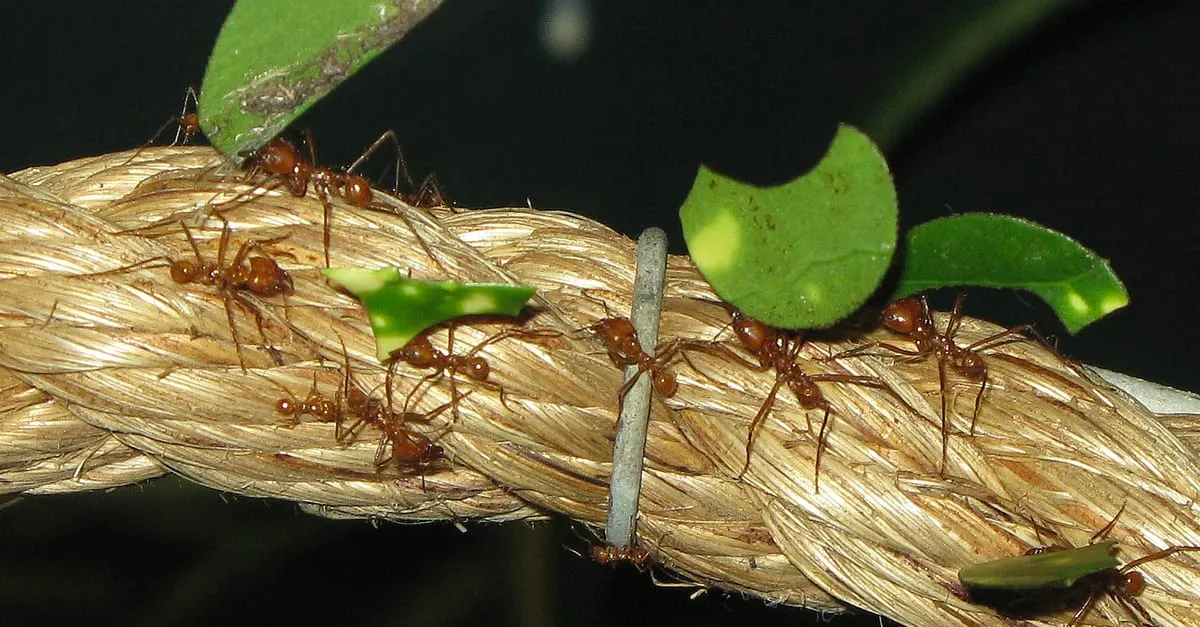
So how strong are ants, really? When scientists actually put leafcutter ants on a scale and loaded them up, the answer came out at about 9 times their own body weight for a maximum carry (Journal of Experimental Biology). That is already remarkable, and it is a lot lower than the numbers you usually hear. The reason an ant can do even that has nothing to do with muscle quality. It is geometry, and it favors anything small.
What the numbers actually say
Here is where the honest answer gets interesting, because the famous figures and the measured ones do not match. Pest-control sites and even some museum pages say leafcutter ants haul leaf pieces around 50 times their body weight, and that number is repeated everywhere. But when Paolo Segre and Ebony Taylor tested Atta cephalotes leafcutters under controlled loads in 2019, the workers maxed out at about 8.78 times their body weight, and that ratio held steady whether the ant was big or small (Journal of Experimental Biology). They also found that foraging ants out in the field usually carry less than they could, keeping some power in reserve.
So the "50 times" you see quoted is a loose, generous figure, not a measured one. Even at the careful number, the feat is hard to picture. A two-milligram worker carrying nine times its weight is doing the rough equivalent of a 180-pound person jogging off with another person and a half on their back, over rough ground, without putting it down.
Then there is the number that gets quoted most of all: 5,000 times. That one needs a footnote, because it does not mean what people think.
The 5,000-times figure is a neck, not a lift
In 2014, engineers at The Ohio State University, led by Carlos Castro with Vienny Nguyen and Blaine Lilly, wanted to know how the Allegheny mound ant (Formica exsectoides) carries such oversized loads in its jaws. They glued ants into a tiny centrifuge and spun them faster and faster, pulling on the neck joint until it tore (Ohio Supercomputer Center).
The joint began to stretch at about 350 times the ant's body weight, and it finally ruptured somewhere between 3,400 and 5,000 times (Entomology Today). So the "5,000 times" is the breaking strength of a single joint under pull in a machine. It is not the weight an ant lifts and walks around with. Entomology Today even revised its own headline later, swapping "lift" for "withstand pressure," because the two got tangled together. The carrying figure, a handful to a few dozen times body weight depending on the species and the test, is the one to keep. The neck-joint number just shows how overbuilt that little hinge is, sitting where soft membrane meets hard exoskeleton.
Why being small makes you strong
Galileo worked this out in 1638, long before anyone weighed an ant. Muscle force comes from cross-sectional area, how thick the muscle is when you slice through it, and area scales with length squared. Body weight comes from volume, and volume scales with length cubed (Square-cube law). The same scaling explains other small-body power tricks, like how hard a mantis shrimp punches.
Watch what that does as you shrink something. Halve an animal's size in every dimension and its muscle cross-section drops to a quarter, but its weight drops to an eighth. Strength fell, sure, but weight fell faster. Shrink it again and the gap widens. By the time you are ant-sized, your muscles have barely any weight left to fight, so the load you can move relative to yourself becomes enormous. An ant is not built from some miracle material. It is just small, and smallness pays a strength-to-weight dividend that no big body can claim.
The exoskeleton helps too. With the hard parts on the outside, an ant has more room inside for muscle and more surface for those muscles to anchor to (Popular Science). But the main reason is the square and the cube pulling in different directions.
Run the law backwards and it gets eerie
The same math says a human, shrunk to ant size without otherwise changing, would be "ant strong" by the same ratio. Nothing special about the ant, only its dimensions. Now run it the other way, the way every giant-bug movie quietly ignores. Blow an ant up to your height and its weight climbs with the cube while its leg muscles and joints only thicken with the square. The math turns cruel fast. A human-sized ant could not lift those 5,000-times loads. It could not lift itself. Its legs would buckle and its exoskeleton would crack under a body that had outgrown the geometry holding it together.
So the strongest creatures by their own weight are mostly tiny, and they are strong because they are tiny, not in spite of it. The next time an ant drags a dropped raisin across the kitchen floor, you are not watching a superhero. You are watching the square-cube law do what it always does, in a body small enough to cash in. The carry is impressive enough at nine times its weight; it does not need the inflated numbers to earn the stare.
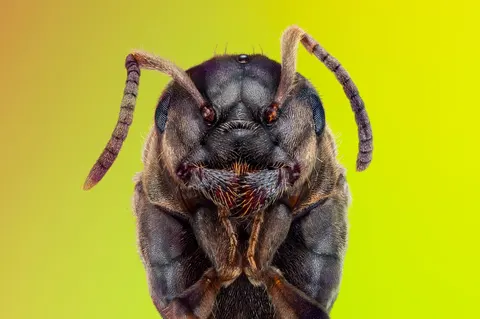
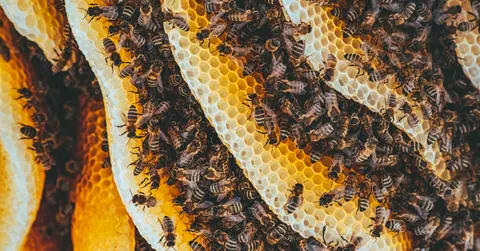
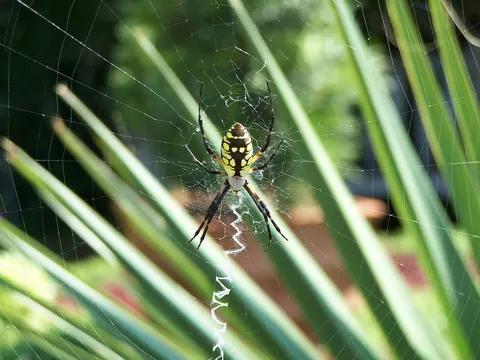
Keep wondering: that overbuilt little body runs on a surprisingly capable mind, so it is worth asking whether ants have brains. Other tiny workers turn raw materials into something larger than themselves, which is why bees make honey, and another small builder spins a structure stronger than it looks, which is why spiders make webs.
Join the conversation
Comments are reviewed before they appear. Be kind and stay curious.
Loading comments…