
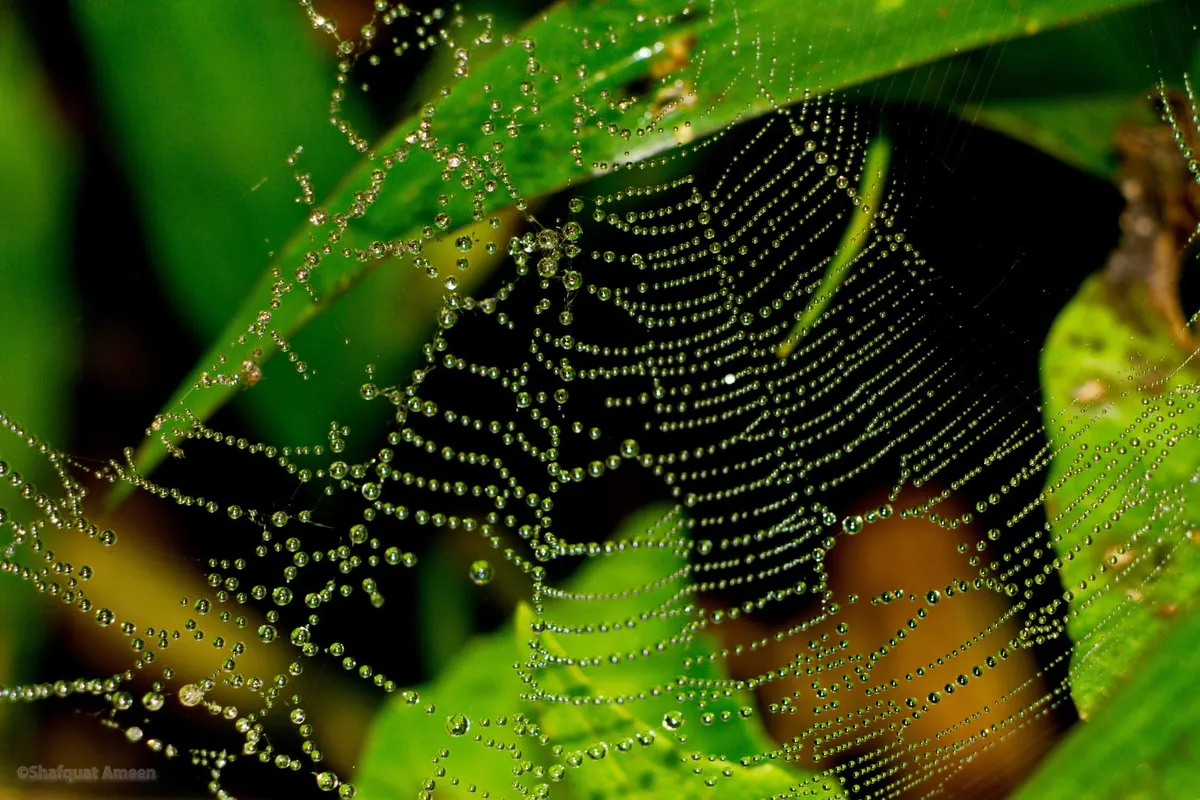
A thread of spider dragline silk snaps at about 1.1 gigapascals of tension. High-tensile steel snaps at about 1.5. So in the head-to-head everyone repeats, the flat claim that spider silk is stronger than steel, silk loses. That is also the wrong contest. How strong is spider silk depends entirely on which kind of strong you meant, and on the measure that matters to a spider, the myth is underselling it.
Steel wins on strength, and silk is still the better material
Dragline silk is not stronger than steel in the plain sense of the word. In the comparison table materials scientists have cited for decades, silk from the orb weaver Araneus breaks at 1.1 GPa, high-tensile steel at 1.5 GPa, and Kevlar 49 at 3.6 GPa (Gosline et al., Journal of Experimental Biology). Silk comes third. The claim survives because two other measurements do favor silk, and both are arguably more useful than raw strength: silk beats steel per unit of weight, and it beats steel and Kevlar on toughness by a margin that isn't close. The line is true. It is true about a different number than it sounds like.
Strength and toughness describe two different ways of failing
Tensile strength answers one narrow question: how hard can you pull before the thing parts? It says nothing about how much punishment the material soaks up on the way. That is toughness, the energy a material absorbs per unit volume before it breaks, and it is where the comparison flips.
Steel is strong and stiff, which means it barely moves before it goes. High-tensile steel fails after stretching about 0.8 percent. Kevlar fails after about 2.7 percent. Dragline silk stretches 27 percent first, ten times more than Kevlar, and all that stretching is energy going into the fiber instead of into breaking it. The result, in Gosline's numbers: dragline silk has a toughness of 160 MJ/m³, against 50 for Kevlar and 6 for high-tensile steel. Silk is "3 to 10 times tougher than its engineering counterparts," as the paper puts it. Against steel specifically it is not 3 times tougher. It is nearly 27 times tougher.
That gap is the whole reason a web works at all. A steel web of the same thickness would be stronger and would still fail, because a flying insect does not pull gently on a thread. It arrives with kinetic energy that has to go somewhere. Silk stretches, converts most of that energy into heat through internal molecular friction, and holds. Denny's load-cycle experiments, reported in the same paper, put the hysteresis at roughly 65 percent, so about two thirds of the insect's energy is dissipated rather than stored, and the web does not act like a trampoline and catapult dinner back out.
Per gram, silk genuinely does beat steel
Here is the part of the myth that holds. Strength as engineers quote it is force divided by cross-sectional area, which quietly assumes you care about volume. Often you care about weight instead. Silk is protein, steel is iron, and silk is dramatically the lighter of the two, so a gram of silk is a far longer thread than a gram of steel. Divide strength by density and silk comes out around five times stronger than steel (Ramezaniaghdam et al., Frontiers in Bioengineering and Biotechnology). That measurement is specific strength, and for anything an animal has to haul around or fly, it is the number that matters. The same logic explains how strong ants really are: scale changes which number counts.
The honest version of the claim needs four words on the end. Stronger than steel for its weight. Drop them and it is false.
One more caveat worth knowing, because it explains why published silk figures disagree with each other. Silk is hygroscopic, and water wrecks its stiffness. Dragline silk measures around 17 GPa of elastic modulus when dry and about 1.4 GPa when fully hydrated, and the authors of that study concluded much of the scatter in the literature traces back to humidity in the lab (Vehoff et al., Biophysical Journal). There is no single true number for spider silk. There is a range, and the weather is part of it.
The spider that beats Kevlar tenfold
In 2010, a team surveying Madagascar found Caerostris darwini, Darwin's bark spider, which strings webs across rivers. Its dragline averages 350 MJ/m³ of toughness and reached 520 MJ/m³ in the best samples, with an ultimate strength of 1,652 MPa. That is "more than twice tougher than any previously described silk, and over 10 times better than Kevlar" (Agnarsson, Kuntner & Blackledge, PLOS ONE). It is the toughest biological material known.
Ordinary silk has a second trick, too. Gosline's team loaded Araneus dragline at realistic impact speeds rather than the slow pull of a standard lab test, and the fiber stiffened and strengthened as it was hit faster. Their results were preliminary and they said so, but in the best tests the strength virtually matched Kevlar's and the toughness reached roughly 1,000 MJ/m³. Silk is not a passive rope. It gets better the harder you hit it, which is exactly the property you want in a trap, and a reminder that biological materials are tuned to the job rather than to the test bench, the same way a mantis shrimp's punch is built around the physics of striking a shell.
Why there is no spider silk jacket in your wardrobe
If silk is this good, the obvious question is where you can buy some. Nowhere, and the reason starts with the animal. Spiders are territorial and cannibalistic, so you cannot farm them in trays the way you farm silkworms. One attempt to make a single textile 3.4 meters long needed a million Nephila madagascariensis spiders, more than 70 workers, and over half a million dollars.
The workaround is to skip the spider: put silk genes into bacteria, yeast, plants, or goats, and harvest the protein. That runs into biology. Silk genes are enormously long and highly repetitive, and host cells handle them badly. In E. coli the repeats create such demand for one particular building block, glycine, that the cell's supply of glycyl-tRNA runs short and production stalls. What does get made tends not to dissolve properly, which makes it hard to purify. Plant systems yield micrograms to around 200 mg per kilogram of tissue, while the commercially viable threshold is 1 to 5 grams per kilogram, a gap of more than an order of magnitude.
Even solving that leaves the harder half. A spider does not extrude silk, it spins it, pulling the protein through a gland that changes acidity and shears the molecules into alignment on the way out. Artificial fibers still fall short of natural dragline "because of the difficulty in fully mimicking the complex hierarchical structures" (Li et al., Advanced Science). Knowing the protein sequence gets you a jar of goo, not a thread.
Which leaves the myth in an interesting place. "Stronger than steel" is the wrong compliment, paid to the wrong property, and it undersells what is going on. The remarkable thing about silk was never that it resists a hard pull. It is that a garden spider, working at body temperature, out of water, with no furnace and no chemistry set, spins a fiber that absorbs more energy than the best thing our factories can make. We have known the sequence for thirty years and we still cannot copy it. That is the fact worth repeating, and it is the one nobody quotes.
Keep wondering: the trap itself has its own logic in why spiders make webs, small bodies break strength records in how strong ants are, and biology beats engineering again in how hard a mantis shrimp punches and in why woodpeckers don't get headaches.

Join the conversation
Comments are reviewed before they appear. Be kind and stay curious.
Loading comments…