
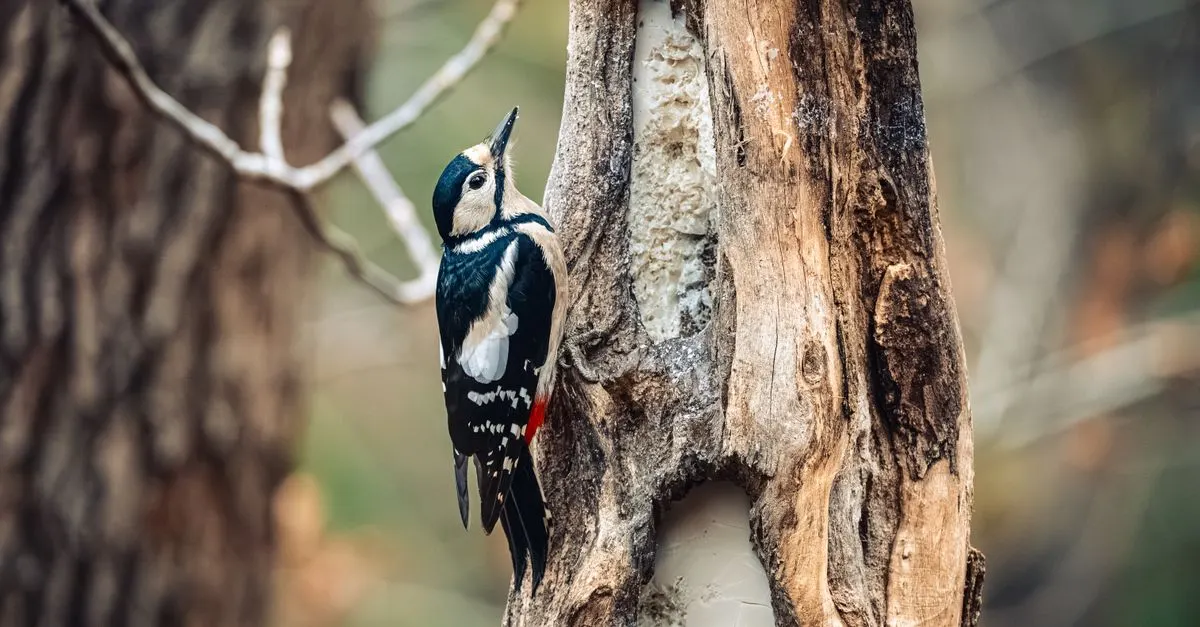
Sit near a tree where a woodpecker is working and the sound is almost violent. The bird slams its face into solid wood thousands of times a day, fast enough that the head is a blur, and then it just flies off to the next trunk. Anything that happened to your skull would land you in an emergency room. So how does the woodpecker walk away without so much as a wince?
Woodpeckers avoid headaches mainly because their brains are tiny
A woodpecker dodges injury not through a cushioned skull but because its brain is so small that the same jolt produces far less pressure than it would in a big head (NPR). A woodpecker brain weighs about two grams, roughly 700 times lighter than ours. Drive that little brain into a wall and there simply is not enough mass and motion to build the kind of force that bruises tissue. The bird hits just as hard as the headlines say. Its brain barely notices.
That is the short version, and it quietly demolishes the explanation most of us grew up with.
The shock-absorber story was wrong
For years the popular answer was that woodpecker skulls are clever crash helmets, full of spongy bone and built-in padding that soak up the blow before it reaches the brain. It is a tidy idea. It is also, as it turns out, backward.
In 2022, biologist Sam Van Wassenbergh and colleagues filmed three woodpecker species pecking in slow motion and measured exactly how their heads moved on impact. If the skull were acting as a shock absorber, the brain should decelerate more gently than the beak. Instead the head and beak slowed down together, almost in lockstep. The skull was not cushioning anything (Current Biology). Their conclusion was blunt: the woodpecker's head works like a stiff hammer, not a safety helmet (ScienceDaily).
The reason is pure physics, and it is a little funny once it clicks. A woodpecker pecks to dig, drum, and chip wood apart. A padded, springy head would swallow part of every swing, like trying to drive a nail with a rubber mallet. The team calculated that any shock absorption would actually be a disadvantage, forcing the bird to work harder for the same hole (Current Biology). Evolution did not build a helmet. It built an efficient chisel and then made sure the brain inside could take it.
A jolt that should knock out a human
So how big is the hit the brain shrugs off? In older biomechanical measurements, the head decelerates at around 1,000 g on impact, while a human concussion can set in somewhere around 60 to 170 g. The 2022 study put it plainly: the deceleration of each peck exceeds the known threshold for a concussion in monkeys and in people (NPR). By that yardstick every single peck should rattle the bird senseless.
It does not, and small size is the whole trick. Concussion is not really about how fast something stops; it is about the pressure that builds inside the skull when a brain lurches and presses against bone. A tiny, light brain carries far less of that punishing momentum. Run the numbers on a brain the size of a woodpecker's, and the simulations show the pressure landing comfortably below the level that hurts a primate brain (Current Biology). The bird gets the violent deceleration without the dangerous pressure. Same hit, different brain, completely different outcome.
The supporting cast
Small brain mass does the heavy lifting, but a few other features tilt the odds further. The brain sits snug inside the skull with very little room to slosh around, so it cannot pick up speed and slam into the bone the way a loosely held brain can. And the hyoid, a long bone that anchors the tongue, loops up and over the back of the skull like a strap, which may help steady the head through each strike (Forest Preserve District of Will County). None of these turn the skull into a cushion. They just keep a small, well-packed brain in its safe lane while the head goes on hammering, up to about 12,000 times a day.
It is a neat reversal of the story we tell ourselves. We assumed the woodpecker survived by softening the blow, the way a careful animal should. The real answer is that it survives by not softening anything at all, and by being built small enough that a brutal hit never turns into a brutal headache. The next time you hear that machine-gun rattle in the woods, you are not listening to a bird being gentle with itself. You are listening to a stiff little hammer that simply does not have enough brain to bruise.
Keep wondering: see how owls can turn their heads almost all the way around without hurting themselves, how birds find their way across whole continents, and just how strong ants really are for their size.



Join the conversation
Comments are reviewed before they appear. Be kind and stay curious.
Loading comments…