
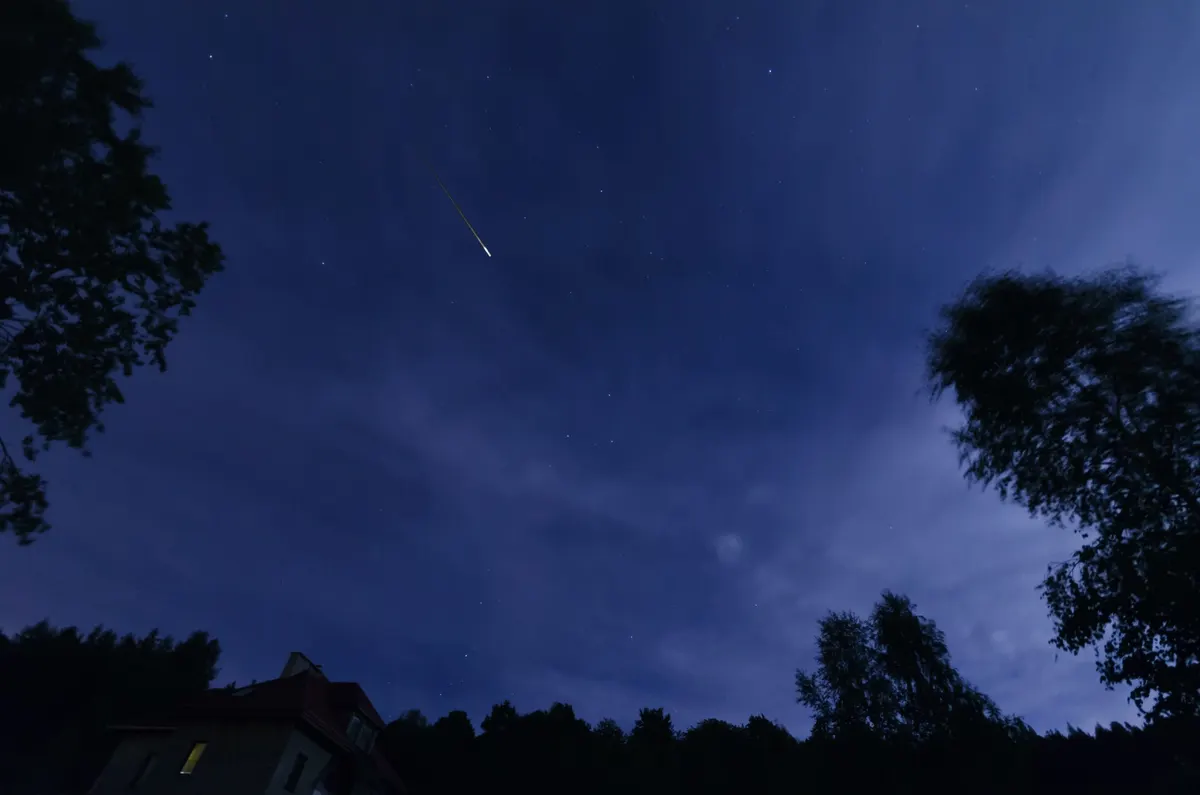
Make a wish, the story goes, because a star just fell out of the sky. It's a lovely line, and it's wrong on the most basic point. No star fell. Stars are colossal furnaces light-years away, and not one of them has ever dropped toward Earth. What you actually saw was a speck of rock, often smaller than a grain of sand, burning itself up a few dozen kilometers over your head. So what is a shooting star, really, if it isn't a star at all?
A shooting star is a speck of space rock burning up, not a star
A shooting star is a tiny piece of space rock, called a meteoroid, vaporizing as it hits the upper atmosphere. NASA's name for the event is a meteor: "when meteoroids enter Earth's atmosphere, or that of another planet, at high speed and burn up, they're called meteors. This is also when we refer to them as 'shooting stars'" (NASA). The bright streak is the glowing trail of torn-off material, made roughly 75 to 120 kilometers up (Wikipedia). The rock itself is usually no bigger than a grain of sand. Nothing about it is a star.
The confusion is understandable. You see a bright point of light moving fast across a field of fixed stars, and your brain files it under "star, but falling." The reality is closer to a dust mote catching fire, and much of that dust is debris shed by comets as their tails stream off them. The real stars in that same view are unimaginably farther away and going nowhere.
Why it isn't a star, by a factor of trillions
It helps to feel the gap in scale. The nearest star other than the Sun sits about 40 trillion kilometers away. A shooting star burns up around a hundred kilometers up, which is roughly the distance from a city to the next one over. One is a sun. The other is a fleck you could have held between two fingers an hour earlier.
These flecks are leftovers from the building of the solar system, broken off asteroids or shed by comets as they loop around the Sun. NASA describes meteoroids as space rocks that "range in size from dust grains to small asteroids." The ones that make the shooting stars you actually notice are at the small end. Most are "about the size of a grain of sand," around a millimeter or smaller (Wikipedia). A pea-sized rock can throw a streak bright enough to make a whole campsite gasp. The flash is dramatic, but the object causing it would be unremarkable sitting in your palm.
There's a separate naming layer worth knowing, because the same rock gets three names depending on where it is: a meteoroid in space, a meteor as it streaks and glows, a meteorite if any piece survives to the ground. That one-rock-three-names distinction trips up almost everyone.
Not friction: the air gets crushed, and crushing heats it
Ask most people why a shooting star glows and they'll say friction, the rock rubbing against the air. That's the second myth, and it's the more interesting one to fix.
The real cause is compression. A meteoroid hits the atmosphere at hypersonic speed, somewhere between 40,000 and 260,000 kilometers per hour (Scientific American). At that pace it can't shove the air out of the way fast enough, so it crushes the gas in front of it into a thin, violently compressed layer. Squeeze a gas hard enough and its temperature shoots up. Meteor scientists are blunt that the glow comes from "atmospheric ram pressure (not friction)" doing the heating (Wikipedia). It's the same physics that warms the air in a bicycle pump when you compress it, just turned up to an absurd degree.
That compressed air gets hot enough to do real damage. When it reaches about 2,000 degrees Celsius, "the solid material in the meteoroid starts to vaporize," and the surface "blows off in a process called ablation" (Scientific American). The streak you see isn't really the rock. It's the trail of glowing, vaporized rock and excited air the rock leaves in its wake as it sheds itself layer by layer.
Why it happens so high, and why it's gone in a second
Both numbers, the altitude and the speed, follow from the same fact: there's barely any air up there, but the meteoroid is moving so fast it doesn't matter. Around 100 kilometers up the atmosphere is wispy, yet at tens of kilometers per second even that thin gas slams into the rock like a wall. The glow starts high, where the speck first meets enough air to heat it, and usually winks out by 50 to 95 kilometers as the meteoroid finishes ablating away (Wikipedia).
That's why a shooting star lasts a heartbeat. A sand grain has almost nothing to burn, and it's burning at thousands of degrees while moving faster than any bullet. By the time your eye registers the streak, the object that made it has already ceased to exist, scattered as a faint smear of vapor in the high atmosphere. The wish-making window is short because the thing you're wishing on is being annihilated in real time.
Showers happen when Earth drives through a comet's litter trail
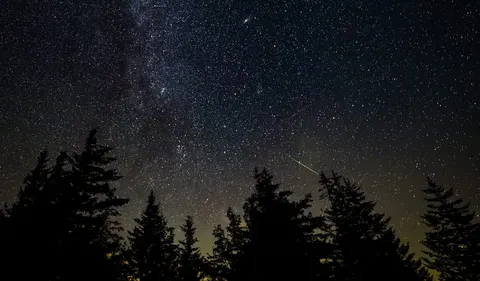
Some nights the sky throws dozens of these at you. That's a meteor shower, and it's not luck. It's a date on the calendar. As a comet swings near the Sun, it sheds a long trail of dust and grit along its orbit. Once a year, Earth plows straight through that trail, and NASA puts it plainly: "Earth passes through the trail of dusty debris left by a comet" (NASA).
The August Perseids are the famous case. "Every Perseid meteor is a tiny piece of the comet Swift-Tuttle," NASA notes, and most of that debris is "between the size of a grain of sand and a pea." So a meteor shower is, in the most literal sense, Earth driving through a comet's litter at well over 200,000 kilometers per hour, with each speck flaring out high overhead. The "stars" are really crumbs off a dirty snowball that passed this way decades ago.
Here's what stays with me. The next time someone points at a streak and tells you to wish on a falling star, you'll know you're watching a grain of comet dust cremate itself a hundred kilometers up, briefly outshining suns that are trillions of kilometers behind it. The wish is optional. The physics is the better story.
Keep wondering: sort out why the same rock is called a meteor, then a meteorite, find out why real stars twinkle but planets don't, and trace the violent cosmic furnaces behind where gold actually comes from.
Join the conversation
Comments are reviewed before they appear. Be kind and stay curious.
Loading comments…