
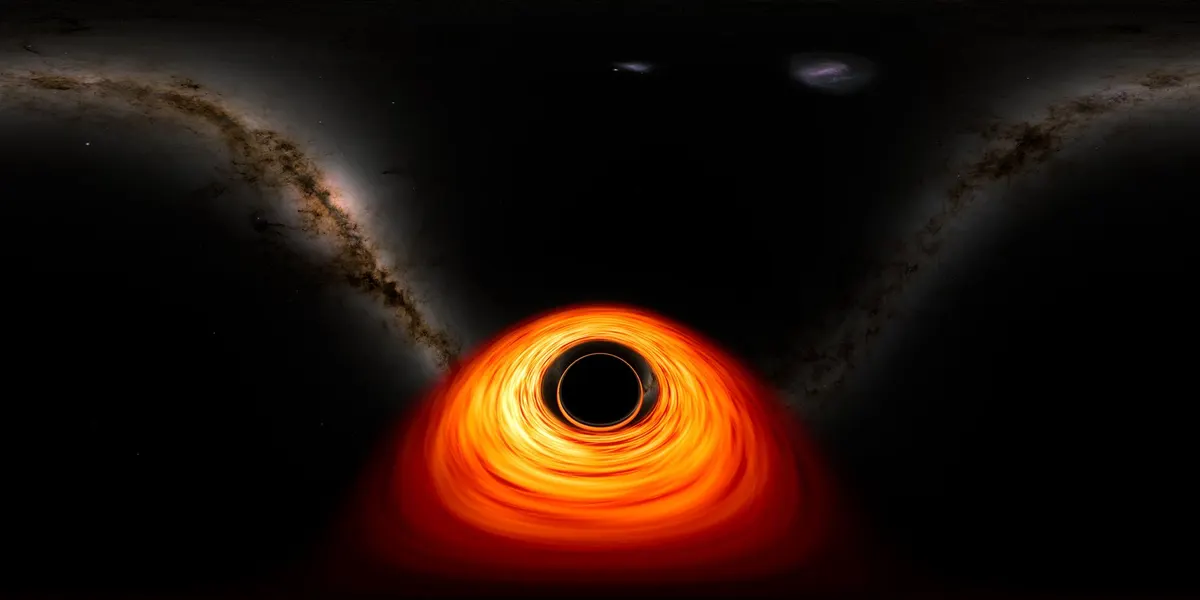
What would a black hole look like if you ran the film backwards? Nothing falls in. Everything comes out. Light and matter pour from a boundary that no ship, no photon and no signal can ever cross going the other way. That object has a name, it has real equations standing behind it, and it has exactly zero confirmed examples anywhere in the sky. So what is a white hole, and why does physics keep describing something it has never once seen?
A white hole is a black hole with the direction of time flipped
A white hole is the time-reverse of a black hole: a region of spacetime that things can leave but can never enter. A black hole's edge is a one-way door inward, where the escape velocity passes the speed of light and nothing gets back out (NASA). A white hole's edge is the same door hung the other way round. It is a legitimate solution to Einstein's field equations (Wikipedia). It is also something no astronomer has ever seen, no known natural process can build, and one classic argument says would tear itself apart almost as soon as it appeared.
So the honest position is awkward and worth stating up front. The mathematics is fine. The object may well be fiction. Those two things are allowed to be true at once, and untangling why is more interesting than either a flat yes or a flat no. If you want the wider picture of what might sit beyond a black hole's edge, that question has its own answer. This one goes at the white hole itself.
Where the solution actually comes from, and why that matters
Karl Schwarzschild solved Einstein's equations for a lone spherical mass in 1916, months after general relativity was published. His solution described what we now call a black hole. But the coordinates he used misbehaved at the horizon, and when later physicists patched that up and followed the geometry as far as it would go, they found the solution was bigger than anyone had ordered.
The full version is called the maximally extended Schwarzschild metric, and "maximally extended" means what it sounds like: keep continuing every possible path until it either runs forever or hits a singularity, and leave no artificial edges. Do that, and the solution contains four regions rather than one. There is the exterior we live in. There is the black hole interior. There is a second exterior universe that our region cannot reach. And there is a fourth region that is the black hole interior with time running the other way, spitting matter out instead of swallowing it (Wikipedia). That fourth region is the white hole. Nobody proposed it. It fell out of the geometry.
Connect the two exteriors through the middle and you get the tube that Einstein and Nathan Rosen described in 1935, the Einstein-Rosen bridge, better known now as a Schwarzschild wormhole (Wikipedia). The black hole is one mouth, the white hole is the other. That is the actual source of every "black holes are tunnels to somewhere else" story you have ever heard.
Here is the detail that most explanations leave out, and it is the one that does the most damage to the white hole's chances. The maximally extended solution describes an eternal black hole: an object that has always existed, was never formed, and will never end. Real black holes are not like that. They are made, violently, when a massive star runs out of fuel and collapses, and the spacetime of a collapsing star is described by a different solution that simply does not contain regions three and four. No known gravitational process produces the white hole region at all.
Why a white hole cannot survive being looked at
Suppose one existed anyway. It would not last.
In August 1974, Douglas Eardley published a short paper in Physical Review Letters with a title that reads like a verdict: "Death of white holes in the early universe" (Physical Review Letters 33, 442). His argument is elegant and fairly brutal. A white hole sits in a universe that has stuff in it. Stray gas, dust, starlight, the faint background glow of everything. All of that is falling toward the white hole's enormous gravity, because a white hole pushes matter out but still pulls on it just as hard as a black hole of the same mass.
That infalling material piles up in a thin shell just outside the horizon. It gets blueshifted and compressed as it accelerates in, and the effect grows exponentially. Given a little time, even a whisper of ambient matter accumulates enough energy near the horizon to collapse on its own. The white hole does not fight it off. It becomes a black hole. Eardley pointed out that this instability is so aggressive that white holes should have been wiped from the early universe essentially at birth.
There is a bleak symmetry in this. The one thing a white hole is defined by, its refusal to let anything in, is undone by the fact that gravity keeps inviting things anyway. It cannot stop matter from approaching. It can only stop matter from crossing. And approaching turns out to be enough.
Why nobody has ever found one
The searching has been about as thorough as the physics allows, which is to say not very, because nobody knows what a white hole is supposed to look like.
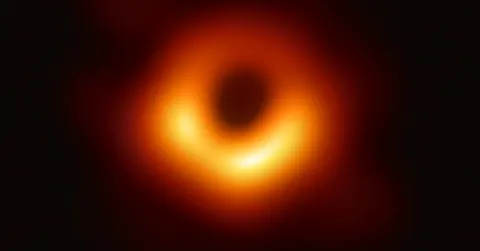
A black hole announces itself through its effects: gas heated to X-ray brightness as it spirals in, stars whipping around an invisible mass, the shadow the Event Horizon Telescope imaged. A white hole would do the opposite, which sounds easier to spot and is not. Something that erupts once, briefly, from a point in space, with no progenitor and no warning, looks like a great many things in astronomy. There is no signature that says white hole rather than some explosion we have not classified yet. As things stand, no astronomical source has been successfully identified as one (EarthSky), and the standard summary is blunt: very few scientists believe white holes exist, and most treat the solution as a mathematical exercise with no counterpart in the real universe (Wikipedia).
That is not the same as proof of absence. It is the more ordinary situation of an idea that predicts almost nothing testable and so cannot be killed, only ignored. Compare that with how black holes die, which is also unobserved but at least makes a specific prediction about a specific glow.
The gamma-ray burst that got people talking
Once, briefly, there was a candidate.
On 14 June 2006, NASA's Swift satellite caught a gamma-ray burst from a galaxy 1.6 billion light years away in the southern constellation Indus. It lasted 102 seconds, which put it firmly in the "long burst" category, and long bursts come from massive stars collapsing, which means they come with a supernova. This one did not. Hubble looked. Nothing. "This was close enough to detect a supernova if it existed," said Caltech's Avishay Gal-Yam. "Even Hubble didn't see anything." Neil Gehrels, who led the Swift mission, put it more simply: "This is brand new territory; we have no theories to guide us" (NASA).
GRB 060614 became the founding member of a new hybrid class: long in duration, short in character, with no dead star to account for it. In 2011, Alon Retter and Shlomo Heller proposed that it was a white hole. Their idea, published as "The Revival of White Holes as Small Bangs" (arXiv), was that a white hole need not linger long enough for Eardley's instability to kill it. It could erupt all at once, a "Small Bang", dumping its matter in a single instant and leaving nothing behind to be destroyed. That sidesteps the stability problem by refusing to give the white hole any lifespan to be unstable during.
It has not caught on. The proposal sits well outside mainstream astrophysics, the theoretical problems with white hole physics are substantial, and one burst with a missing supernova is thin ground on which to build a class of object (Phys.org). GRB 060614 remains unexplained by any single agreed model, which is a very different statement from GRB 060614 being a white hole.
The version of the idea that refuses to die
The white hole has one serious modern life left, and it is a strange one.
Carlo Rovelli and colleagues working in loop quantum gravity have argued that black holes do not simply evaporate away to nothing. Instead, when a black hole shrinks far enough, quantum effects could let it tunnel into a white hole, which then releases what it holds. Rovelli's own one-line summary of the work is that loop quantum gravity predicts black holes evolve into white holes (arXiv). In that picture the white hole is not a weird eternal fixture of spacetime at all. It is a phase, the far end of a black hole's life, and the small leftovers might even be numerous enough to matter cosmologically.
Take that seriously with the appropriate amount of salt. Loop quantum gravity is a candidate theory of quantum gravity, not a confirmed one. The transition has no observational support. It is a proposal made inside a framework that has not itself been tested. What it does show is that the white hole is not quite a fossil: it keeps reappearing whenever physicists poke at the place where general relativity gives up, which is exactly the same place a falling observer would find out what the interior is really like.
There is something almost fitting about that. The white hole is a thing our best theory of gravity can describe perfectly and cannot make, cannot destroy and cannot find. It is what a working equation looks like when the universe declines to take it up.
Keep wondering: the wider question of what lies beyond a black hole's edge is the natural place to go next, then find out how black holes actually end, and if you want the scale all this sits inside, see how big the universe is.

Join the conversation
Comments are reviewed before they appear. Be kind and stay curious.
Loading comments…