
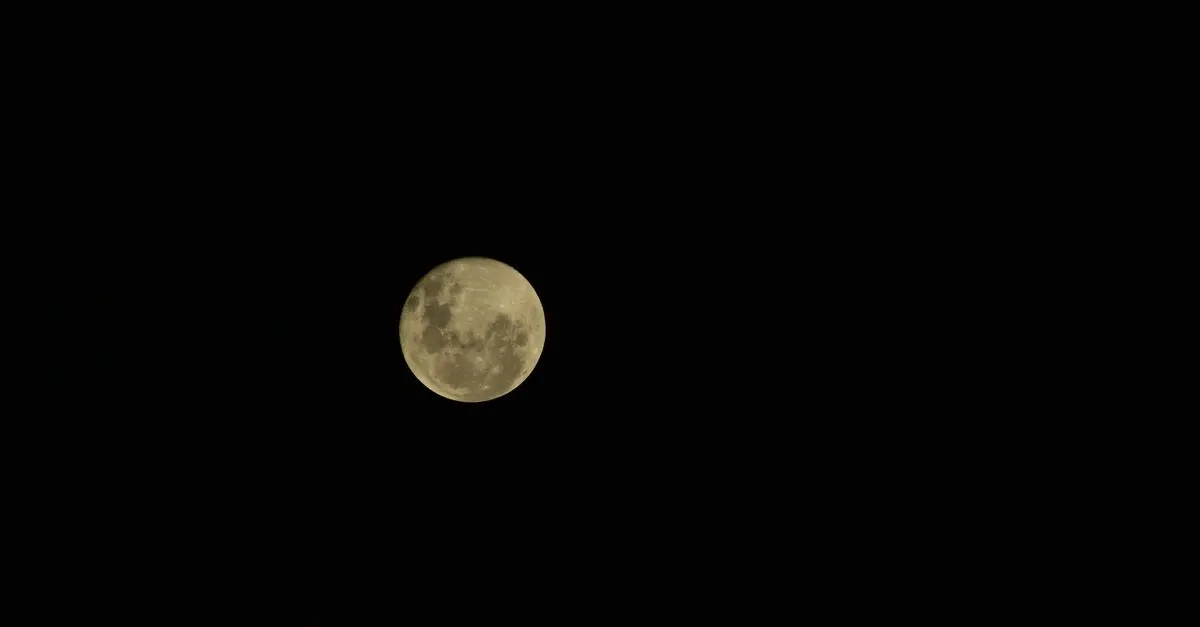
It is the kind of question you ask lying on your back in the grass, watching the Moon hang there looking heavy and close. What if it just fell? Most people picture one apocalyptic moment, a single planet-cracking thump, a flash and then nothing. The truth is stranger and slower than that, and it starts going wrong long before anything touches the ground. The Moon never actually arrives. Something else gets it first.
The Moon would break apart before it ever hit
If the Moon drifted close enough to fall, it would not crash as a solid object. It would shatter into a ring of rubble first, the instant it crossed Earth's Roche limit. That is the distance where Earth's tidal pull on the near side of the Moon grows stronger than the Moon's own gravity holding itself together. For Earth and the Moon that line sits at roughly 19,900 kilometers (BBC Sky at Night). Cross it, and the Moon stops being a moon.
So the honest answer to "what would happen if the Moon crashed into Earth" is that, in the strictest sense, it could not. It would come apart in the sky on the way down. The collision you are imagining gets replaced by something longer and, in its own way, worse. To see why, it helps to walk the Moon in from a safe distance and watch what breaks at each step.
Stage one: the tides go wild
Before any of that, the approach itself would rewrite the planet. The Moon already raises the ocean tides we live with. Pull it closer and the effect does not creep up gently, it multiplies. Tidal force falls off sharply with distance, so halving the gap does far more than double the strain.
The ordinary tides that nudge a harbor up and down would swell into walls of water sweeping inland twice a day, scouring coastlines, drowning low ground, then dragging back out. The seafloor would flex with them. Earth's crust, which already bends a little under the Moon's pull, would heave hard enough to set off earthquakes and wake volcanoes on a schedule, twice every time the Moon swung overhead. None of this needs a single rock to fall. It is just the Moon getting close, leaning on the whole planet at once, and the planet groaning under the weight of being leaned on.
Stage two: the Moon becomes a ring
Then comes the Roche limit, and the tidal force that has been stretching the Moon finally wins. The side facing Earth is pulled harder than the far side, and the Moon, with no internal strength to speak of beyond its own gravity, gives way. It does not explode. It crumbles, drawing out into a long arc of boulders and dust that wraps the planet.
For a while, Earth would have rings. Not the delicate silver of Saturn, but a dark, churning band of broken Moon, close overhead and wide enough to throw a shadow across the daytime sky. It is the same process that built nearly every ring in the solar system: a body wandered too close to its planet and was torn apart, its pieces spread into a circle (BBC Sky at Night). Saturn's rings may be the wreckage of an old moon that crossed exactly this line. What we would be watching is the same event, happening to us, in real time.
Stage three: the bombardment
The rings would not last. Orbits this low decay, dragged down by friction and collisions among the debris, and the rubble would spiral inward, not all at once but in a long, brutal rain. Pieces the size of city blocks and then of mountains would streak in over years, each one a fresh fireball, each impact a regional catastrophe and the largest of them global. The sky would glow with the heat of re-entering rock. Whole continents would take hits. The dust and vapor thrown up would wrap the planet and dim the Sun for a long time after, the way the worst impacts in Earth's past did.
This is the part the single-thump version of the question gets wrong. There is no clean moment of collision to brace for. There is a slow demolition, spread across years, as the Moon comes down piece by piece instead of all at once.
The same Moon that gave us gentle tides and the craters we read like a logbook would now be writing those craters into our own ground. It is a grim picture, and it is worth saying plainly before the good news lands.
The reason none of this will happen
Here is the twist that lets you sleep tonight: the Moon is not falling toward us. It is leaving. Every stage above, the tides, the ring, the long rain of broken rock, depends on the Moon coming closer, and the Moon is doing the exact opposite.
The Moon drifts away from Earth at about 3.8 centimeters per year, roughly the rate your fingernails grow. That is not a guess. We know it to within a few millimeters because Apollo astronauts left mirror-like retroreflectors on the surface, and observatories around the world still fire lasers at them and time how long the pulse takes to bounce back (NASA JPL). Every year the round trip takes a hair longer, because the Moon is a little farther out than it was. The mechanics of why it keeps receding come down to the tides quietly handing energy back and forth between the spinning Earth and the orbiting Moon, but the headline is simple: the gap is widening, not closing. Run the clock forward and the Moon does not crowd in, it shrinks into the distance.
There is no natural force that would reverse it and shove the Moon back in. The whole scenario, the rings, the bombardment, all of it, runs in exactly the wrong direction. We are not waiting for the Moon to fall. We are slowly, quietly being left behind by it.
So the next time it looks close enough to touch, you can enjoy the illusion. The Moon hanging there is not creeping in for a collision. It is on its way out, one fingernail's width at a time, and the worst it will ever do is keep the cold, still surface we already know.
Keep wondering: read why the Moon is drifting away from Earth in the first place, where all its craters came from, and what would happen if the Sun simply vanished.


Join the conversation
Comments are reviewed before they appear. Be kind and stay curious.
Loading comments…