
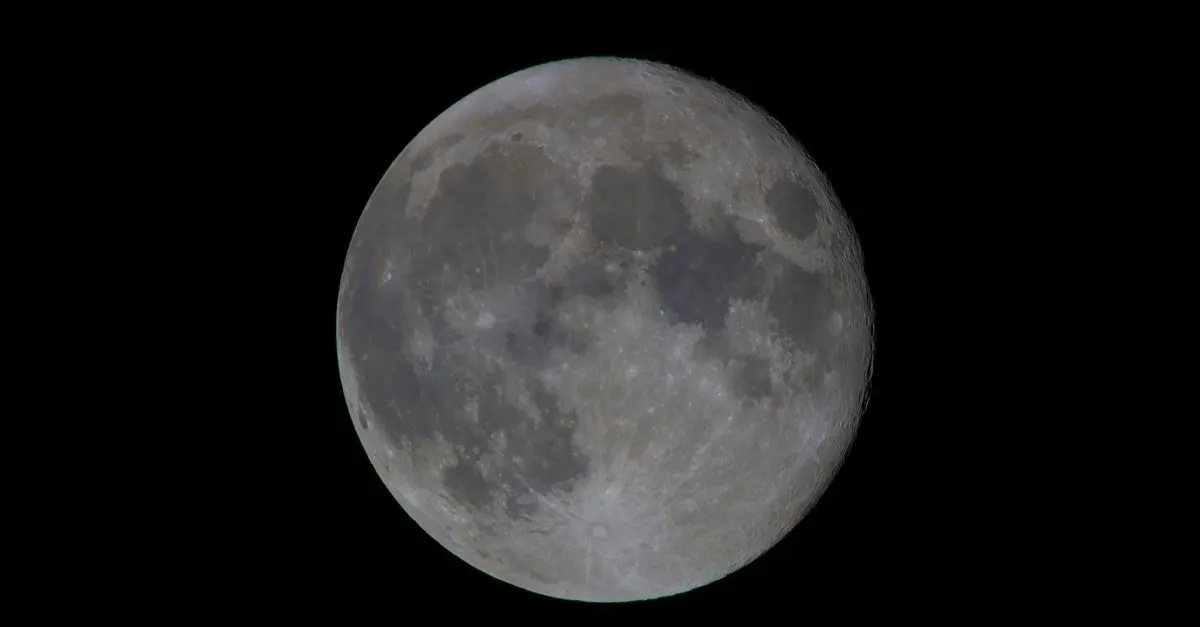
The Moon is leaving. Not dramatically, not all at once, but steadily, by about 3.8 centimeters every year, roughly the speed your fingernails grow. It doesn't sound like much. Over a human lifetime it adds up to a couple of meters. But it has been happening for billions of years, the Moon was once far closer and far bigger in the sky, and the same slow drift is quietly stretching out the length of your day. The strangest part is how precisely we know all this: from mirrors astronauts left on the Moon more than fifty years ago.
The tides are pushing it away
Here's why the Moon is moving away from Earth: the tides. The Moon's gravity pulls the oceans toward it, raising a bulge of water on the side of Earth that faces the Moon. But Earth spins on its axis once a day, far faster than the Moon takes to circle us, about 27 days. So Earth's rotation drags that tidal bulge slightly ahead of the Moon instead of letting it sit directly beneath it (Wikipedia, tidal acceleration).
Now you have a giant lump of water, sitting ahead of the Moon, with its own gravity. It tugs the Moon forward along its orbit, like a hand on its back giving a constant gentle push. That extra energy doesn't speed the Moon up in place; in orbital mechanics, adding energy lifts you into a higher, wider orbit (University of Illinois, Physics Van). So the Moon climbs, a few centimeters a year, and it never stops.
Earth pays for it in time
None of that energy comes from nowhere. The Moon gains it, and Earth loses it. As the tidal bulge pulls the Moon ahead, the Moon pulls back on the bulge, and that drag acts like a brake on Earth's spin. Our planet is very slowly winding down (Live Science).
The effect is tiny but relentless: the day is getting longer by something like one to two milliseconds every century. Run that backward and the deep past looks strange. When the Moon first formed, around 4.5 billion years ago, it was close enough that an Earth day lasted only a handful of hours (Live Science). The dinosaurs lived on a planet that spun faster than ours, with shorter days and a closer, larger Moon overhead. The Moon's retreat and the slowing of our clock are two halves of the same bargain.
Measured with mirrors on the Moon
How do you catch a 3.8-centimeter drift across nearly 400,000 kilometers? You bounce light off the Moon. When Apollo astronauts visited, they set down panels of retroreflectors, special mirrors that send a beam straight back the way it came. Ever since, observatories on Earth have fired laser pulses at those panels and timed exactly how long the light takes to return (Live Science). Light covers the round trip in about two and a half seconds, though a crewed ship plodding across the same gap is a different story, as you find out in how long it would take to get to the Moon. Timing that laser pulse to a fraction of a billionth of a second pins the Moon's distance down to centimeters. Fifty years of those measurements is how we watch the Moon inch away in real time. The astronauts are long gone, but the mirrors are still up there, still working, still answering.
The Moon you see is the closest it will ever be
Sit with what the drift means for the view. Because the Moon is slowly receding, the Moon in tonight's sky is a hair larger than the Moon your great-grandchildren will see. Wind forward far enough, hundreds of millions of years, and the Moon will hang small enough that it can no longer quite cover the Sun. The total solar eclipse, that rare perfect overlap where the Moon blots out the Sun and reveals its corona, is a coincidence of this exact era. The Moon happens to be just the right distance, right now, to match the Sun's size in our sky. Give it enough time and that ends, and future skywatchers will only ever see the Sun's edge blazing around a too-small Moon.
We tend to treat the night sky as the one thing that never changes. It's changing, slowly, every night. The Moon is drifting off, our days are quietly lengthening to match, and we happen to be alive in the brief window when the two great lights in our sky are the same size. The Moon won't leave us, the math won't allow it, and the dying Sun will rearrange everything long before it could. But it is, gently and measurably, putting distance between us.
Keep wondering: the Moon has more stories than you'd guess, from why it's so cratered to whether it makes its own light and what would happen if the Sun simply vanished.


Join the conversation
Comments are reviewed before they appear. Be kind and stay curious.
Loading comments…