
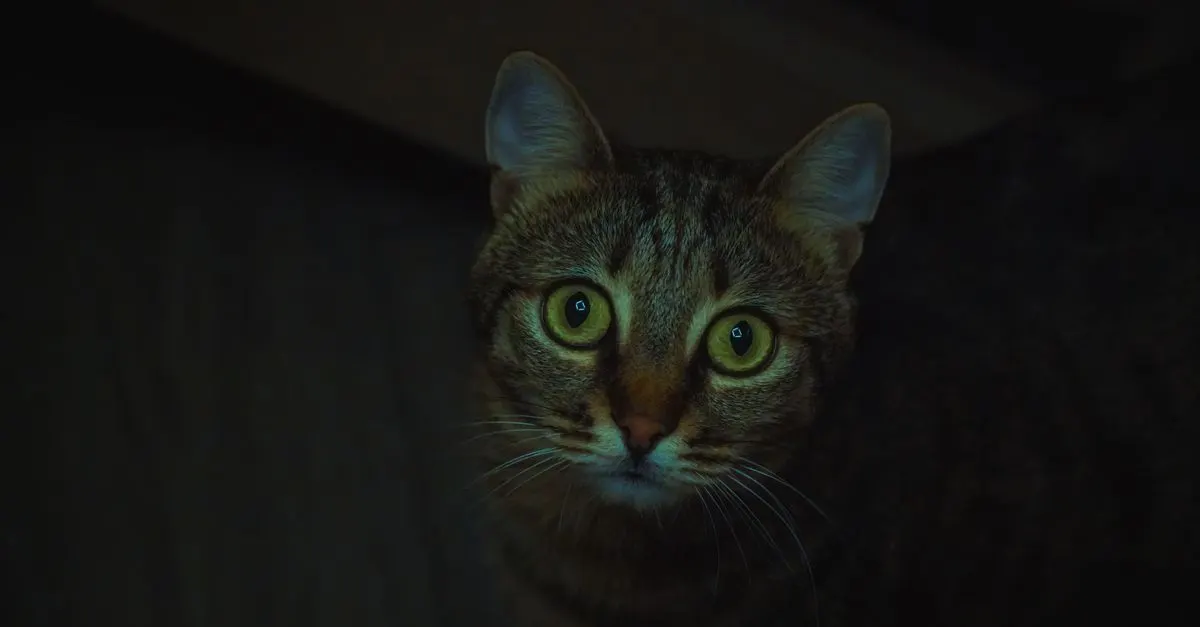
You've seen it on a dark road or down a midnight hallway: two coins of green-gold fire, hanging in the black, that turn out to be a cat. The same mirror-backed eyes are why a deer freezes in your headlights, overwhelmed by a light its night vision was never built for. The eyes look lit from within, like a small animal carrying its own lanterns. It's one of the eeriest sights in nature, and it rests on a misunderstanding. A cat's eyes don't glow. They have nothing to glow with. What you're seeing is light, your headlights, a streetlamp, a phone screen, going into the cat's eyes and coming back out.
A mirror at the back of the eye
Here's why cats' eyes glow in the dark: behind the retina, a cat has a thin reflective layer called the tapetum lucidum, Latin for "bright tapestry." It works exactly like a mirror (Carnegie Museum of Natural History). When light enters the eye, it passes through the retina, where light-sensing cells try to catch it. Whatever they miss would normally be lost, soaked up by the back of the eye and gone. The tapetum stops that. It bounces the missed light straight back through the retina, giving those cells a second chance to grab it. And the sliver of light that still isn't absorbed passes back out through the pupil, toward you. That returning light is the glow.
So the eyes aren't producing anything. In a truly dark room, with no light at all going in, a cat's eyes don't shine. The lanterns only switch on when there's light to reflect.
Why a cat bothers with a built-in mirror
The whole arrangement is a night-vision upgrade. By giving the retina two passes at every photon instead of one, the tapetum squeezes far more vision out of very little light, boosting the sensitivity of a cat's eye by around 44 percent (VCA Animal Hospitals). The payoff is dramatic: a cat can see in roughly one-sixth the light a human needs. Dawn and dusk, the hours when cats most like to hunt, are bright as afternoon to them. The glow is just the visible side effect of an eye built to make the most of the dark.
Why the glow comes in colors
That green-gold shade isn't random either. In cats the tapetum is built largely from riboflavin and zinc, and the amount of zinc tweaks the color of the light it throws back (Popular Science). Most cats glow a greenish gold, but the range runs through yellow and even blue, and it can differ from one cat to the next. A young kitten's eyeshine can even be a different color than the eyeshine it grows into as an adult. Shine a light at a dog, a deer, or a raccoon and you'll catch the same trick in a slightly different hue, because all of them carry their own version of the same reflective layer.
Why your own eyes stay dark
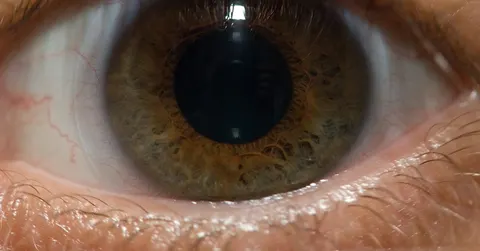
Here's the part that puts it in perspective: humans don't get to do this. We have no tapetum lucidum at all (Carnegie Museum of Natural History). Light our retinas miss is simply absorbed and gone, with no mirror to send it back, which is exactly why our eyes don't shine in the dark and why we're so much worse at seeing in it. The closest we come is the "red-eye" in a flash photo, and even that is a different, fainter thing: that red is light glancing off the blood vessels at the back of the eye, not a mirror doing its job. It's a leak, not a feature.
That contrast is really a story about trade-offs. Cats gave up some daytime detail and color for a glowing, light-hoarding eye that owns the dark. We gave up the dark for sharp, colorful daylight vision. So the next time a pair of eyes flares green at the edge of your flashlight beam, you're not looking at something magical or sinister. You're looking at your own light handed back to you, bounced off a tiny mirror evolved for a world you can barely see in.
Keep wondering: light plays tricks all over the living world, from creatures that actually make their own glow to why people have different eye colors, and the cat keeps plenty of other secrets, like why it kneads.
Join the conversation
Comments are reviewed before they appear. Be kind and stay curious.
Loading comments…