
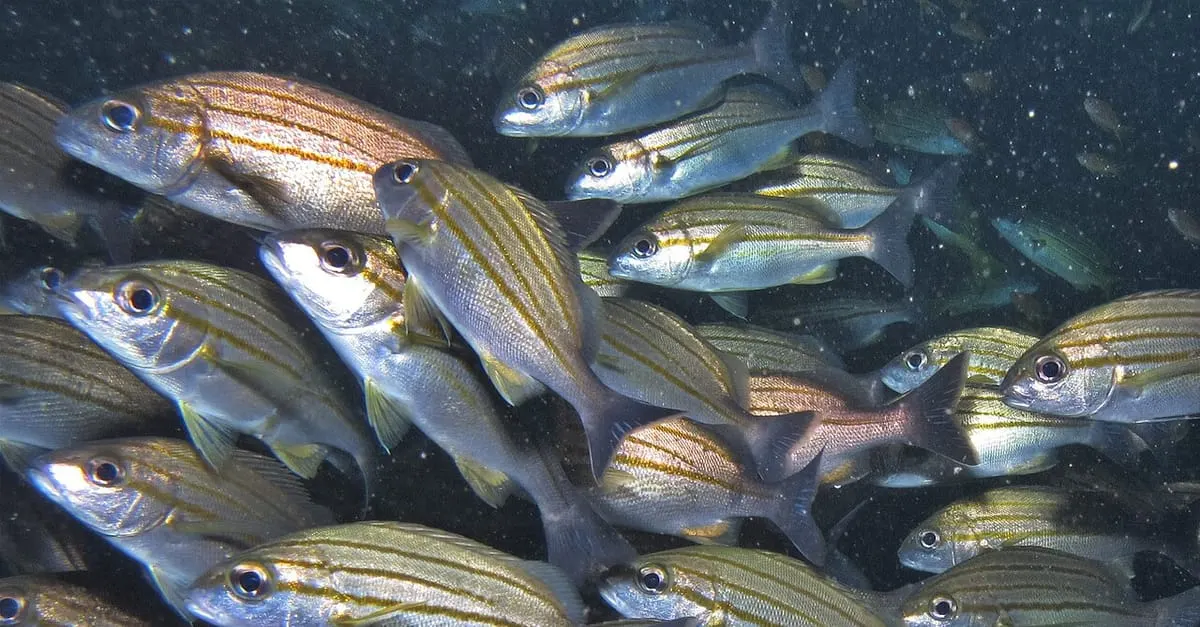
Watch a school of silvery fish turn all at once, a thousand bodies banking like a single curtain pulled through the water, and the obvious question is how they do it without crashing. The better question is why they bother. Swimming shoulder to shoulder with a crowd seems like a fast way to share your food and advertise your location to anything hungry. So why do fish swim in schools? Predator avoidance is one reason, but the answer changes with the species and situation.
Safety in numbers is one important reason
A school can help with predator avoidance, but it is not a single-purpose behavior. Separating from a group can increase a fish's exposure to predators in some species, while schooling can also help fish locate food, reproduce, communicate with neighbors, and reduce the energy cost of swimming (fish-schooling review). The balance changes across species and situations.
The first is the confusion effect. To a predator, a school is a wall of near-identical, silvery, same-sized bodies all moving at once. Picking one target out of that shifting mass overloads the hunter's visual system, and a swirling crowd can scramble its other senses too, the pressure-detecting lateral line and, in some predators, electrical sensing (Wikipedia). A predator that cannot commit to a single fish often ends up lunging at the gap between them and coming up empty.
You are just one of many
The second trick is plain arithmetic, called the dilution effect. When a predator does strike, it can only grab a small share of a big group, so the odds that you are the unlucky one shrink as the crowd grows (Wikipedia). Bury yourself in a school of ten thousand and any one attack is likely to take someone else.
Biologists sometimes call this the selfish herd. No fish is being noble by joining the group. Each one is trying to put other bodies between itself and the danger, and the school is just what you get when every individual plays that same self-interested game at the same time.
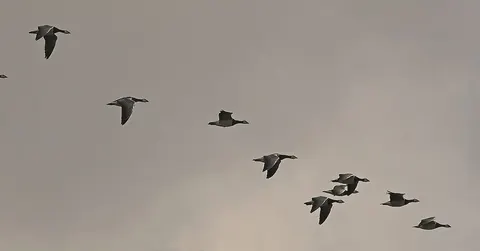
Then there are the eyes. A fish alone has to split its attention between feeding and scanning for threats. In a school, that scanning gets spread across hundreds of individuals, so danger gets spotted sooner and each fish can spend more time eating and less time watching for shadows (Wikipedia). One fish flinches, the alarm ripples outward in a fraction of a second, and the whole group reacts at once. Birds bank together for much the same reason, which is part of why geese fly in a V.
Schooling is not only about predators
Predator avoidance matters, but it is not the whole story. Crowds can also help fish find things. When fish search for a patch of food together, larger groups can locate it faster because individuals watch their neighbors and follow those that have found food (fish-schooling review). The school can act as a moving information network.
It helps with mating, too. If you already live surrounded by your own kind, you never have to go looking for a partner, and many fish ride their schools across long spawning migrations, navigating more accurately as a group than any one of them could alone. The same crowd that hides you from a hunter delivers your next meal and your mate.
A school may also save fish energy
A school is not only a social huddle, it is also a piece of fluid dynamics. Every swimming fish leaves a wake, a trail of spinning whirlpools called vortices. A fish swimming behind a neighbor can time its tail beats to push against those swirls and get a free shove, a bit like a cyclist drafting in the slipstream of the rider ahead.
For years that was a theory waiting on proof. A 2020 study then tracked real goldfish and robotic ones and found that followers do tune their tail beats to the wake of the fish in front, a strategy the authors named vortex phase matching, and that doing so typically saves energy (Nature Communications). The "typically" matters: the savings depend on position and timing, not on simply tagging along. The fish even managed it with their eyes and lateral line knocked out, which hints that the body falls into the energy-saving rhythm on its own. A leading position can carry a different aerodynamic cost, but that does not establish a universal rule that fish must rotate or drift backward.
Shoaling, schooling, and the difference between them
One last bit of fine print, because biologists are picky about it. Shoaling and schooling are not quite the same thing (Wikipedia). A shoal is any group of fish hanging together for social reasons, swimming somewhat loosely and independently. A school is tighter and disciplined: the fish all point the same way, holding the same speed and spacing, moving like a single organism. The two states are not fixed. A relaxed shoal nosing around a reef will snap into a coordinated school the instant a shark slides into view, because that is exactly the moment the confusion and dilution tricks earn their keep.
There is no single reason fish school. Depending on the species and situation, the group can confuse predators, spread risk, improve food finding or reproduction, carry information between neighbors, and reduce swimming costs. The same moving crowd can solve different problems at different moments.
Keep wondering: those same fish are pulling off another quiet feat just to breathe, which is how fish breathe underwater; the open water they school in gets stranger and darker the deeper it goes, all the way down through how deep is the ocean; and some of its residents skip the crowd entirely and glow instead, which is why sea creatures glow.


Join the conversation
Comments are reviewed before they appear. Be kind and stay curious.
Loading comments…