
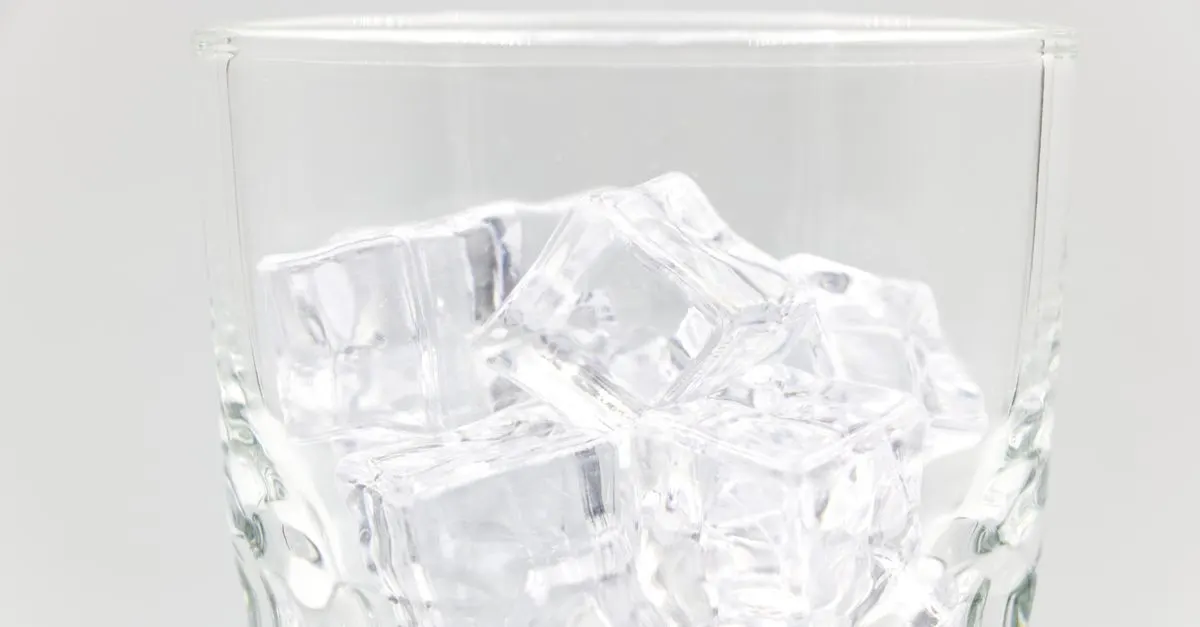
Drop a cube into a glass of water and you usually get a little reward for it: a sharp crack, sometimes a run of pops and snaps, occasionally a hairline fault spreading across the ice while you watch. It feels almost alive. It is one of those tiny everyday physics demos hiding in plain sight, and the reason behind it is the same reason a cold glass can shatter under hot water.
Ice cracks in water because of thermal shock
Ice cracks the moment it hits warmer water because of thermal shock: the outer layer of the cube heats up and tries to expand while the still-frozen core stays cold and the same size, and that tug-of-war builds more stress than the brittle ice can hold (Physics Van, University of Illinois). Something has to give, so a crack races through the cube. That snap you hear is the sound of the ice relieving the strain the only way it can.
The tug-of-war inside the cube
When water touches the surface of a cube, that surface warms up fast. Like most solids, warming ice wants to expand a little (ScienceABC). But heat moves slowly through ice, so the inside of the cube is still sitting at freezer temperature and barely changes size at all.
Now you have one solid object trying to be two different sizes at once. The warm shell pulls to grow while the cold core refuses to budge, and the boundary between them gets squeezed and stretched. Engineers call that uneven growth differential thermal expansion, and the strain it produces is the whole story. When the strain climbs past what the material can take, it fails and fractures (Wikipedia).
The reason ice gives up so readily is that ice is brittle. It cannot bow or stretch to absorb the mismatch the way a rubber band would. Faced with stress it cannot accommodate, it simply breaks, and the crack runs along the cube's weakest planes, often the tiny air pockets frozen inside it.
Why some cubes barely whisper and others go off like popcorn
The loudness is not random. It tracks the temperature gap. The colder the ice and the warmer the water, the bigger the size mismatch between shell and core, and the more violently the ice has to crack to release it (Physics Van). A cube straight from a deep freezer dropped into a warm cocktail will snap far more than a soft, half-melted one slid into ice-cold water.
This is why bartenders and clear-ice fans pay attention to it. A big, slow-melting cube hauled out of a chest freezer and dropped into a room-temperature spirit gives that dramatic crackle people love in a good whiskey pour. The cube is not flawed. It is just announcing the temperature shock in real time. Let the same cube warm up on the counter for a minute first and it goes in almost silent, because you have shrunk the gap that drives the whole effect.
The same trick can shatter a glass
Here is where the kitchen demo turns into a genuine warning. Glass plays by the exact same rules. Pour boiling water into a cold glass and the inner surface heats and expands while the outer surface stays cool and tight, and that uneven expansion can drive a crack clean through brittle glass (Wikipedia).
The difference is scale and consequence. An ice cube relieves its stress with a harmless pop and a few hairline faults, because it is small and the temperatures even out in seconds. A glass full of boiling water holds a steep temperature gap long enough for a crack to travel, and a glass shattering in your hand is a worse afternoon than a crackling drink. Borosilicate glass, the stuff measuring jugs and lab beakers are made from, shrugs it off because it barely expands when heated, so the mismatch never gets large enough to break it.
So the next time ice snaps in your glass, you are hearing the same physics that engineers design around in cookware, kilns, and spacecraft heat shields, scaled down to something you can hold. A cold thing met a warm thing, one side grew faster than the other, and something brittle settled the difference. It is a small sound, but it is the whole principle, performed for free in your drink.
Keep wondering: find out why ice floats instead of sinking like most frozen things, why salt melts ice on a winter sidewalk, and why metal feels colder than wood at the very same temperature.


Join the conversation
Comments are reviewed before they appear. Be kind and stay curious.
Loading comments…