
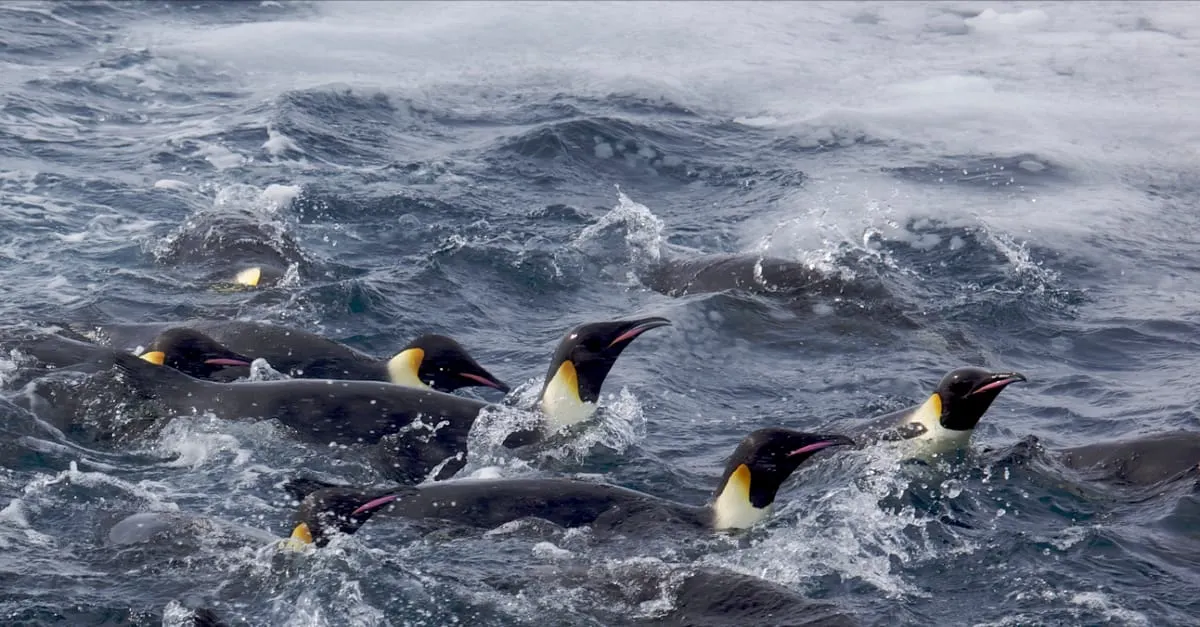
How long can penguins hold their breath? An emperor penguin, the best diver of the bunch, usually stays under for 3 to 6 minutes, but the longest dive anyone has ever clocked ran 27.6 minutes on a single breath. No tank, no tube, just the air the bird carried down with it. So how does an animal the size of a small child outlast a free diver who has trained for years? It does not simply hold more air. It hides air where you would not think to look, then spends it like a miser.
Emperor penguins are the record holders
The emperor penguin sets every number worth knowing here. On a normal foraging trip its dives last about 3 to 6 minutes each, already long for a bird (Australian Antarctic Program). When the hunt drags on, it goes much further. The longest emperor dive on record ran 27.6 minutes, the longest of any bird, and a handful have crossed the 20-minute mark (SeaWorld). That 27.6-minute figure is the one usually quoted; researchers have since logged an even longer outlier, but the famous record is the one most sources still cite.
Depth runs on a separate scale. The deepest dive ever recorded for an emperor reached about 564 meters, deeper than any other bird goes, and that single dive lasted roughly 22 minutes (Australian Antarctic Program). Most of their dives stay far shallower, usually between 100 and 200 meters, because that is where the fish are. The extremes are the exception, not the commute. Smaller penguins, the little ones you see at zoos, surface much sooner, often after a minute or two.
Air in the muscles, not just the lungs
Here is the trick. A penguin going deep is not leaning mainly on one big lungful of air. It carries oxygen in three places at once: the blood, the lungs, and the muscles (Scripps Institution of Oceanography). That third one is the surprise, and it is the same reason fish manage without ever surfacing at all, just solved with a different toolkit than the gills that let fish breathe underwater.
Penguin muscle is loaded with myoglobin, the protein that makes meat dark red, except penguins carry it in extraordinary amounts. Myoglobin grabs oxygen and holds it right inside the muscle, so the legs and flippers bring their own private fuel supply down with them. When the blood can no longer deliver oxygen fast enough, the muscles keep working off the reserve packed into their own cells.
Slowing the body to a crawl
Storing oxygen is only half of it. The other half is refusing to waste any. The moment a penguin dives, its body triggers the dive response, the same reflex that flickers on when you splash cold water on your face, only far stronger. The heart slows hard. An emperor's normal rate of around 70 beats per minute can drop to as low as 10 during the deepest part of a dive (University of Bristol).
At the same time, blood vessels clamp down and reroute the flow. Organs that can sit idle for a few minutes get cut off, and the oxygen goes to the brain and heart, the parts that cannot pause. Around five minutes in, the penguin crosses what physiologists call its aerobic dive limit, and lactic acid starts building up in its blood (Scripps Institution of Oceanography). That burn is the wall most animals hit and turn back from. The penguin tolerates it and keeps going, which is how a six-minute fuel budget stretches into a twenty-minute dive. Down at depth there is a payoff working in its favor too: the crushing pressure squeezes its compressible air sacs small, so less buoyant air fights it on the way down.
How a person stacks up
Put a human next to this and the gap is almost rude. An untrained person can hold their breath for about 30 to 90 seconds before the urge to breathe becomes impossible to ignore (Medical News Today). Elite free divers train for years to stretch that out, and even they fall short of an ordinary emperor's everyday dive.
The penguin is not holding its breath the way you do, white-knuckled and counting. It rebuilt the whole problem. We get one oxygen tank and a panic button wired to it. The penguin spread its oxygen across three reservoirs, turned its heart down to a slow drip, and learned to ignore the alarm. It is clumsy on land for the same reason it is untouchable below the surface: every part of it is built for the dive, not the walk. That tradeoff, body shaped by where an animal lives, is the same logic behind why polar bear skin is black under all that white fur.
Keep wondering: those record dives plunge into a world most life never sees, which raises the question of how deep the ocean really goes, and down in that dark some of the locals make their own light, which is why sea creatures glow.


Join the conversation
Comments are reviewed before they appear. Be kind and stay curious.
Loading comments…