
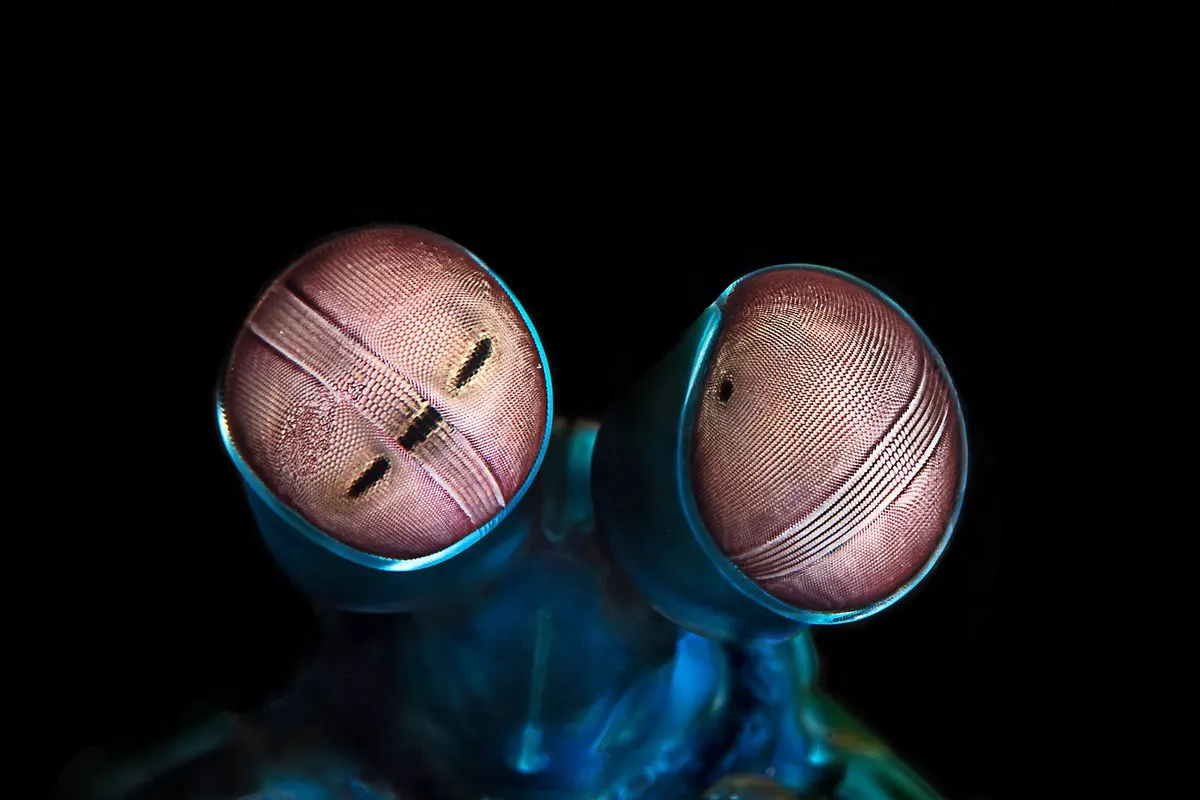
Twelve. That is how many color channels sit in a mantis shrimp's eye, against three in yours. Count the receptors handling polarized light and brightness too, and some species reach sixteen. The internet did the obvious arithmetic and decided these animals must see a rainbow we cannot even imagine. How many colors can a mantis shrimp see, then? Fewer than you, in the way that actually counts. The arithmetic is wrong, and the way it is wrong is more interesting than the myth.
Twelve color channels, and worse color vision than yours
A mantis shrimp almost certainly sees fewer colors than you do. In 2014, Hanne Thoen, Martin How, Tsyr-Huei Chiou and Justin Marshall trained the thumbnail-sized stomatopod Haptosquilla trispinosa to pick one colored light over another for a food reward, then slid the two colors closer and closer along the spectrum until the animals started guessing. They started guessing early. The team's paper in Science called the performance "surprisingly poor." A later review from Marshall's own lab put a number on it: stomatopod spectral discrimination is roughly ten times worse than in goldfish, butterflies, birds and humans tested the same way. Once two colors sat within between about 15 and 25 nanometers, depending on the wavelength of each other, accuracy dropped to around chance. Your eye, with a quarter of the hardware, separates wavelengths 1 to 4 nanometers apart.
Both 12 and 16 are the right number
The two figures you see quoted describe different things, which is why nobody can agree on one. Cronin, Bok, Marshall and Caldwell counted 16 functional photoreceptor classes in species whose eyes carry six rows in the midband, the strip of specialized ommatidia running across the middle of each bulging eye. That is the whole inventory, and it is the most diverse retina known in any animal. Only twelve of those classes are doing color. Those twelve sample narrow slices of light from deep ultraviolet to far red, 300 to 720 nanometers, with three of them sitting in the ultraviolet alone. The other classes are handed over to polarization and brightness.
So the honest sentence is this: twelve color channels, sixteen receptor classes in total, and no evidence of a secret rainbow behind any of them.
Your color vision is arithmetic, and theirs may not be
Here is the part that makes the result make sense. Human color is a comparison. Three cone types respond broadly and overlap heavily, and what you actually perceive comes from your brain weighing one cone's output against another's. The colors live in the comparison, not in the receptors. That is why three sloppy detectors and a lot of neural work beat twelve sharp ones with no work behind them. It is the same reason eye color itself tells you nothing about how well someone sees: the interesting machinery is not the part you can look at.
Thoen's team found no sign of that comparison in the mantis shrimp. The behavior ruled out the standard color-opponent system. What they proposed instead is that each of the twelve channels works as a standalone wave-band detector, and the animal scans its eyes across a scene so the receptors sweep it in sequence, like a photocopier bar passing over a page. Color would then arrive as a pattern of which channels fired, read directly, with nothing compared and nothing computed. Marshall and Thoen later co-wrote a commentary in i-Perception making the trade explicit: a system like that would suit an animal with a small brain and a need for fast hunting decisions, where a color has to be recognized rather than measured. It is coarse on purpose. Twelve narrow detectors that never talk to each other cannot outperform three broad ones that do.
This is the same animal that fires the fastest punch in the ocean in a few thousandths of a second. Fast and rough is a theme.
The story is not finished
The barcode idea is a hypothesis, not a verdict, and the researchers who proposed it say so. The 2022 review from Marshall's lab is titled "more questions than answers" for a reason, and it flagged that stomatopods held under artificial light get worse at color tasks over time, which means husbandry may have shaped some earlier results. Then in 2025, Ching-Wen Judy Wang and Marshall published what they call the first direct behavioural evidence of spectral opponency in stomatopods, and argued for a hybrid: some comparison, plus some of the pattern-reading. So the myth is dead, but the replacement is still being built. What survives every version is the core finding. More receptors did not buy better color.
What they do have that you never will
The genuinely extraordinary part of these eyes was never the color. In 2008, Tsyr-Huei Chiou and colleagues reported in Current Biology that the stomatopod Gonodactylus smithii detects circularly polarized light, where the wave corkscrews as it travels. It was the first animal known to do it, and the paper called it a visual feat never expected in the animal kingdom. Mantis shrimp read linear polarization too, and some of them signal to each other with polarized patterns on their bodies, a private channel most predators cannot open. It is a sense with no human analogue at all, which is presumably why it never went viral. There is no picture you can post of what it looks like.
The internet wanted the mantis shrimp to be a better version of us, seeing our colors and then some. It is stranger than that. It is an animal that took a completely different road out of the same problem, arrived somewhere worse by our measure, and kept a sense we have no word for. Being outperformed is boring. Being unimaginable is not.
Keep wondering: the ocean is full of animals whose eyes and skins break the rules we assume, so try how octopuses change color while probably being colorblind, then why cats' eyes glow in the dark, and go deep with why so many sea creatures make their own light.
Join the conversation
Comments are reviewed before they appear. Be kind and stay curious.
Loading comments…