
Cosmology can tell you the age of the universe to within a fraction of a percent. It cannot tell you whether the universe ends. Is the universe infinite? That is not a funding problem or a technology problem that better telescopes will fix in twenty years. The measurement we have is real, it is precise, and it still does not settle it. The trouble is baked into the question, and it may never come out.
So when someone asks whether the universe is infinite, physicists give the answer they almost never give about anything else. They just say they don't know.
Nobody knows, and the measurement we rely on cannot decide it
No one knows whether the universe is infinite, and the best evidence we have, the shape of space itself, is not able to settle the question. Space measures flat. The European Space Agency's Planck satellite, combined with galaxy survey data, pins the curvature of the universe at 0.001 plus or minus 0.002 in the units cosmologists use, which is zero to within the error bars. A perfectly flat universe can run on forever. But a flat universe can also be finite and wrapped back on itself with no edge anywhere. And a gently curved universe, one far bigger than the patch we can see, would read as flat too, because the curvature would hide inside those error bars.
Infinite is permitted. Infinite is not proven. Nobody has an experiment on the calendar that would prove it.
The 93 billion light-year bubble is a horizon, not a wall
Start with what we can actually see, because almost every confusion about this question begins there.
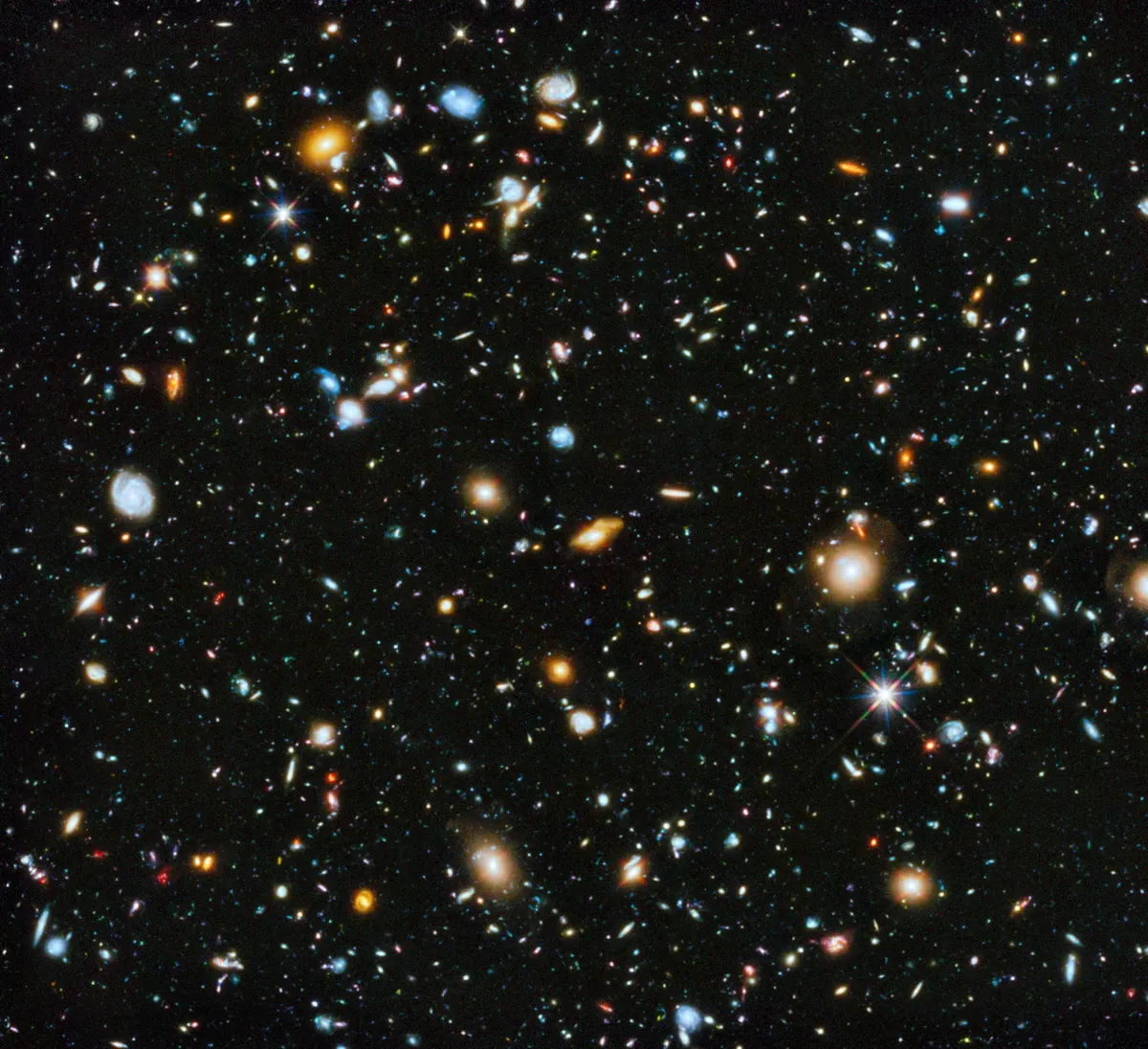
The observable universe is a sphere roughly 93 billion light-years across with us at the centre. That is not because we are special. Light travels at a finite speed and the universe has been expanding for a finite time, so there is a maximum distance from which anything has had a chance to reach us yet. Anyone standing anywhere else has their own sphere of the same size, centred on them, overlapping ours.
The number surprises people, since the universe is only 13.8 billion years old. But space stretched while that ancient light was in transit, carrying its source farther off, so the objects whose light is arriving now sit about 46.5 billion light-years away today. Double that for the diameter and you get 93.
Here is the part that matters. That boundary is a horizon, not a barrier. There is nothing there. It is the cosmic equivalent of the line where the sea meets the sky when you stand on a beach: real, measurable, and entirely a fact about you rather than about the ocean. Sail toward it and it moves. Nothing in the physics suggests the universe stops at the edge of what we can observe, and the size question has never had a ceiling on it, only a floor.
So every claim about the whole universe is an extrapolation from one bubble. That is the difficulty in one sentence.
Flat, closed, or saddle-shaped: the three geometries on the table
General relativity allows space to have one of three overall geometries, and you can tell them apart with a big enough triangle.
In a flat universe, triangles add up to 180 degrees and parallel lines never meet, exactly as your school geometry taught. In a closed universe, space curves like the surface of a sphere: triangles come out fatter than 180 degrees, and parallel lines eventually converge, the way two people walking north from different points on the equator end up meeting at the pole. In an open universe, space curves the other way, like a saddle, and triangles fall short of 180 degrees.
The consequences are not subtle. A closed universe has finite volume, guaranteed. A flat or open one can be infinite. So measure the curvature and you learn something enormous about how much universe there is.
We can measure it. The trick is drawing a triangle big enough to matter, and the universe drew one for us. The cosmic microwave background, the oldest light in the sky, is speckled with hot and cold blotches whose true physical size is calculable from known physics. We know how big those blotches are, and we can see how big they look. Compare the two and the geometry of the space in between falls out. If space were curved like a sphere, the blotches would appear magnified; if curved like a saddle, shrunken.
They come out the size flat space predicts.
Flat to within a fraction of a percent, and that is exactly the problem
This is where the answer refuses to close.
Every measurement has a precision, and precision is not proof. Planck's curvature figure is consistent with zero, but the error bars leave room for a small amount of curvature either way. A small amount of curvature over a distance as vast as the observable universe corresponds to a universe that is finite but colossal: hundreds or thousands of times larger than everything we can see, its curvature so gentle that our 46 billion light-year triangle cannot detect the bend.
Stand in a wheat field with a meter stick and try to measure the curvature of the Earth. You will conclude the ground is flat, and you will be wrong, and no amount of care with the meter stick will save you. The instrument is not the issue. The patch is too small. Our patch might be too small.
That is the asymmetry at the heart of this. Detecting curvature would be a discovery: it would prove space closes back on itself and put a number on the total. Failing to detect curvature proves nothing at all, because a big enough finite universe and an infinite one give identical readings. Every improvement in precision pushes the minimum size of a finite universe higher without ever crossing over into evidence of infinity. You cannot measure your way to forever.
There is also a subtler catch buried in the Planck analysis. The microwave background on its own does not pin curvature down well, a problem cosmologists call the geometric degeneracy: different combinations of curvature and expansion rate produce nearly the same pattern on the sky. The tight flatness number only appears once you add galaxy survey data. The measurement is a composite, not a single clean look.
The universe that is finite with no edge anywhere
Now the idea that breaks most people's intuition, and the reason "flat means infinite" is wrong.
Flatness is a statement about local geometry. It tells you what triangles do here. It says nothing about how space is connected on the largest scales. A flat universe can still be wrapped: travel far enough in one direction and you come back to where you started, having never turned, never crossed a boundary, never found an edge. Think of the old arcade screen where flying off the right side puts you back on the left. The screen is flat. The screen is finite. The screen has no edge. Cosmologists call the three-dimensional version a 3-torus, and it is a perfectly legal solution to Einstein's equations.
If we lived in one, the sky would give it away. Light could circle the cosmos and reach us from multiple directions, so the same patch of early universe would appear more than once on the microwave sky, printed as matching circles of temperature blotches in opposite parts of the heavens. Cosmic wallpaper. The Planck team went looking. Their searches yielded "no detection of a compact topology with a scale below the diameter of the last-scattering surface", and for the cubic torus specifically, they showed the repeating cell would have to be at least about as large as the observable universe itself.
Which rules out a small wrapped universe and leaves a large one entirely on the table. In 2024 the COMPACT collaboration made the point plainly in Physical Review Letters: the absence of matched circles leaves many topologies open, so cosmic topology has not been ruled out. A wrapped, finite, edgeless cosmos slightly bigger than our horizon is still allowed by everything we have looked at.
The time the data leaned closed, and the argument that followed
The flatness consensus has been poked recently, which is worth knowing about because it shows how thin the margin really is.
In 2019, Eleonora Di Valentino, Alessandro Melchiorri and Joseph Silk published a paper in Nature Astronomy arguing that Planck's microwave background spectra, taken alone, prefer positive curvature at more than 99 percent confidence, meaning a closed and therefore finite universe. Their case was that a closed cosmos would neatly explain an oddity in how much the Planck data appear gravitationally lensed. Their title said the quiet part out loud: a possible crisis for cosmology.
The rebuttal came fast. George Efstathiou and Steven Gratton reanalysed the same data with a revised treatment and reported a curvature of 0.0004 plus or minus 0.0018, squarely flat, and concluded the closed-universe hint was a statistical artefact rather than a signal. Most cosmologists landed there, especially since adding galaxy survey data pulls the number back to flat. But the exchange is a useful reminder: the flatness of space is a hard-won inference from a couple of datasets that mostly agree, not a fact anyone has read off a dial.
What would actually settle it, and why nothing will
Almost every other big cosmic question has a road map. We know roughly what instrument would settle what happens to the stars we watch twinkling overhead once their fuel runs out. Even the death of a black hole has a worked-out theory behind it, however absurd the timescale.
This one has no road map. If space is wrapped on a scale just beyond our horizon, a future survey might catch the repeated patterns, and then we would know: finite, and here is how big. That is the one clean win available. But if the universe is genuinely infinite, or finite at a thousand times our horizon, no observation and no future technology distinguishes those cases. The information is not slow to arrive. It is not coming. Everything outside our horizon is receding faster than its light can reach us, and the expansion is accelerating, so the fraction of reality we can interrogate is shrinking.
My own view is that "infinite" has quietly become a placeholder rather than a claim. It is the simplest thing to write in the equations, it fits, and it costs nothing. That is not the same as being true, and the honest version of the sentence is smaller and stranger: the universe is at least 93 billion light-years across, it does not appear to bend, and past that we are guessing with excellent instruments.
Keep wondering: the full scale of what we can see is worth sitting with, and so is the question of how we pinned the age at 13.8 billion years when the edges refuse to be pinned at all. For a limit that physics does understand, look at what waits on the other side of a black hole.

Join the conversation
Comments are reviewed before they appear. Be kind and stay curious.
Loading comments…