
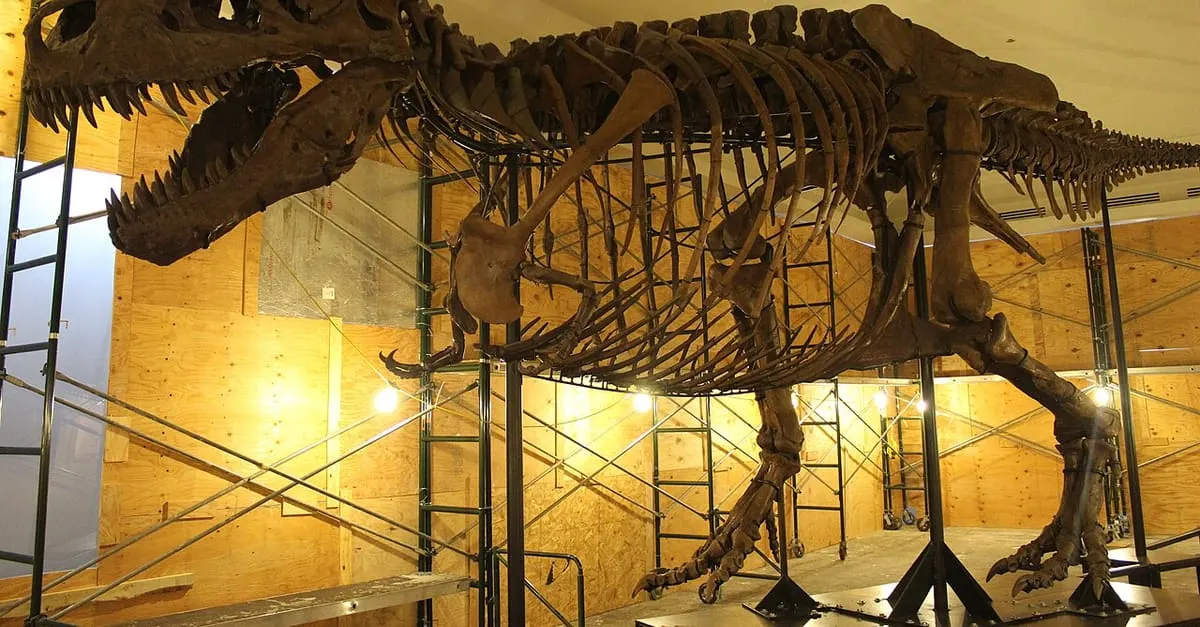
Stand under a mounted T. rex skeleton and a strange question creeps in. Was this thing a sluggish, sun-warmed lizard the size of a bus, or did it run hot, fast, and hungry like a giant bird? People have argued about it for over a hundred years, and for most of that time the honest answer was a shrug. Then researchers started reading the chemistry locked inside the bones, and the picture that came back was more interesting than either side expected.
The answer is that some were and some were not
Dinosaurs did not share one metabolism, and the best modern evidence says many dinosaurs were warm-blooded while others were not, according to a 2022 study analyzed by the Field Museum. Meat-eating theropods like T. rex and Velociraptor, along with the enormous long-necked sauropods, ran metabolisms as hot as living birds. Plant-eating ornithischians like Triceratops and Stegosaurus, on the other hand, had low metabolic rates that look much more like a cold-blooded reptile's. Same family tree, very different internal furnaces.
That split matters because "warm-blooded" and "cold-blooded" are not the tidy boxes most of us learned in school. Warm-blooded animals (endotherms, like mammals and birds) burn fuel constantly to hold a steady inner temperature. Cold-blooded animals (ectotherms, like lizards) let the environment set their temperature and bask to warm up. Dinosaurs, it turns out, spread out across that whole range rather than picking a side.
How you read the temperature of something dead for 66 million years
You cannot take a dinosaur's pulse, so the trick is to find a chemical fingerprint of breathing. When an animal uses oxygen to burn fuel, the reaction leaves behind tiny amounts of molecular waste that get baked into the walls of its bones. Those byproducts are stable. They can survive for tens of millions of years.
Paleontologist Jasmina Wiemann's team aimed lasers at fossil thigh bones and used Raman and infrared spectroscopy to measure how much of that waste had accumulated, then compared it against living animals whose metabolic rates are already known (ScienceDaily). More residue means more oxygen burned, which means a higher metabolism. The method is also non-destructive, so a priceless fossil comes out the other side intact.
The team ran 55 different animal groups through this process, from dinosaurs and flying pterosaurs to ocean-going plesiosaurs and modern birds, mammals, and lizards (Nature). The headline result was that a fast, bird-like metabolism was not a late invention. It appears to have been present near the very root of the dinosaur family tree, before some lineages later dialed it back down.
Hot rods and slow burners
So which dinosaurs ran hot? The saurischians, the "lizard-hipped" group, came out warm. That includes the theropods, the bipedal predators that gave us T. rex and the raptors, and the sauropods, the skyscraper-necked giants like Brachiosaurus. Some of these animals were not merely warm-blooded. Their inferred metabolic rates landed even higher than many mammals, closer to a living bird (Field Museum). That fits the active, fast-growing animals these creatures appear to have been, and it fits the fact that the smallest feathered theropods eventually became birds. The link is direct enough that the feathers themselves tell part of the story, which is worth a detour through whether dinosaurs had feathers.
The cooler crowd were the ornithischians, the "bird-hipped" plant-eaters, a name that is a confusing accident of anatomy rather than ancestry. Triceratops, Stegosaurus, and the duck-billed hadrosaurs all registered low metabolic rates. Wiemann suggested these animals may have leaned on the same tricks reptiles use today, soaking up sunshine to warm their bodies or migrating toward warmer climates with the seasons (Field Museum). A basking Stegosaurus is a different mental image than a basking lizard, but the principle is the same.
Why would a high metabolism be worth having if it is so costly? Because it buys capability. Burning fuel fast lets an animal stay active in the cold, hunt at dawn, grow quickly, and keep moving long after a cold-blooded rival would have to stop and reheat. A modern lizard is a sprinter that tires in seconds; a bird can fly for hours. The price is appetite. A warm-blooded T. rex needed to eat far more than a cold-blooded animal of the same size, which is part of why the question is not academic. Metabolism shaped how these dinosaurs lived, what they ate, and how much of the landscape they could dominate. A slow metabolism is not simply worse, though. The same low-burn lifestyle that keeps a cold-blooded reptile from needing constant meals is also tied to why turtles live so long, and a basking, low-metabolism Stegosaurus may have traded T. rex's frantic pace for a steadier, cheaper way of getting through the day.
Why the old debate was never quite settled
If the answer is "it depends," why did the argument last a century? Because earlier evidence pointed in two directions at once. Dinosaur bones grow in a way that looks fast and warm-blooded, yet some dinosaurs were so huge that their sheer bulk would have held heat all on its own, the way a warm bathtub cools slowly. A study in Science in 2014 looked at growth rates and argued that many dinosaurs were "mesotherms," sitting in a middle zone between hot and cold, regulating their temperature partly through their bodies and partly through their size.
That middle-ground idea has not gone away, and it should not. Some of what looks like warm-bloodedness in a 30-ton sauropod really could be plain physics. A body that big loses heat slowly no matter what, a quirk biologists call gigantothermy. It is the same principle behind why metal feels colder than wood: how fast heat moves in or out depends on the material and the shape, not just the temperature. A small lizard cools the moment the sun sets, but a dinosaur the size of a school bus barely changes temperature overnight, even with a modest metabolism. So a steady body temperature does not always prove a fast metabolism. The 2022 chemistry pushes back toward genuine endothermy for many groups, but the field still disagrees on the details, and that is normal for a question we are answering from fossils alone. When the sources hedge, the honest move is to hedge with them.
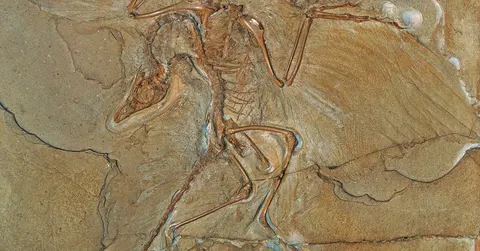
What almost everyone now agrees on is the cleanest evidence of all. Birds are dinosaurs, full stop, the surviving branch of those small warm-blooded theropods. Every robin, penguin, and pigeon is a feathered theropod that made it through the asteroid that wiped out the rest. The creatures that lost that lottery were not so lucky, a story that rhymes with why the woolly mammoths went extinct much later. So when you wonder whether dinosaurs were warm-blooded, you can also just look out the window at a sparrow burning fuel at a furious pace, or marvel that the tiny arms of T. rex belonged to an animal that ran every bit as hot.
Keep wondering: the warm-blooded theropods were also covered in feathers, and you can trace the family resemblance right down to why T. rex had such tiny arms.

Join the conversation
Comments are reviewed before they appear. Be kind and stay curious.
Loading comments…