
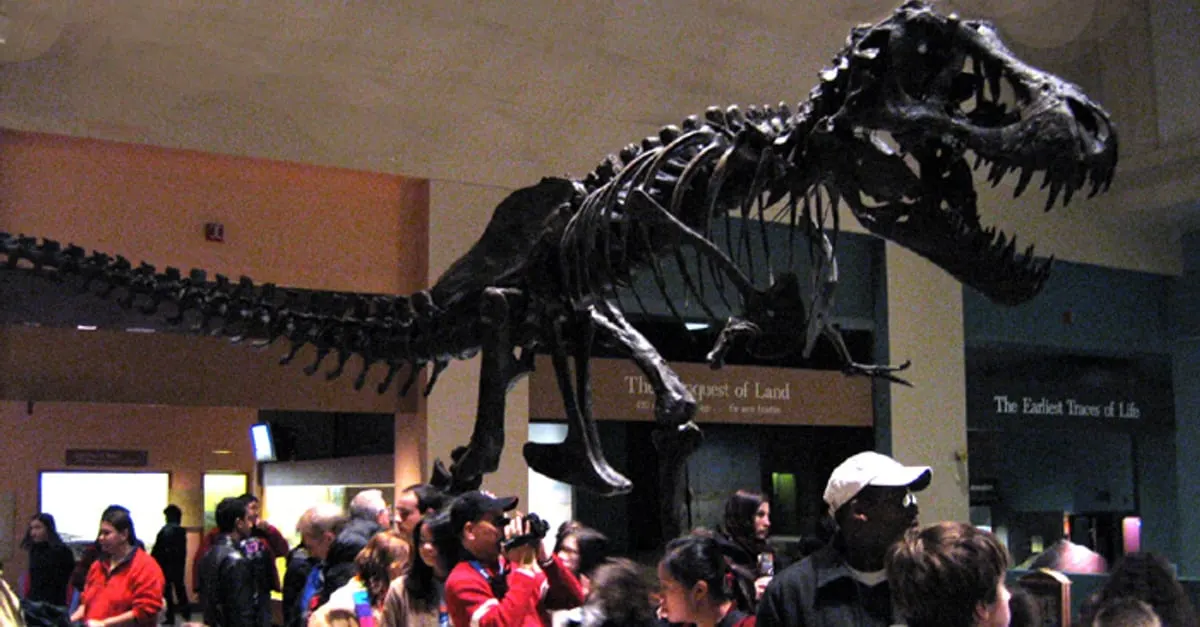
Why did T. rex have tiny arms? Nobody can say for sure, and that is the honest starting point. The most ambitious attempt yet came in May 2026, when a team studying 82 species of meat-eating dinosaurs pointed away from the arms themselves and toward the giant head above them. It is a strong answer. It is not the final word, because this is one of those questions where the fossils allow more than one story.
The leading idea is that the head took over from the arms
The newest answer comes from a 2026 study in Proceedings of the Royal Society B, which found that across meat-eating dinosaurs, short arms evolved hand in hand with big, powerful skulls (University of Cambridge). The short version: as the jaws became the weapon, the arms had less to do, and they shrank. That is now the front-runner for why the arms got small. It still does not tell us what, if anything, the leftover arms did day to day, which is where the older debate lives.
First, the strangeness of the thing. Tyrannosaurus rex ran more than 12 meters long and weighed several tons, and each arm was only about a meter from shoulder to claw (Smithsonian). Hold that against the rest of the body and the arms look almost decorative. They could not reach the mouth. They could not touch each other.
What they were not is feeble. The upper arm bone was short but stout, and in 2001 paleontologists Kenneth Carpenter and Matt Smith estimated the arm muscles at about 3.5 times stronger than a human's (Smithsonian). Short but strong is the whole puzzle. Evolution does not usually keep building heavy muscle onto a limb it is throwing away. So the arms invite two opposite readings at once: useless leftover, or small tool kept for a reason.
The ideas people floated before 2026
Before the new study zoomed out, the proposals fell into a few camps, and none of them won outright.
One is that the arms were vestigial, shrinking because they had stopped earning their keep, the way evolution quietly phases out a part once it is no longer worth the cost. Carpenter and Smith pushed back on that. They argued the arms were too heavily muscled to be useless, and that T. rex used them to clutch struggling prey against its chest while the jaws did the killing (Smithsonian). Older proposals add a grip during mating, holding a partner in place, and a prop role, with a resting T. rex pushing its chest off the ground before standing. Getting a multi-ton body upright is no small job, so an extra shove from two strong arms is at least plausible.
Then there is the relative-proportion argument from biomechanist John Hutchinson, who suspects the arms did not shrink so much as the legs grew longer (Live Science). His blunt summary of the whole field is worth keeping in mind: it is a nice story, but ultimately we do not really know. These ideas are not crazy. They are just hard to test on an animal nobody has watched move, which is exactly why the debate stayed open so long.
How the 2026 study reached that answer
The work was led by Charlie Scherer of UCL with Elizabeth Steell of Cambridge, and instead of picking a single function, it zoomed out. Looking across many theropod lineages, the team found that short arms had evolved independently in at least five separate groups, tyrannosaurids plus four others, and that the shrinking tracked the growth of big, powerful skulls more tightly than it tracked sheer body size (University of Cambridge).
That points to a trade-off. As prey got enormous, the head became the better weapon and the arms quietly stepped back. "If you've got a big skull and you're tackling big prey, then you don't need your arms as much, and arms become a bit redundant," Steell put it. Scherer framed it as a swap: "The head took over from the arms as the method of attack. It's a case of 'use it or lose it'" (University of Cambridge). Grabbing a sauropod the length of a tennis court with your hands was never going to work. Clamping down with a skull full of spike-like teeth was the move.
This settles the why-shrink question more than the what-for question. It gives a strong reason the arms got small. It does not tell you what the leftover arms did, and those two questions are not the same.
Padian's 2022 twist: short arms as bite insurance
One more idea is worth pulling out, because it flips the usual logic. In 2022, Berkeley paleontologist Kevin Padian proposed that the arms shrank not despite group feeding but because of it. Picture several adult tyrannosaurs crowding one carcass, each with a massive head and bone-crushing jaws working inches from the next animal. A long arm in that scrum is a long arm waiting to be bitten off. Padian argued that shortening the limbs out of jaw range cut the risk of accidental amputation, blood loss, and lethal infection (UC Berkeley News). It is a hypothesis, not a verdict, and it is hard to test, but it shows how differently the same stubby arm can be read.
What we actually know, and what we don't
Here is the honest scorecard. The arms were short and strongly muscled. Short arms evolved more than once in big-headed predators, which makes the head-versus-arms trade-off the leading explanation for the shrinking. What we do not know is whether T. rex used its arms for anything specific. The prey-clutch, mating-grip, and prop ideas remain live but unproven, and Padian's bite-avoidance idea is one more reading rather than a confirmed reason. The convenient line that the arms were "useless" still sits awkwardly next to all that muscle.
It is worth sitting with how strange that is. This is one of the most famous animals that ever lived, mounted in every major museum, scanned and modeled and argued over for more than a century, and we still cannot say with confidence what it did with its hands. The skull we understand. The arms keep their secret. Big bodies tend to do this, forcing odd trade-offs that take decades to untangle, the same way giraffes' long necks and camels' humps each came with their own catches.
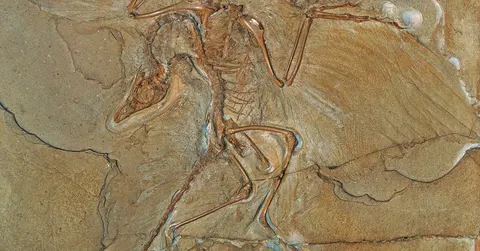
Keep wondering: those arms may have carried more than scales, which raises the question of whether dinosaurs had feathers; the same fossils fuel the long argument over whether dinosaurs were warm-blooded; and if you want a living animal whose deep past is just as confounding, look at why turtles live so long.

Join the conversation
Comments are reviewed before they appear. Be kind and stay curious.
Loading comments…