
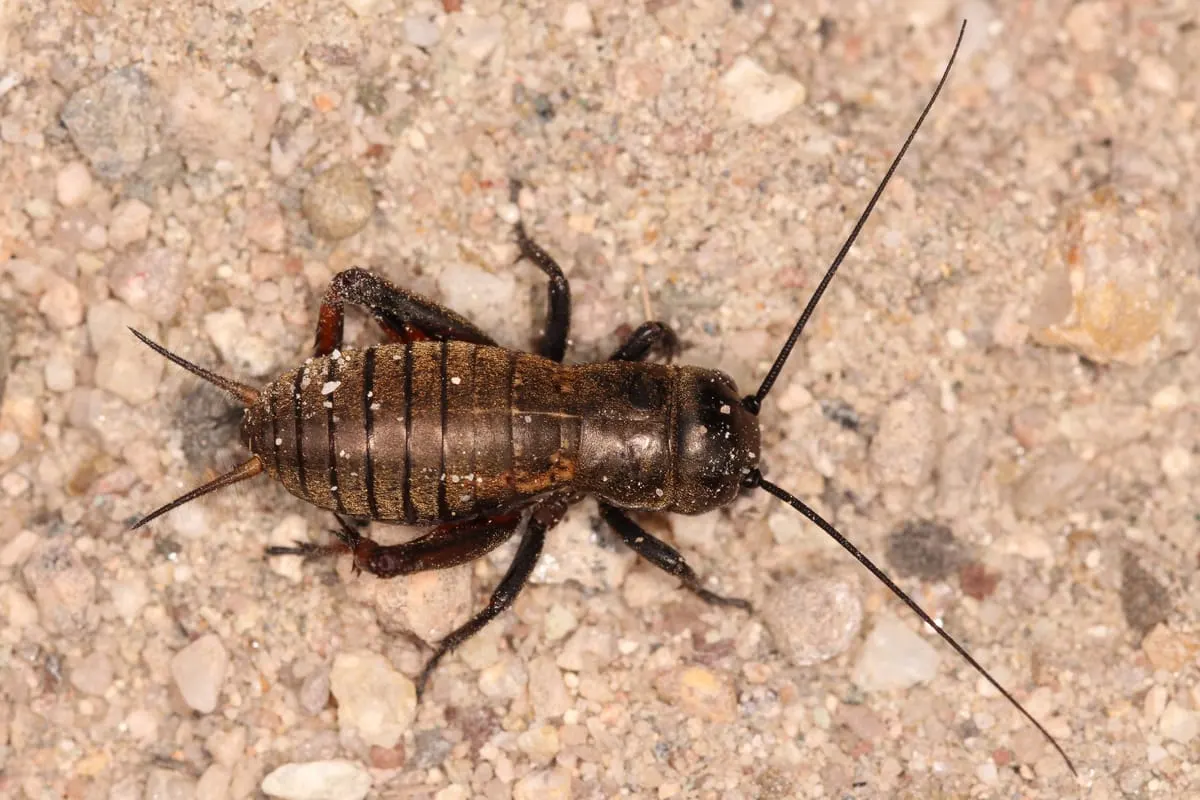
On a warm night the sound is everywhere and almost invisible, the steady pulsing chirp we file under "summer" and stop hearing, layered over the frogs croaking for the very same reason: to carry, and to be chosen. But that noise is doing real work, it's made in a way most people get wrong, and hidden inside it is a number: the air temperature.
It's the wings, not the legs
Start with the part nearly everyone has backwards. So why do crickets chirp, and how? A male cricket makes the sound by rubbing his front wings together, not his legs. One forewing carries a hard scraper and the other a file of fine ridges, and dragging the scraper across the file sets the wings ringing, a method called stridulation (Library of Congress). The picture of a cricket sawing its legs together is borrowed from grasshoppers, which really do rub a hind leg against a wing. Crickets are all about the wings (University of Florida IFAS).
And it's almost always a male doing it. Females lack the file-and-scraper apparatus, so the night chorus is essentially a stadium of males, each one singing.
Different songs for different jobs
A cricket doesn't have just one chirp. It has a small repertoire, and each song means something specific. There's a loud, repetitive calling song meant to reach a female from a distance, a quieter courtship song switched on when a female comes near, and a harsher, aggressive song used to face off against rival males (Library of Congress). So the wall of sound on a July night is really thousands of overlapping personal ads, with the occasional turf war breaking out between two males who got too close. The crickets are not the only insects with a hidden agenda after dark, either: it took scientists a long time to work out what really pulls moths toward a porch light.
The chorus is also a thermometer
Here's the genuinely strange gift hidden in the noise. Crickets are cold-blooded, so their body, and the muscles that work those wings, runs at the temperature of the air around them. Warm air, faster chirps; cool air, slower (The Old Farmer's Almanac). That link is tight enough to read backwards, which is exactly what the physicist Amos Dolbear noticed back in 1897. The popular rule of thumb: count the number of chirps in 14 seconds, then add 40, and you get a rough air temperature in degrees Fahrenheit (The Old Farmer's Almanac). Thirty chirps in 14 seconds means roughly 70 degrees.
It isn't perfect, and it falls apart in the cold, since crickets mostly stop chirping once the temperature drops far enough. But the effect is real enough that one cricket, the snowy tree cricket, is nicknamed the "thermometer cricket" for how cleanly its chirp rate tracks the heat (Singing Insects of North America). Next time the night is loud with them, count for fourteen seconds and add forty. The crickets have been quietly reporting the weather all along.
Keep wondering: another animal broadcasts on a schedule in why roosters crow, tiny brains run a whole society in do ants have brains, and insect engineering peaks in why bees make honey.

Join the conversation
Comments are reviewed before they appear. Be kind and stay curious.
Loading comments…