
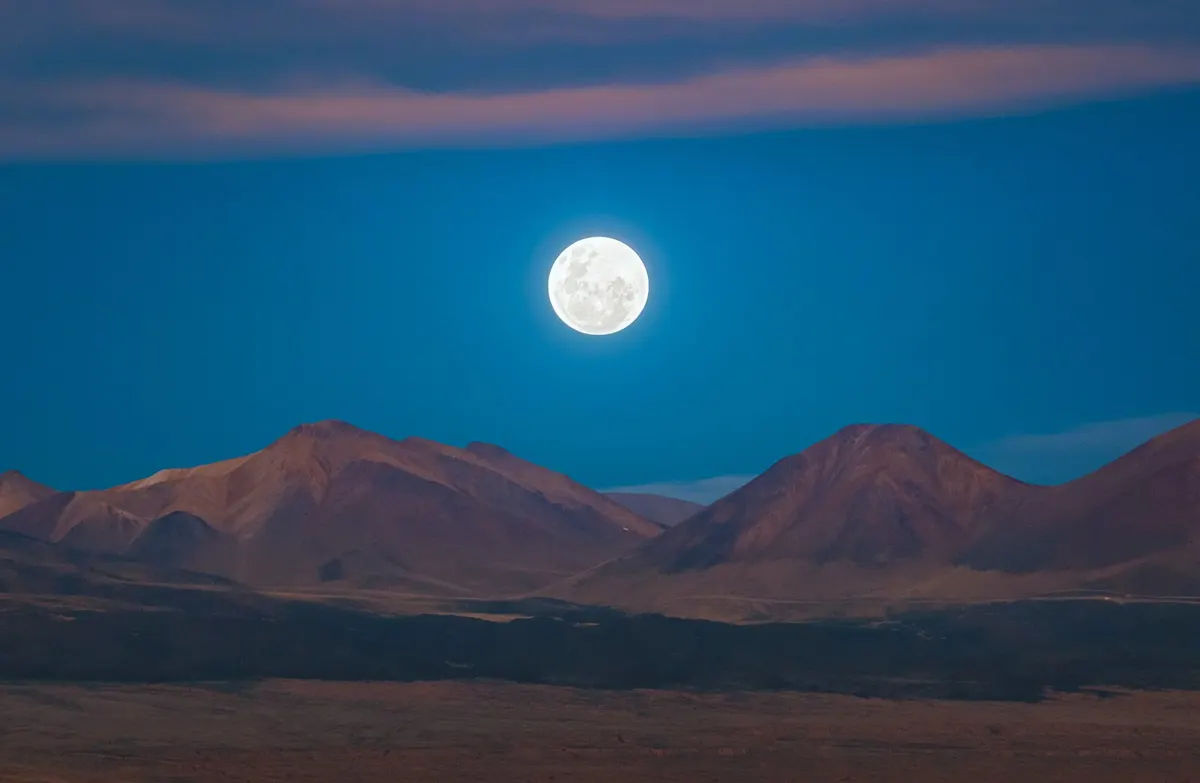
A full moon lifts over a line of rooftops, orange and swollen, so wide it looks like it could roll down the street and flatten a bus. Two hours later the same moon is a small white coin high overhead, the kind you could blot out with your thumbnail. Nothing happened to the moon in between. Point a camera at both and it records the same disk, give or take a percent. Why does the moon look bigger on the horizon, then, when the moon is plainly not doing anything?
Your brain inflates it, and nobody has proved how
The moon illusion happens entirely inside your head. The moon's angular size stays at roughly 0.52 degrees, about a thumb tip held at arm's length, wherever it sits in the sky, and at the horizon it is actually about 1.5 percent farther from you than when it is overhead. Farther means slightly smaller. Something in your visual system is enlarging it anyway, and after two thousand years of argument, the people who study perception still cannot agree on what. NASA's public answer to the question is admirably blunt: "We don't really know, but scientists are still trying to figure it out."
That's the honest state of it. What follows is not a build-up to a tidy answer, because there isn't one: it's a tour of the best guesses and why each is in trouble.
The atmosphere gets the blame, and the atmosphere is innocent
The oldest explanation is the one most people still reach for: the thick wedge of air near the horizon acts as a lens and magnifies the moon. Aristotle proposed a version of it in the fourth century BC, and Ptolemy and Cleomedes were still working the same idea in the second century AD.
It's wrong. Air does bend moonlight on the way in, which is why a low moon looks orange and why stars low in the sky twinkle hardest. But bending is not magnifying. Near the horizon, light from the bottom edge of the moon travels through more air than light from the top, so refraction pushes the bottom up more than the top. The moon gets slightly squashed. If the atmosphere is doing anything to that disk, it's making it a touch smaller and flatter.
The distance is against the idea too. When the moon is overhead you're standing more or less directly beneath it. On the horizon, you've rotated to the side of the planet, which puts you about one Earth radius farther away. That is where NASA's 1.5 percent comes from. The giant orange moon is the smaller, more distant, slightly flattened one. Your eyes are lying to you in the opposite direction from the physics.
Your brain treats the sky as a squashed dome
The leading explanation for centuries has been the apparent-distance theory, which the 11th-century scholar Ibn al-Haytham described in something close to its modern form.
It goes like this. You don't perceive the sky as an infinite void. You perceive it as a flattened dome, with the horizon far away past the fields and rooftops, and the top of the dome hanging fairly low over your head. The moon's image on your retina is the same size in both places. If your brain believes the horizon moon is much farther away and it still fills the same slice of your vision, the only way to reconcile that is to conclude the thing must be enormous. Perceived size scales with perceived distance, a relationship known as Emmert's law.
Lloyd Kaufman and Irvin Rock made the case for this in Science in 1962, and their finding that the terrain between you and the horizon matters is one of the more durable results in the field. Take the ground away and the illusion weakens.
The problem with that theory: ask anyone, and the big moon looks closer
Here's where it falls apart. If the illusion works because your brain files the horizon moon as far away, then people should describe it as far away. They don't. Ask observers to judge the relative distance of the two moons and they typically say the horizon moon looks closer, which is exactly backwards from what the theory needs. Perception researchers call this the size-distance paradox, and it has been a thorn in the apparent-distance camp for decades.
One way out is to say your conscious report and the machinery underneath disagree: the system treats the moon as far away while you experience it as looming. Kaufman, with James Kaufman in a 2000 PNAS paper, used artificial moons and binocular disparity to test this and concluded the perceptual system does place the horizon moon farther off. Others read the paradox as proof the whole framework is upside down, and that the size comes first and the distance judgment follows.
The rival camp says the moon needs something to be compared to
The other major idea is contrast. A moon sitting behind a distant treeline is next to objects your brain knows are large, and it dwarfs them. A moon in blank sky has nothing to be measured against. This is the Ponzo effect, the same trick that makes the far bar look longer between converging railway tracks, and NASA offers some version of it as a popular candidate, while noting in the same breath that it is not a perfect explanation either. It's a close relative of what your brain does when it builds a face out of two windows and a doorway: fitting a familiar interpretation to a pattern that never earned it.
It has its own hole. NASA points out that astronauts in orbit see the moon illusion too, with no trees, no rooftops, no horizon clutter of any kind. Constellations swell near the horizon as well, and they have no consistent foreground either.
A third camp argues the elevated moon is the odd one out. Staring into empty sky lets your eyes drift toward their resting focus, and that shift shrinks the perceived size of what you're looking at, an effect called accommodative micropsia. On this reading the horizon moon is normal and the high moon is being unfairly shrunk. The 2000 PNAS work raises serious objections to micropsia theories, which are still widely cited anyway.
You can switch the illusion off in about four seconds
Whatever the cause, it's fragile, and you can break it on the next full moon. NASA suggests three tricks: photograph the moon low and high with the same lens and compare the disks, look at the huge horizon moon through a rolled-up paper tube, or bend over and view it upside down between your legs. All three work. The enormous moon deflates on the spot and turns back into the coin you'd see at midnight.
The between-the-legs version has a serious echo in the lab. Higashiyama and Adachi had 90 observers judge the size and distance of targets in a field, and found that inverting the body lowered size constancy and compressed the perceived distance scale, and that it was body orientation rather than the flipped retinal image doing the work. Turn yourself upside down and your size-scaling machinery starts making different decisions. That is a strange fact about you, not about the moon.
Which is the part worth sitting with. The moon is the most-watched object in human history. We've mapped every crater on it, measured the centimeters it drifts away from us each year, and walked on it. We can tell you its distance tonight to within a few centimeters. We cannot tell you why it looks big when it's low. The unsolved problem was never the moon. It's the four inches behind your eyes.
Keep wondering: the atmosphere that gets wrongly blamed here is genuinely responsible for why stars twinkle, the same brain that inflates a low moon will build a face out of a plug socket, and if you want to catch the moon misbehaving in daylight, it's up there more often than you think.

Join the conversation
Comments are reviewed before they appear. Be kind and stay curious.
Loading comments…